
THE SHORT ANSWER
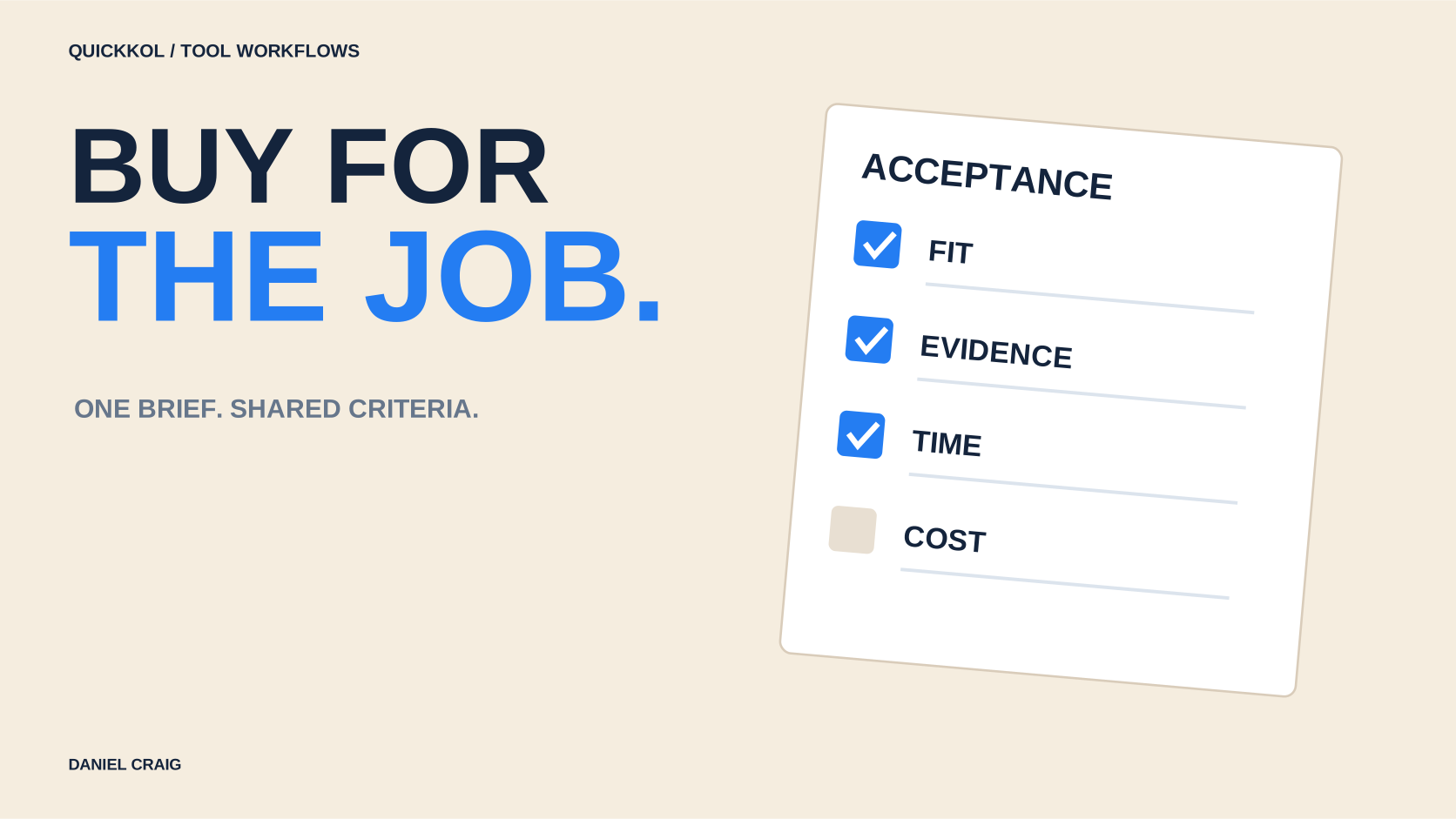
The best influencer marketing tools are those that pass your current brand task at an explainable total cost. Identify whether the bottleneck is sourcing, outreach, delivery or measurement before comparing products. This guide offers task-based candidates and a buying scorecard, without presenting vendor descriptions as a measured performance ranking.
Give procurement one observable job
Do not buy against the longest feature list. State the brand, market, content situation, partnership volume and slowest operating step. An outdoor brand entering the UK needs creators who can demonstrate wet-weather commuting equipment; a multinational reconciling payments has a different job.
Separate mandatory conditions, useful extras and exit criteria. Missing relevant content in the target market is a material gap that attractive dashboards cannot offset. A fixed task gives speed, fees and usability a common basis for comparison.
Shortlist candidates by the work they support
Evaluate QuickKOL for brief-led discovery, content understanding and outreach preparation. Modash documents discovery, analysis and partnership workflows; Aspire presents campaign and content approval capabilities; CreatorIQ is a candidate for enterprise operations. Native reporting and website analytics can support authorized result checks.
These are product directions, not fit guarantees. Ask each vendor to process the same task instead of showing only a favorite customer case. Record missing information, required access and work that remains with the brand.
Score evidence without hiding a critical gap
A practical pilot might review thirty search results, ten candidate records, one outreach draft and one delivery export. This is an operating sample, not a database accuracy study. Mark each requirement supported, manually supplemented or unavailable, retaining source links and dates.
Weights for quality, time and cost should reflect the brand. A score must not conceal a failed hard requirement: unsuitable language is not repaired by a cheaper subscription. Have a second teammate review several records without the vendor explaining them.
Count the work outside the subscription
Separate subscription, extra usage, setup, training, manual review and export cleanup. As an example, tool A costs 250 plus twelve operating hours; tool B costs 400 plus five. At 30 per hour, totals are 610 and 550 before creator fees.
Only observed time differences justify that comparison. Check billing periods, retention and exit conditions. Similar features may use different billing units. Profile views divided by partnerships do not, by themselves, establish the full cost of a completed collaboration.
Test handoff and exit before making the commitment
Ask a teammate outside the buying process to take over one candidate, locate evidence, identify unknowns and find the outreach owner. Export a batch and inspect identity, dates, rights and stop-contact flags. Finding a creator does not establish that the relationship can be maintained.
Keep a primary option, a backup and a reason for deferring other purchases. Avoid buying a system nobody will maintain for hypothetical complexity. Solve the current bottleneck and expand using observed results.
Turn the buying decision into an operating plan
Document task scope, passing evidence, remaining manual work, full cost and a review date. If volume, markets or partnership types change after three months, retest the affected steps. One successful demonstration does not establish permanent fit.
Once products are selected, use the marketing toolkit rollout guide to assign operating responsibilities.
For reporting sources and handoffs, continue with the analytics stack guide. Apply the same acceptance criteria to QuickKOL rather than relying on the identity of this article’s publisher.
Choose the guide for the brand question
Unsure whom to find? The discovery brief workflow explores relevant communities.
Have a name or video clue? The creator identity resolution guide handles namesakes and connected accounts.
Need stable retrieval? The reproducible search guide preserves queries and exclusions.
Testing direction before spending? The free search pilot separates public evidence from paid capability gaps.
Preparing to sign? The pre-contract vetting workflow reviews facts, unknowns and conditions.
Preparing contact? The outreach operations checklist assigns approval, replies and stops.
Need post-launch evidence? The campaign tracking plan defines capture and observation windows.
Cannot verify a report? The single-tool analytics audit traces one row to its source.
Systems disagree after signing? The management systems handoff guide assigns authoritative fields and repair ownership.
Need one bounded project trial? The single-campaign tool acceptance test follows a complete delivery cycle.
Research method and scope
Product directions use official references and this site’s product descriptions checked October 15, 2026. This is not an independent vendor performance ranking. Sample sizes, hours and costs are procurement examples; the brand sets task-specific weights.
Compare tool directions by brand task
Candidates reflect official positioning, not independently tested rankings. Verify plan and regional scope.
| Direction | Candidates | Acceptance question |
|---|---|---|
| Discovery and content fit | QuickKOL, Modash | Can fit evidence return to original content? |
| Execution and approval | Aspire | Are deliverables and approvals connected? |
| Enterprise operations | CreatorIQ | Can it demonstrate actual organizational permissions? |
| Result verification | Native reports and website analytics | Are access, window and provenance clear? |
CHECKLIST
Five brand procurement checks
Have the brand owner confirm each item with evidence and a next action.
- Fix the task and mandatory conditions
- Retain sample findings and source content
- Record supplementation and operator time
- Test a handoff and export
- Document the choice, backup and review date
Sources and further reading
- 01QuickKOL: Product context and workflow
- 02Modash: Discovery, analysis and partnership workflows
- 03Aspire: Campaigns, approval and partnership management
- 04CreatorIQ: Enterprise creator marketing
External pages can change. Recheck platform rules, contracts and local law before launch.