
THE SHORT ANSWER
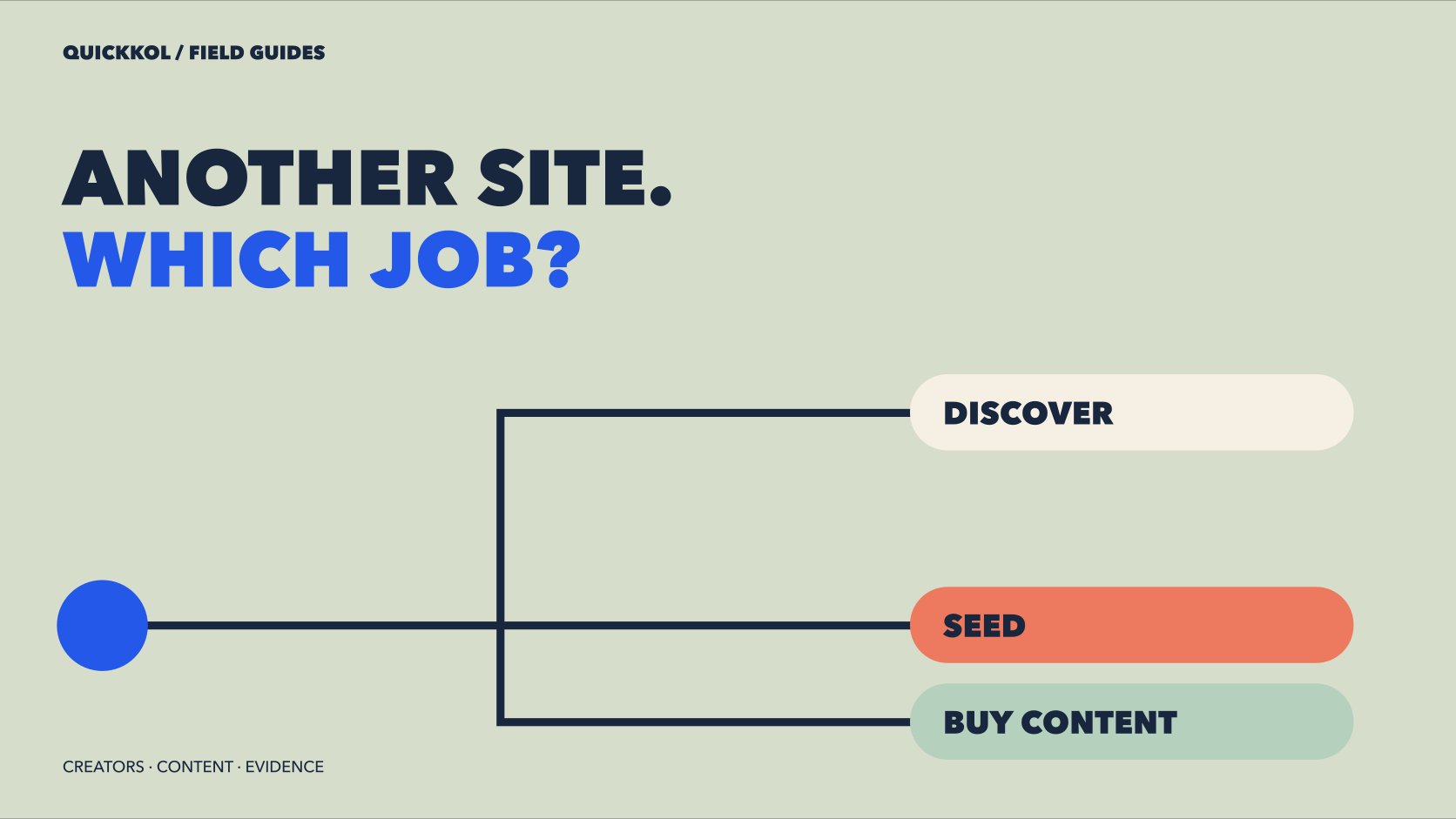
Choose a Tomoson alternative by the missing job: discovering relevant people, purchasing a defined collaboration or managing an ongoing program. QuickKOL can be evaluated for brief-led discovery and outreach preparation. Modash, Collabstr and Aspire present other documented workflow directions. Test the same task before comparing costs. This is a buying guide, not a measured vendor leaderboard, and it does not repeat an unverified historical Tomoson plan as a current offer.
Translate the old product reference into a current job
A search for a Tomoson replacement can mean product seeding, content purchasing or a different source of candidates. Write down where the previous workflow failed and what a successful replacement must complete. The public information checked for this article did not let us verify a clear current Tomoson brand plan, so no current price or operating-status conclusion is inferred.
Describe the job instead of copying an old feature list. “Find creators who can demonstrate a product in UK small kitchens” is testable across different products. It prevents the team from rejecting a useful workflow merely because its interface is unfamiliar, or buying a familiar-looking marketplace that cannot serve the target task.
Separate outbound discovery from marketplace purchasing
QuickKOL’s product context centers on brief interpretation, real-time search, content understanding and outreach preparation. Modash documents discovery and partnership workflows. Collabstr provides a creator marketplace and collaboration-management route. These are product directions, not independently tested performance claims.
Outbound discovery requires the brand to qualify fit and obtain a response. Marketplace purchasing requires inspection of the actual package, rights and transaction terms. Absence from a marketplace does not establish that a creator is unsuitable; presence does not establish an appropriate audience. Decide which route fits the campaign’s procurement process before treating two database counts or subscription headlines as comparable.
Evaluate management when the relationship continues
Recurring relationships introduce different requirements from a one-off search: scope, dates, conversation history, assets and permissions. Aspire’s official positioning includes campaign and partnership work, making it a candidate to evaluate for those needs. A product overview is a starting point, not proof that your team’s process is supported.
Ask for a demonstration of a changed relationship: does a second project preserve the right context, and can an expired asset be distinguished from an active one? The tool does not need to replace every finance or contract system. It does need to make remaining manual work visible. A smaller system with a reliable handoff may fit better than a broader platform whose records nobody maintains.
Run one comparable acceptance task
Give each candidate the same brief. Review a manageable sample, such as thirty returned profiles, for relevant work, duplicates, market evidence and unanswered conditions. Thirty is an operating sample, not a database-wide accuracy study. Have someone who missed the demonstration independently review several records.
Prepare an outreach draft for the actual scope without needing to send it during evaluation. Test whether evidence and reasons survive export and handoff. Mark requirements supported, manually supplemented or unsupported. This makes the comparison concrete and shows where operator effort goes. Avoid letting a polished demonstration or a single favorite creator substitute for the campaign-specific task the team needs to complete.
Compare full operating cost and exit effort
Suppose option A costs $180 per month plus ten operating hours, while B costs $300 plus five. At an internal rate of $30 per hour, totals are $480 and $450 before creator fees. These are hypothetical calculations. Only observed operating-time differences can justify the comparison.
Check annual commitments, usage units, seats, contact access and export conditions in the current offer. Free registration is not full free access, and a monthly equivalent may still require annual billing. Keep implementation and exit effort separate from steady-state subscription cost. The platform pricing guide examines those contract questions in more depth. A useful alternative should be affordable to operate and practical to leave.
Document the reason for the selected route
Record the primary job, options considered, passing evidence, remaining manual work, cost and review date. Apply the same acceptance standard to QuickKOL even though it publishes this guide. A vendor deserves selection because it passes the task, not because it appears first in an article.
If the main requirement is seeding products, continue with the product-seeding alternatives guide. If the replacement is already chosen, use the migration checklist. These pages deliberately answer different questions: route selection, gifting execution and record transfer. Reopen the decision when market, volume or partnership type changes, rather than treating a successful trial as permanent evidence for every future campaign.
Worked example: choose a first alternative route for an ecommerce brief
Suppose an ecommerce brand wants eight research candidates who can explain a kitchen product in an ordinary home. The first choice is not a vendor ranking. It is whether the team needs broad discovery, applications from interested creators or a marketplace route to defined deliverables. Each creates a different review burden and exposes different information.
A discovery route may find a strong content match before commercial interest is known. An application route may reveal interest early while requiring substantial fit review. A packaged offer can clarify a proposed transaction while still leaving audience and usage questions unresolved. Use the same assignment to compare two plausible routes rather than treating their different result counts as equivalent coverage.
Record relevant leads, available evidence, unresolved commercial conditions and manual work. If the team changes the brief midway, note the change instead of attributing the new result to product superiority. The immediate decision is which route can complete this campaign responsibly. A longer-term system choice can follow after the team understands its repeated workload. This keeps “sites like Tomoson” tied to the job being replaced rather than to a list of superficially similar websites.
FAQ: must an alternative reproduce the old platform exactly?
An alternative does not need to reproduce every old interface element. It needs to support the business task and preserve the records required to perform it. A small product trial may not need a complex payment workflow. A recurring team program may care more about ownership, permissions and continuity than about a large public directory.
Separate a missing convenience from a missing requirement. A documented manual handoff can be acceptable at low volume, while an unsupported mandatory field may rule out a route entirely. The replacement decision should reflect expected workload and the consequences of an error, not nostalgia for a familiar dashboard.
Also avoid using old comparison articles to assert Tomoson’s current pricing, availability or operating condition. When a reliable current commercial offering cannot be established, the appropriate state is unresolved. That uncertainty is not evidence of closure, a security incident or any particular cause. Evaluate the documented alternatives on their own terms and confirm current access before committing. A useful comparison can remain honest about an uncertain reference point without inventing a story to make the recommendation sound more complete.
Research date, evidence and limitations
Official product pages reviewed October 21, 2026. No vendor hands-on test or commercial quote is claimed. A current Tomoson brand plan was not verified; this does not establish discontinuation or its cause.
Compare alternative directions by job
Editorial analysis and labeled hypothetical examples, not performance rankings, quotes or guarantees.
| Direction | Candidates to evaluate | Acceptance test |
|---|---|---|
| Outbound discovery | QuickKOL, Modash | Relevant evidence for the same brief |
| Marketplace purchase | Collabstr | Package, rights and transaction terms |
| Ongoing program | Aspire | Relationship history and delivery handoff |
CHECKLIST
Before you put this into practice
Record the answers in the campaign working file.
- Define the missing job
- Compare the same task
- Count labor and usage costs
- Retain selection and exit evidence
Sources and further reading
- 01Modash: Official brand platform overview
- 02Collabstr: Creator marketplace and collaboration management
- 03Aspire: Brand creator marketing workflows
External pages can change. Recheck platform rules, contracts and local law before launch.