
THE SHORT ANSWER
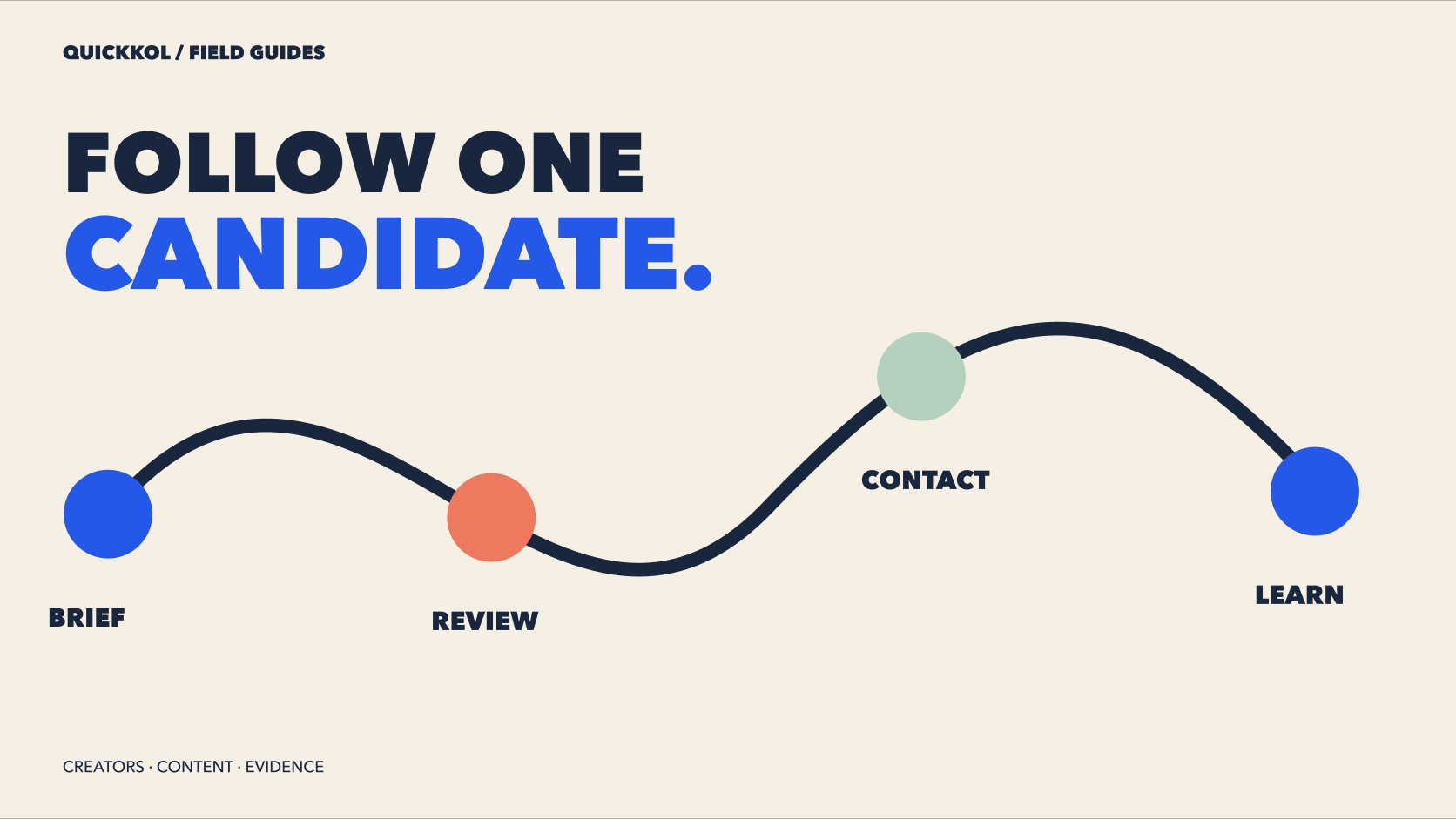
An influencer marketing platform organizes one or more parts of a creator collaboration into a repeatable workflow. Some products emphasize discovery, while others emphasize transactions, management or reporting. Follow one candidate from brief to review to see what the product actually connects. A feature label does not establish that an identity, approved scope or result survives the next handoff. This article explains the operating sequence; the separate platforms comparison guide addresses how to compare vendors against your requirements.
Start with the job your team must finish this week
“We need a platform” is often a description of frustration. The actual problem may be finding relevant creators, preventing duplicate contact, preserving scope or reconciling live posts with orders. Select one bottleneck and write the work it currently creates.
Define input, output and owner. A discovery task might start with a one-page brief and end with ten candidates supported by relevant content evidence. A database subscription is an input to that task, not the completed result. When evaluating a product, ask someone to perform the real handoff with a small, representative brief rather than touring unrelated features.
Preserve intent during discovery
Search conditions should follow the product job, audience and content situation. Once candidates appear, retain the query, date, reason for fit and a relevant work sample. Otherwise the next teammate receives a name without the reasoning needed to evaluate it.
Modash’s official product overview documents discovery alongside additional operational workflows. Evaluate QuickKOL around brief interpretation, relevant discovery, content understanding and outreach preparation. Do not infer feature parity between the products from a shared category name. In a trial, use a niche the team understands so an attractive result card can be checked against actual content rather than accepted as a recommendation by default.
Separate observations from estimates during evaluation
Public content, vendor estimates, creator-authorized analytics and brand orders are different evidence sources. Retain the collection date, definition and limitation alongside each value. A “high fit” score is less useful when the reviewer cannot see which customer need or work sample supports it.
When information is missing, record the next verification step instead of automatically rejecting the account or inventing a value. An operationally useful platform helps people make a reviewable decision. It does not need to pretend every uncertainty can be resolved through a single score. The audience-quality guide explains why suspicious signals should prompt investigation rather than an unsupported accusation.
Give outreach a status and an owner
Drafted, sent, replied and commercially agreed are different states. Define who can send, when a follow-up is due, when a refusal stops contact and where the agreed terms live. Counting generated messages does not establish that a relationship is being managed well.
The same creator may have several accounts, making ownership and deduplication important. A drafting capability still needs someone to check product facts, tone and the proposed request. The outreach operations guide provides a more detailed handoff. Test whether a teammate can find the latest approved scope without reading an entire inbox, because that is where apparent automation often becomes manual reconstruction.
Treat fulfillment and reporting as separate capabilities
Contracts, samples, approvals, payments and attribution may live in other systems. A navigation label does not prove support for your market, payment route or storefront. Verify the required integration and access with the actual workflow. If a manual bridge remains, document who performs it and how often.
Aspire’s official information describes brand collaboration operations, while Collabstr provides marketplace and collaboration routes. These descriptions can inform a test plan. They are not evidence that this article performed an end-to-end procurement trial. Distinguish documented capability, demonstrated capability and your own verified operating result when preparing an internal recommendation.
Judge value from a complete, usable record
Suppose a team processes twenty candidates each week and saves eight minutes per candidate: 160 minutes of gross time saved. If cleanup and synchronization take ninety minutes, net time saved is seventy minutes. This hypothetical model still excludes training, error correction and changes in decision quality.
Define trial success through a complete record: the next teammate can continue the job, key evidence is traceable and required outputs can be exported. A platform creates value when the workflow becomes reliably easier. The platforms comparison guide turns that conclusion into a vendor matrix, and the pricing guide helps translate the chosen scope into a contract cost rather than a misleading headline subscription.
Worked example: diagnose an apparent automation problem
Suppose the team spends two hours each week finding the latest quotes. It describes the problem as insufficient automation. Investigation may show that replies are split between inboxes, filenames are inconsistent and no one marks the approved scope. Buying a larger feature set without defining ownership can preserve the same ambiguity in another interface.
First establish a record owner and version rule. Then test whether the platform reduces searching, duplicate updates and errors. Follow a quote revision through approval and ask a second teammate to locate the current agreement. Include manual copying and cleanup in the time record. If the new workflow adds another place to paste information, the apparent automation may not create net value.
This diagnostic does not imply that software is unnecessary. It identifies which handoff the software must support. A product that preserves approved scope and responsibility may be more useful for this team than a sophisticated discovery feature they rarely need. The decision should come from the observed bottleneck and a representative test, with the remaining manual steps written down rather than hidden behind the word “integrated.”
FAQ: must one platform handle the entire program?
Not necessarily. A combination of tools can work when identity, status and responsibility survive the handoffs. If one system supports discovery and another holds agreements, define when the record moves, who updates it and which system is authoritative for each field. Without that rule, two individually useful tools can create conflicting histories.
An all-in-one platform also needs verification. Broad coverage in a product description does not establish support for every required market, account type or integration. Ask the team to complete the same real assignment rather than assuming a single login removes all operational work.
Compare the total effort required to maintain a usable record, including training, exception handling and export. The aim is not to maximize the number of tools or minimize it at any cost. It is to make the required work dependable. A platform should earn its place by improving a defined part of the process. When a manual bridge remains acceptable at the current volume, document it and set a review condition instead of adding speculative integrations the team does not yet need.
Research date, evidence and limitations
Official product information checked October 21, 2026. No paid-account trials were completed across vendors. Workflow advice and time figures are editorial models, not vendor promises.
Follow one candidate through the platform
Editorial analysis and labeled hypothetical examples, not performance rankings, quotes or guarantees.
| Stage | Carry forward | Failure signal |
|---|---|---|
| Discovery | Query, work sample and fit reason | Names without reasoning |
| Evaluation | Source, definition and open conditions | Unexplained score |
| Outreach | Owner, status and scope | Duplicate contact or conflicting versions |
| Review | Delivery and consistent results | Only aggregate views |
CHECKLIST
Before you put this into practice
Record the answers in the campaign working file.
- Choose a real bottleneck
- Test a representative brief
- Distinguish estimates and authorized data
- Make the output usable by the next owner
Sources and further reading
- 01Modash: Official brand platform overview
- 02Aspire: Brand creator marketing workflows
- 03Collabstr: Creator marketplace and collaboration management
External pages can change. Recheck platform rules, contracts and local law before launch.