
THE SHORT ANSWER
If you want other sites like Tomoson for seeding, define whether the offer is an optional product experience, paid content or an affiliate collaboration. Delivery, feedback and publication are different outcomes. Choose a workflow that supports the required invitations, shipping and records. A gifted product is not automatically a posting agreement, and an expensive logistics stack cannot repair poor product fit. This article covers gifting execution; the alternatives buying guide covers vendor selection.
Define the offer before looking for software
Optional seeding lets the recipient decide whether to try and discuss a product. A paid deliverable needs agreed scope. Affiliate work introduces commission and eligible-sale terms. These arrangements can coexist, but they should not be blurred in an invitation or shipping note.
Do not add an unexpected posting obligation inside a parcel. Explain the product, the reason for the invitation, whether feedback is requested and whether a separate paid task exists. This clarity also improves reporting. Someone declining a product, receiving it but not using it, and completing a paid video are not comparable outcomes. Define the relationship before selecting a platform so the software records the intended exchange.
Qualify product fit before collecting shipping details
Check the content situation, specifications, limitations and shipping eligibility. Apparel sizes, equipment compatibility and food-storage requirements can make an apparently relevant candidate unsuitable. A high acceptance count is not a useful result when recipients cannot use the product.
Obtain interest before collecting the minimum shipping information through an agreed route. Keep personal addresses out of broadly shared prospecting lists. Allow the creator to decline an unsuitable product. The brand should know whether a replacement, sizing exchange or delayed dispatch would still serve the project. These checks are operational choices, not claims about a particular marketplace’s ability to assess product fit automatically.
Choose tools for logistics, relationships or a paid transaction
Aspire lists seeding and partnership directions, Modash describes brand collaboration workflows, and Collabstr provides a marketplace route for a defined content purchase. These official descriptions identify candidates to investigate; they do not establish every capability for your account, region or product.
Test an exception as well as the successful path: a wrong size, missing parcel or product that is unsuitable after arrival. Ask who handles the issue, where the record changes and which costs remain. A marketplace transaction and a voluntary gifting program may require different workflows. Software should preserve those differences rather than treating every shipped package as a completed creator collaboration.
Track delivery, feedback and publication separately
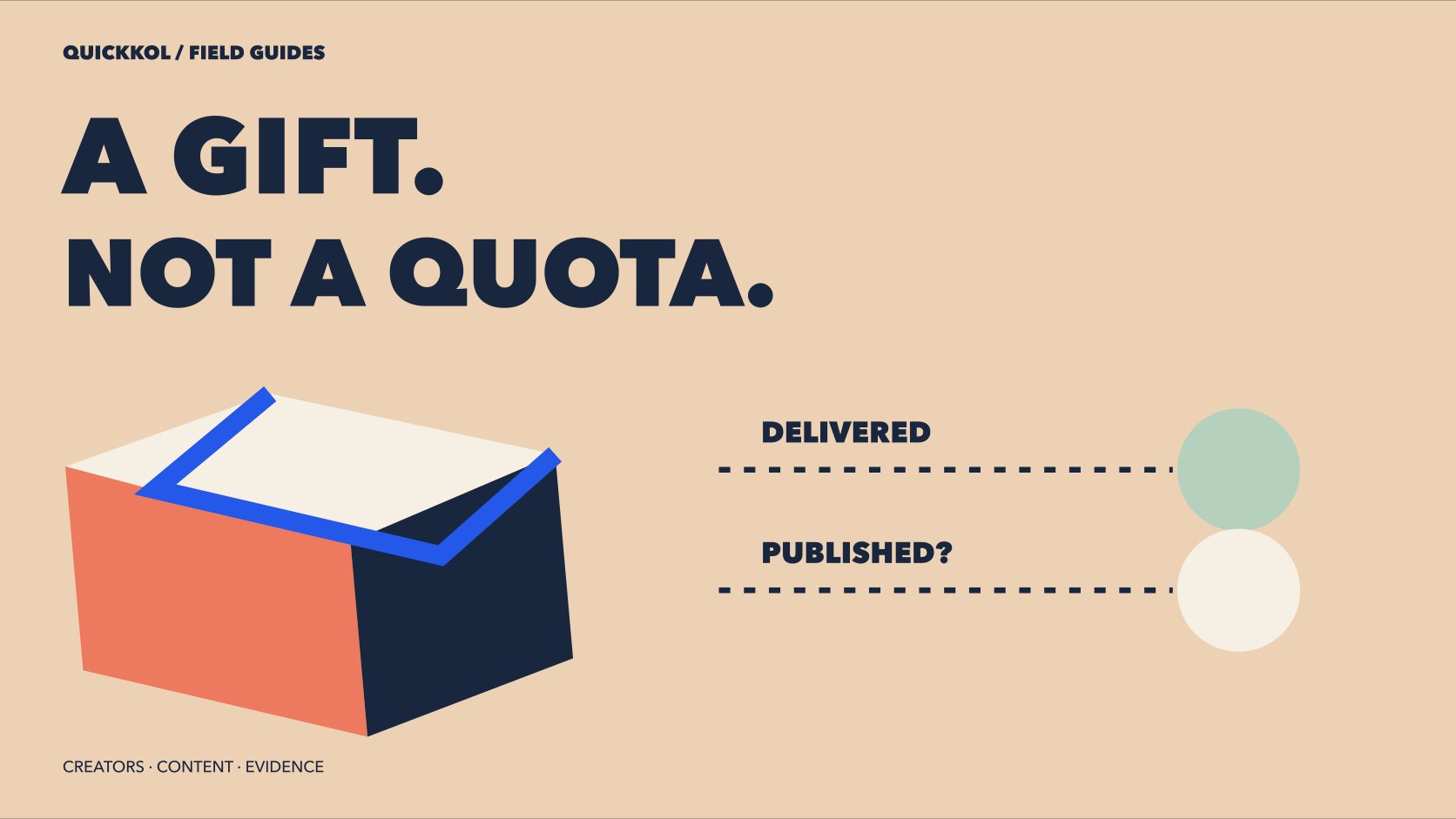
Use factual states: invitation accepted, dispatched, delivered, feedback received, content separately agreed and published. Delivery is not exposure, and private product feedback is not a public endorsement. FTC disclosure guidance is relevant when a gifted product leads to a recommendation with a material connection.
Route product issues to the product owner and agree on public content separately. If guaranteed deliverables are required, negotiate an explicit paid scope instead of relying on an implied obligation created by a gift. The gifting-disclosure guide addresses that boundary. Record non-public feedback with appropriate access so a useful product insight does not become an accidental public testimonial.
Calculate costs against the outcome you actually obtained
Suppose forty invitations lead to twenty acceptances and eighteen dispatched samples. At $15 product cost plus $8 shipping each, dispatch cash cost is $414. Adding $300 of allocated operating time gives a $714 scenario total. These are hypothetical inputs, not market benchmarks or measured campaign results.
If nine useful feedback responses arrive, fully allocated scenario cost per response is approximately $79.33. That is not cost per sale or guaranteed published asset. Six voluntary posts, if they occur, also do not represent six equal audiences. Keep cash, labor and outcome definitions separate so the team can judge whether the program achieved its actual purpose.
Use feedback to decide the next relationship step
A recipient who used the product and provided relevant feedback may be a sensible person to discuss a paid project with. A poor-fit recipient should not keep receiving the same sample. Preserve the reason and respect the boundary instead of treating a gift as permission for repeated publication reminders.
QuickKOL can help prepare content-relevant invitations; the brand still owns the product offer and commitments. If the workflow is moving to another tool, use the migration guide to retain consent, shipping exceptions and relationship context. The goal is a useful partnership pipeline, not a larger dispatch count. A smaller, well-matched gifting batch can teach more than a broad shipment whose outcomes nobody can explain.
Worked example: plan a twenty-sample seeding batch
Suppose the team has twenty samples available. Start by separating accepted recipients, unanswered invitations and refusals. Ship only after acceptance, confirming the product variation, appropriate address use and relevant delivery constraints. The sample count is inventory, not an achieved creator partnership count.
Use distinct states for accepted, dispatched, delivered, optional feedback and actual publication. A package arriving does not establish that the creator used it, liked it or promised to post. If the gift is unconditional, absence of a post is not a missed contractual deliverable. A separate agreement is needed when the brand requires content.
The working file should connect each shipment to a responsible owner and a permitted follow-up route. If the product is lost or arrives unusable, resolve that practical issue before asking for feedback. When comparing alternative sites for this workflow, test whether these distinctions survive exports and team handoffs. The important capability is not merely sending an invitation or generating a shipping label. It is maintaining an accurate relationship record so the brand does not convert a goodwill gesture into an obligation the recipient never accepted.
FAQ: do more samples necessarily produce more content?
No. Acceptance, delivery, product use, willingness to discuss and actual publication are different events. Without relevant historical evidence from the brand’s own process, do not assume a fixed posting percentage or present it as an industry guarantee. Even an observed past rate depends on the product, recipients, relationship and conditions of that batch.
Before increasing volume, inspect relevance, invitation clarity and logistics. A larger shipment does not solve an unsuitable product match or a confusing expectation. It can simply multiply cost and create more follow-up work. If the brand needs a definite content commitment, negotiate an explicit collaboration and separate the sample from the production or publication fee.
Use the pilot to decide what kind of program the team actually wants. Unconditional seeding can support product experience and optional feedback, while contracted content purchases deliver a different level of certainty at a different scope. A replacement platform should support that distinction. Selecting a tool that makes everything look like a campaign deliverable can produce misleading reporting even when the packages themselves arrive correctly.
Research date, evidence and limitations
Reviewed October 21, 2026. Vendor positioning is not an account-level test. Invitation counts and costs are hypothetical, not seeding conversion benchmarks.
Calculate three seeding outcomes separately
Editorial analysis and labeled hypothetical examples, not performance rankings, quotes or guarantees.
| Outcome | Evidence | Not equivalent to |
|---|---|---|
| Delivery | Delivery confirmation | Use, feedback or exposure |
| Feedback | Relevant experience and issues | Public-content permission |
| Publication | Live link and agreed scope | Sales or incrementality |
CHECKLIST
Before you put this into practice
Record the answers in the campaign working file.
- Explain the exchange clearly
- Confirm fit before shipping
- Separate addresses from prospect research
- Do not turn gifting into an implied deliverable contract
Sources and further reading
- 01Aspire: Brand creator marketing workflows
- 02Modash: Official brand platform overview
- 03Collabstr: Creator marketplace and collaboration management
- 04FTC: Disclosures 101 for social media influencers
External pages can change. Recheck platform rules, contracts and local law before launch.