
THE SHORT ANSWER
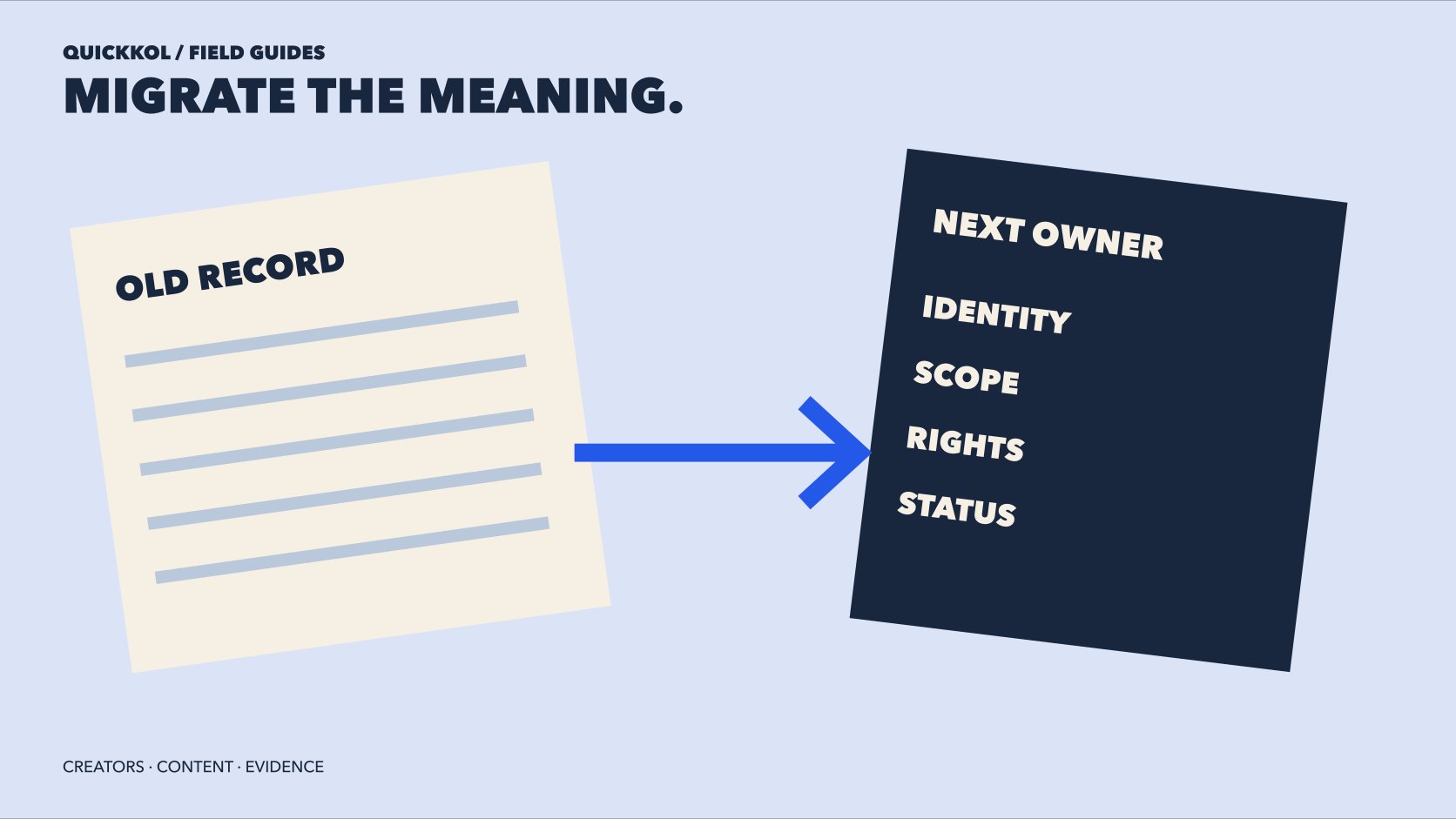
A migration is complete when a new owner can still see who was contacted, what remains promised, which assets may be used and who acts next. Select a suitable replacement first, preserve the available records, define field ownership and test an import before switching. This guide does not assume a particular current Tomoson export feature. The method applies to a brand moving from a marketplace, spreadsheet or older creator tool while active partnerships continue.
Define what is moving and what must keep running
Inventory tools, spreadsheets, contract files, payment records and shipping systems. State which system currently owns each fact. Moving handles alone loses the relationship; uploading every file without selection can expose unrelated information and make the new workspace harder to use.
Identify imminent publications, parcels in transit, pending approvals and outstanding payments. Assign the authoritative record during the transition so two systems do not trigger duplicate follow-ups. Migration is not a reason to suspend existing commitments. A narrow inventory also helps the brand distinguish records that should move from archived material that can remain in an accessible, controlled reference location.
Preserve identity and provenance before cleaning
Retain platform, exact profile URL, handle, display name, contact source and observation date. Keep duplicate display names separate until identity is resolved. A person with several channels may need linked records, but the linkage itself needs evidence. Cleanliness is not a justification for merging unrelated people.
Verify available export capability in the actual account. When a field cannot be exported, use existing authorized records or ask the vendor about a supported route. Do not invent an API or claim a missing field was recovered. Keep a source column during the pilot so a reviewer can return from the imported value to the old record and understand its reliability.
Prioritize commitments, permissions and stop-contact states
Prioritize last contact, declines, stop-contact states, current scope, payment milestones, asset permissions and ownership. Similar status names can hide different meanings. “Complete” might mean content was delivered rather than payment settled or advertising rights confirmed.
Write a field mapping with plain-language definitions. A software move does not expand an asset license. Mark an uncertain expiry as requiring review, not as active indefinitely. Missing descriptive tags are inconvenient; duplicate contact or unauthorized asset use can be more disruptive. The rights-renewal guide provides a deeper check for old materials whose commercial terms no longer match the intended campaign.
Pilot varied records instead of importing the easiest examples
Choose a varied pilot, such as twenty records containing namesakes, linked channels, opt-outs, closed projects, parcels in transit and expired rights. This is a practical operating sample, not a statistical validation of the entire migration. Include the difficult records rather than only the cleanest ones.
Inspect identity, status, attachments, access and next actions in the destination. Modash, Collabstr and Aspire present different product directions; actual import fields and account permissions require hands-on acceptance. “Supports management” does not mean every source field transfers without loss. Test the intended replacement against the record types the brand actually maintains before planning a large import.
Reconcile meaning as well as row counts
Suppose the source has five hundred rows and confirmed deduplication leaves 470 accounts plus twelve cross-platform relationships. Those are hypothetical figures. A destination showing 470 rows has not yet proved success. Reconcile stop-contact states, unfinished commitments and permissions with their meanings intact.
Keep an accessible reference for notes or attachments that cannot move. Do not bury information loss beneath a successful-import message. Have a colleague outside the migration take over one open task without an oral explanation. Can they identify the next action and its evidence? That handoff is a stronger acceptance test than a matching total on two dashboards. Document every unresolved difference before deciding whether to switch.
Switch in stages with an explicit recovery route
Start new work in the destination while closing older commitments under a named authoritative record. Use an observation period to check duplicate messages, stale states and access problems. Stop the old process only after the critical records and handoffs pass review.
QuickKOL can be evaluated for discovery and outreach preparation, but this guide promises no untested direct Tomoson import. Preserve a recovery route, source records and responsible owners. The alternatives buying guide addresses which product to choose; the seeding workflow covers dispatch and feedback. This migration guide’s job is continuity. A completed software purchase is not a completed transition if creators still receive contradictory instructions or the team cannot find an outstanding commitment.
Worked example: migrate five records before moving the whole program
Choose five representative records before migrating the full program: an active partner, an unanswered invitation, a licensed asset, an ended relationship and a project with an unresolved issue. These expose more useful differences than five identical clean profiles. Match identity, status, agreement, asset route and communication history in the destination.
Then inspect permissions and export the records again. Ask a second teammate to confirm that the current scope and next action are understandable without reading the old system. If a field cannot migrate, document its retained location and owner instead of quietly dropping it. An attachment link that only the original administrator can open is not a complete team handoff.
Do not send messages during the trial import or reset relationship states merely because the destination uses a different label. The point is to preserve meaning, not to make every row look standardized. Once the five-record pilot passes, define the batch process, exception handling and final reconciliation. This approach makes migration reviewable before the team changes a working program, reducing the chance that a new website creates duplicate outreach or loses an existing permission boundary.
FAQ: must every old record be completed before migration?
Prioritize fields necessary to honor existing commitments and continue current work. An obsolete research lead does not require the same effort as an active contract or a still-valid asset license. Both need a traceable status, but not every historical blank must be filled before the team can move responsibly.
Mark missing material unknown. Do not reconstruct a contract from memory or infer permission from the fact that an asset was used previously. Assign an owner to resolve important gaps and keep the evidence route with the record. The migration should make uncertainty visible rather than laundering an incomplete history into apparently clean data.
Also define when editing stops in the old system, who handles late replies and what access remains after cancellation. Keeping an archive does not mean everyone should continue updating both systems indefinitely. A clear cutoff and exception process prevents conflicting versions. The migration is complete when active obligations, next actions and evidence locations reconcile, not merely when an import reports a successful row count. That operational definition is more useful than assuming a replacement website automatically inherits the old program’s context.
Research date, evidence and limitations
Sources reviewed October 21, 2026. No vendor dashboard was accessed and no export, import or migration interface was tested. Record counts are hypothetical.
Which facts to migrate first
Editorial analysis and labeled hypothetical examples, not performance rankings, quotes or guarantees.
| Record | Failure risk | Acceptance |
|---|---|---|
| Identity | Namesake merge or duplicate contact | Links and identity evidence retained |
| Commitments | Missed publication, feedback or payment | Scope, date and owner remain clear |
| Rights and stops | Unauthorized use or renewed contact | Expiry and stop states preserved |
CHECKLIST
Before you put this into practice
Record the answers in the campaign working file.
- Assign one authoritative record during transition
- Pilot records with exceptions
- Reconcile state meanings and critical counts
- Keep the old workflow available until acceptance
Sources and further reading
- 01Modash: Official brand platform overview
- 02Collabstr: Creator marketplace and collaboration management
- 03Aspire: Brand creator marketing workflows
External pages can change. Recheck platform rules, contracts and local law before launch.