
THE SHORT ANSWER
An influencer discovery tool helps a brand explore relevant people when it does not yet know whom to approach. Start with the customer problem and look for creators who repeatedly address it. Preserve diversity and unknowns during discovery. The result should be an evidenced candidate pool, not a similarity score treated as a signing decision.
Translate the category into customer jobs
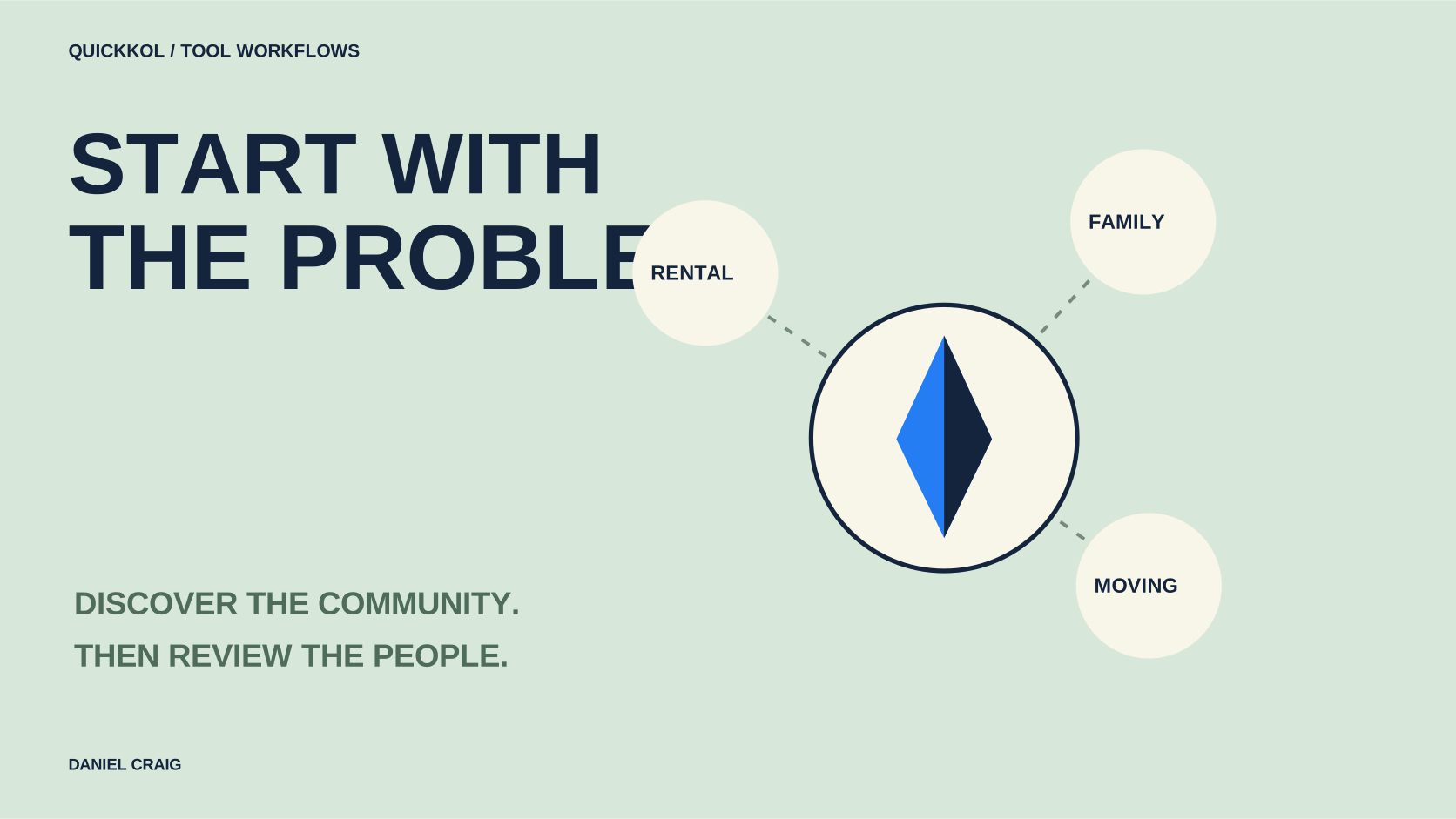
“Home influencer” is too broad to explain who can demonstrate a product. A storage brand might explore rental interiors, family organization and moving into small apartments as separate customer jobs. Each needs different situations, explanations and evidence of use.
Extract market, language, limitations and format from the brief. Keep unresolved assumptions visible, such as whether installation speed matters to buyers. Discovery should help revise the task rather than silently treating the initial brief as proven.
Use multiple routes rather than one identity label
Search user questions, equipment, environments and community vocabulary separately. Do not rely on biography labels or expand immediately to every lifestyle account when the first query is weak. Save the query, source posts and rejection reasons for each route.
Small-space storage can start with no-drill rentals, organizing children’s supplies and packing before a move. If all routes return the same large accounts, inspect whether the tool understands only broad categories or the filters exclude useful specialists.
Treat lookalikes as hypotheses
Modash documentation describes lookalikes through content or audience similarity. First state why the seed creator fits: explanation style, usage situation or audience market. Similar appearance does not establish similar viewers, and similar viewers do not establish willingness to collaborate.
Record the similarity dimension and inspect candidates who differ from the seed. Repeated expansion from one viral account can narrow the pool unnecessarily. Discovery should add useful explanations and communities, not simply reproduce one successful-looking profile.
Measure coverage against the questions you searched
A working sample could inspect eight candidates from each of four routes: thirty-two records. Mark relevant discussion, insufficient evidence, duplicates and irrelevant profiles. This describes the explored sample, not platform-wide accuracy.
Describe gaps specifically, such as missing rental content in the target market. When relevance is weak, adjust language, task framing or hard filters one at a time. Changing the task while comparing tools makes the source of improvement impossible to identify.
Preserve the evidence needed for the next decision
For each retained creator, preserve the account, three relevant posts, a fit reason, market evidence and unknowns. Discovery need not settle every commercial term, but it should expose what remains unresolved. Content interest does not establish purchasing power or partnership interest.
QuickKOL approaches this work through natural-language requirements and content understanding. The brand should open source material and review the reasoning. The output is a pool awaiting assessment, with owners for audience, availability and suitability checks.
Move from exploration to a repeatable review
Once useful routes emerge, fix the market, content job and exclusions. Record which route produced each candidate, why the person was retained and who handles the next step. The next operator should not need to repeat the exploration.
Use the reproducible search guide to stabilize queries and filters, then the pre-contract vetting workflow before making commercial commitments. In QuickKOL, a brand can return to the same brief and examine which candidate reasons justify proceeding to outreach.
Research method and scope
This guide covers exploration of unknown candidates, not identity confirmation or contract review. Official references were checked October 15, 2026. Route and sample counts are working suggestions, not statistical thresholds or database performance claims.
Three routes into discovery
Routes are editorial exploration examples, not guaranteed tool coverage.
| Route | Example | Evidence to retain |
|---|---|---|
| Customer problem | Installing without damaging a rental | Real demonstrations and explanation |
| Usage environment | Organizing a small family home | Repeated content and community questions |
| Adjacent creators | Similar explanations or audience direction | Similarity dimension and differences |
CHECKLIST
From brief to candidate pool
Have the brand owner confirm each item with evidence and a next action.
- List customer problems and unresolved assumptions
- Compare at least two independent discovery routes
- State the dimension behind lookalike suggestions
- Save original content and rejection reasons
- Name the next reviewer and decision conditions
Sources and further reading
External pages can change. Recheck platform rules, contracts and local law before launch.