
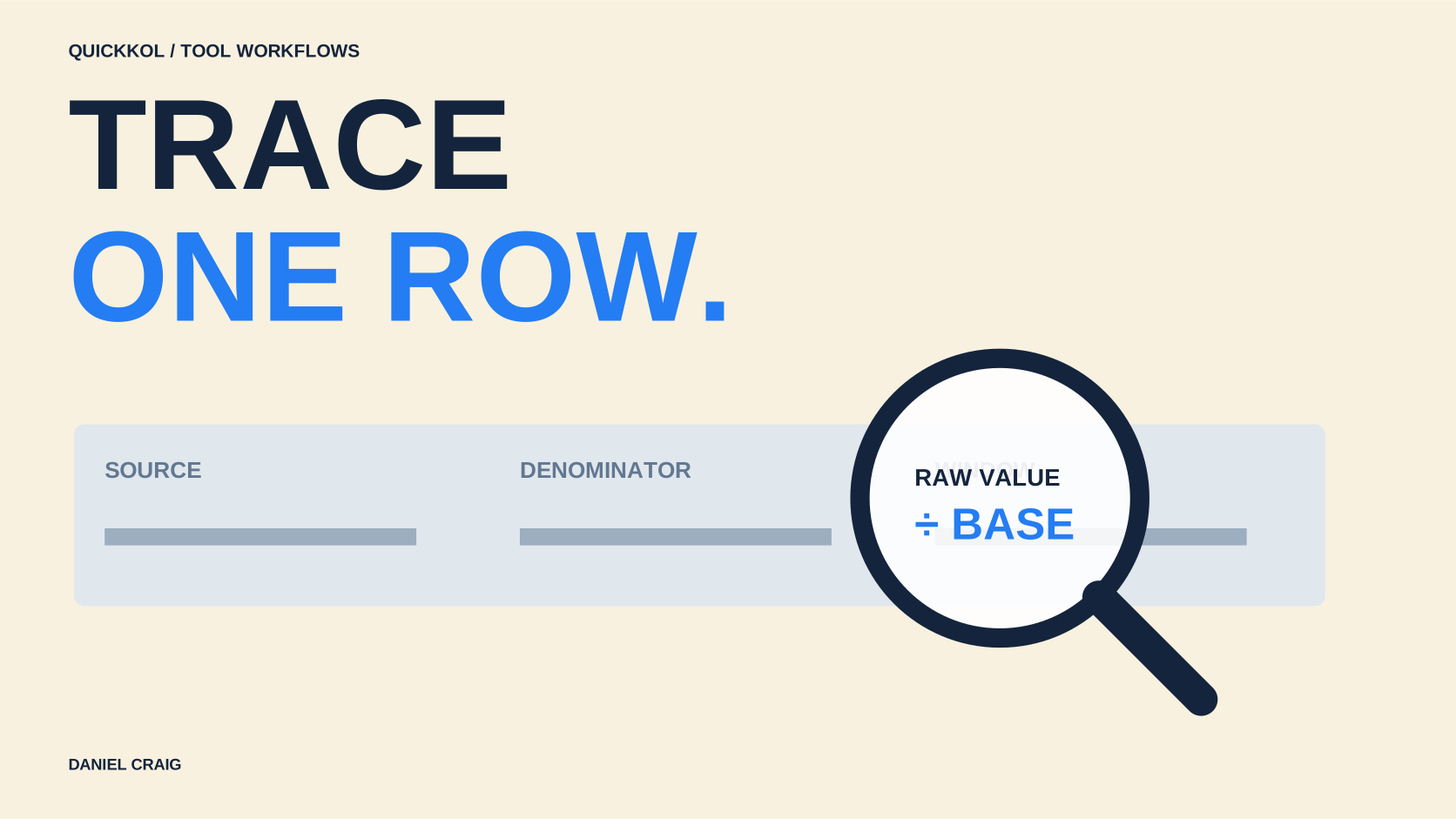
THE SHORT ANSWER
Evaluate an influencer analytics tool by tracing one real report row to its source, definition, window and calculation. The brand should distinguish native values, external estimates and derived metrics, then reproduce the export. More charts or decimal places do not replace provenance. Missing critical fields should visibly limit the conclusion.
Begin with a record tied to original content
Choose content for which the brand has appropriate evidence rather than starting with a monthly overview. Retain account, asset ID, original link, publication time, reporting window and collection time. Ask the tool to show where each value originated.
A record with a missing field or correction is more informative than a flawless demonstration. A perfect sample shows only the happy path. If provenance cannot be displayed, mark the field unverifiable instead of treating a green interface status as evidence.
Inspect the denominator before interpreting performance
Engagement may divide by followers, views or reach. Preserve numerator, denominator and formula. In an example, 600 interactions divided by 20,000 views is 3%; divided by 50,000 followers it is 1.2%. Both calculations can be correct while answering different questions.
YouTube defines impressions and viewing separately, so terminology is not a universal cross-platform unit. Ask for definitions and inspect denominator changes across networks. If normalization is necessary, retain source values and the transformation instead of an unreproducible composite score.
Test whether windows and updates remain explainable
Publication age, calendar month and custom periods produce different results. Ask for start, end, timezone and last update, then test content published across a month boundary. A day-seven cumulative value should not share a comparison column with an in-month increment.
Native exports require access and a reporting period. YouTube Advanced Mode can support checks of relevant native reports where the brand has appropriate access. A current export cannot automatically recreate last week; verify historical snapshots explicitly when they are needed.
Use missing and estimated fields to test transparency
Test a record lacking audience geography, cost or a public interaction value. The tool should state what cannot be calculated instead of treating blanks as zero or silently estimating a complete report. Views can be shown without cost, but a full ROI conclusion cannot.
Estimated fields need provenance, dates and scope. If public estimates and authorized native observations share a column, request explicit labels. The brand needs an explanation of limits, not a smoother chart obtained by removing important unknowns.
Have a second operator reproduce the export
An export should preserve raw metrics, stable identifiers, periods and necessary formulas. Ask a second operator to recalculate one derived value without the sales demonstration, checking deduplication, currency and rounding. Exporting only a final composite score leaves the judgment locked inside the product.
Correct one source value and inspect recalculation, previous-version interpretation and change history. A useful analysis tool should explain how corrections affect subsequent decisions, not merely produce a correct-looking first report.
Approve the tool for specific decisions
Record which fields pass, which need manual checks and which cannot support the task. A product may be adequate for content review but insufficient for cross-market budget allocation. Approve specific uses rather than assigning a task-free overall verdict, and recheck changes to sources and definitions.
Use the analytics stack guide to allocate roles across sources and the campaign tracking plan for timing and capture gaps. Apply the same field and provenance checks to QuickKOL rather than inferring complete coverage from a product label.
Research method and scope
Official metric and export references were checked October 15, 2026. The figures are formula examples. This is an acceptance method, not an independent accuracy benchmark or sales guarantee.
Acceptance path for one report row
The example illustrates denominator differences, not platform accuracy.
| Field layer | Check | Passing evidence |
|---|---|---|
| Source | Native, estimated or derived | Link, date and access context |
| Definition | Numerator, denominator and window | Reproducible formula and source values |
| Missing data | Whether blanks become zeros | Explicit unknowns and limited conclusions |
| Export | Whether another operator can recalculate | Identifiers, raw values and change history |
CHECKLIST
Single-tool analytics audit checklist
Have the brand owner confirm each item with evidence and a next action.
- Select one verifiable real record
- Check provenance, denominator and window
- Test missing values and estimate labels
- Export and independently reproduce derived metrics
- Approve uses against specific brand decisions
Sources and further reading
External pages can change. Recheck platform rules, contracts and local law before launch.