
THE SHORT ANSWER
This Instagram engagement rate calculator uses public likes plus comments and divides that total by followers and, where available, views. It excludes saves and shares rather than pretending they are known zeros. The result is suitable for a transparent manual sample, not a claim to complete Instagram native engagement. Keep creator-provided analytics as a separate, clearly defined dataset when they become available. A different number can reflect a different formula rather than an error.
Define the public-data scope
Public content may display likes, comments and views, but visibility depends on the asset and account settings. Do not fill an unavailable count from memory or a third-party approximation without labeling the source. Keep the post URL, capture date and excluded metrics with the sample.
A brand does not need a creator’s login password to request evidence. Agree on the relevant report and window through an authorized information-sharing route. Public research and native analytics access are different permissions. This worksheet intentionally calculates a narrow public-data formula so an analyst can reproduce it without implying access to information the brand does not hold.
Recalculate the example and retain its label
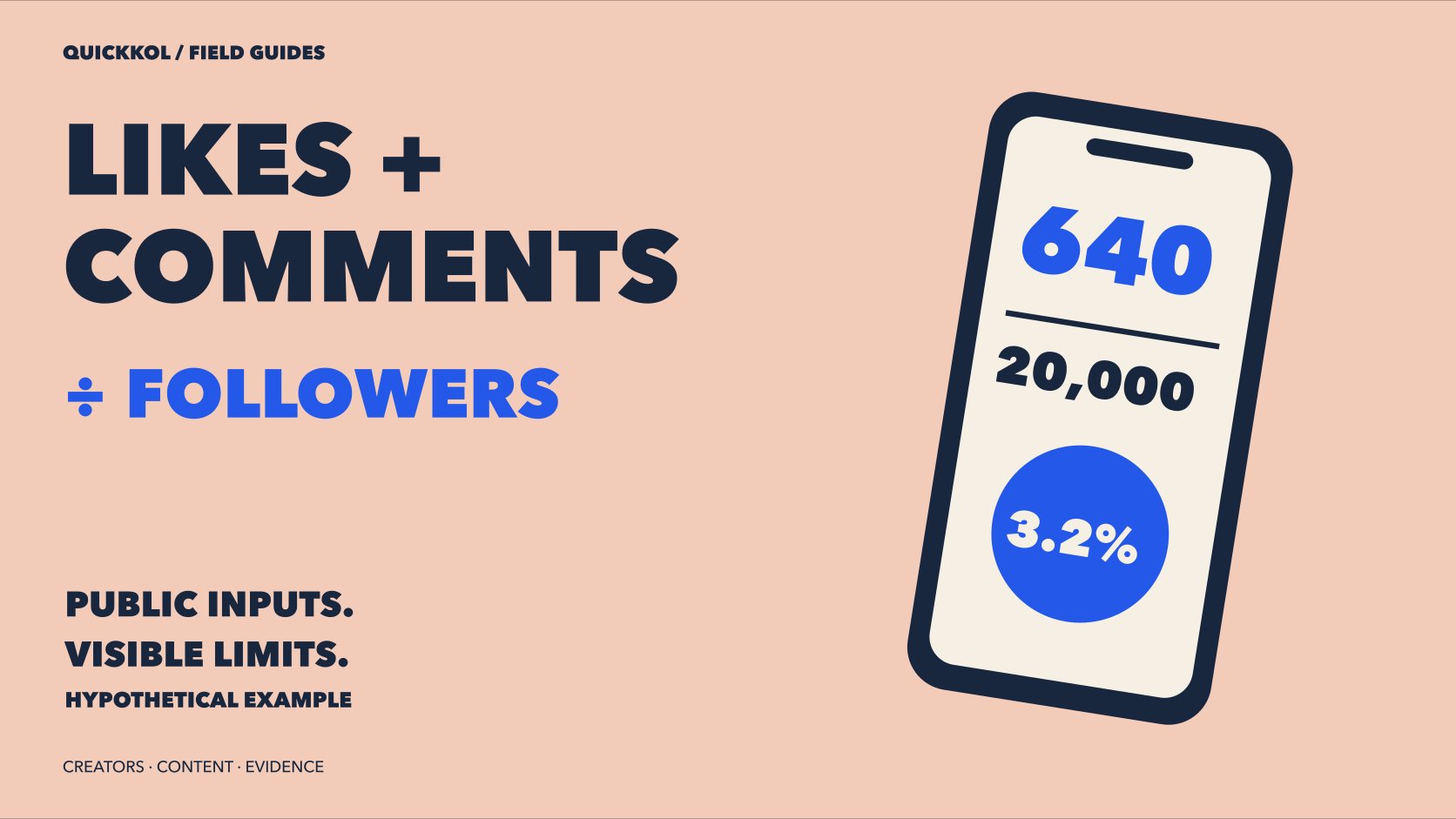
Six hundred likes plus forty comments equals 640 public interactions. Against twenty thousand followers the example produces 3.2%; against ten thousand views it produces 6.4%. The general calculator gives a different result when saves and shares are added. The difference comes from the numerator, not from an Instagram-specific adjustment.
Label the output “public likes and comments divided by followers” rather than an unexplained quality score. Use data from the same asset and remember that views are not unique accounts. The figures are hypothetical defaults. They are not a typical rate for an audience tier, and they should not become a pass threshold simply because the calculator displays them first.
Compare a vendor score only after aligning methods
Modash currently documents median likes divided by followers for Instagram. This page uses likes plus comments for the entered asset. Even when the account is the same, subtracting the two percentages does not diagnose an error. The numerator, aggregation and content sample differ.
Retain the vendor’s original metric name, formula, date and sample scope. A larger historical sample also differs from ten manually chosen posts. If the client requires a common reporting field, recalculate from compatible inputs or explain why alignment is unavailable. Do not silently transform a product score into a supposedly identical native Instagram measure.
Build a sample of comparable Instagram content
Separate Reels, images, carousels, giveaways and paid amplification in the working file. Formats can encourage different behaviors and expose different public metrics. A pinned position is not a publication date, so the first ten items on a profile are not necessarily a recent sample.
Record inclusion and exclusion reasons before looking at which result is more favorable. A median can reduce the effect of an extreme value on typical performance, but it cannot repair an unsuitable sample. Keep post-level values so another reviewer can see whether a comparison reflects format, period or creator differences. The metric-definition guide helps establish the reporting dictionary used across those rows.
Interpret missing counts and small denominators
When likes are hidden, the stated formula cannot be completed; zero would create an artificially low result. When the denominator is small, a few interactions can produce a large percentage. Report the absolute counts beside the rate.
Two interactions from ten views is twenty percent in a hypothetical example. That arithmetic says little about a broad commercial opportunity. High density does not necessarily mean more relevant people, and it should not automatically increase a quote. The brand still needs audience, content and scope evidence. A clearly unavailable result is more honest and operationally useful than a percentage that conceals why the data cannot answer the intended question.
Add native evidence without overwriting the public record
When authorized reporting becomes available, record saves, shares, reach and the relevant period separately. Do not mix a later native total into an earlier public snapshot. Preserve the original record and identify the source type of the new one so the apparent history does not change without explanation.
Engagement describes content response; purchases describe a commercial path. For a larger program, use the Instagram campaign guide to define publication, permissions and tracking. QuickKOL can support content interpretation and candidate organization, while the brand keeps the evidence boundary explicit. The worksheet is useful because its scope is narrow and reproducible, not because it can replace a complete partnership decision.
Worked example: keep public and authorized inputs distinct
Suppose the publicly observed inputs are six hundred likes, forty comments and twenty thousand followers. A likes-and-comments follower ratio is 3.2%. If authorized saves and shares later become available for the same observation window, create a separately labeled expanded definition rather than overwriting the original number while retaining its old label.
This calculator starts with likes and comments so it does not imply that every interaction type is publicly accessible. The view input supplies another denominator, not proof that views are unique people. A report should retain the source route, observation time and format alongside the calculation.
When comparing assets, align their lifecycle as well as their formula. A newly published asset and an older post may have had different opportunities to accumulate interactions. Mixing them can make a clean arithmetic comparison look more meaningful than it is. The example is hypothetical; it illustrates a reporting method, not a target Instagram rate. Keep the input definition visible so the same spreadsheet does not gradually combine public observations, private analytics and estimates under one apparently consistent percentage.
FAQ: why is there no universal pass rate?
A defensible threshold needs a compatible definition, relevant format and observation window. Without those, a universal pass line can reject a suitable creator or approve an unsuitable one for the wrong reason. A single percentage also cannot establish purchasing behavior, content quality or audience honesty.
Build a comparison group relevant to the assignment and retain its selection rule. If only a few comparable assets exist, disclose that limitation rather than assigning an elaborate account grade. The result may still support a useful question, such as why a particular topic attracts more discussion, without proving that the creator will deliver a commercially superior campaign.
Use the calculator to clarify evidence before making the broader decision. Combine the rate with relevant work, market evidence, feasible scope and rights. A creator with a modest percentage may explain a difficult product well, while an account with a high percentage may attract attention unrelated to the proposed purchase. This is why the calculator displays arithmetic rather than an automatic “hire” recommendation. The brand remains responsible for connecting a measured interaction pattern to the customer job it is actually commissioning.
Research date, evidence and limitations
Vendor definition checked October 21, 2026. No Instagram native account was accessed and the tool fetches no profiles. Defaults and the small-sample example are hypothetical.
Public and native data boundaries
Editorial analysis and labeled hypothetical examples, not performance rankings, quotes or guarantees.
| Item | This worksheet | Additional evidence |
|---|---|---|
| Likes and comments | Available public counts | Same asset and window |
| Saves and shares | Excluded | Separate authorized report |
| Unique reach | Not inferred from views | Matched native definition |
PRACTICAL TOOL
Instagram public-interaction worksheet
Uses likes plus comments only; saves and shares are excluded. This is not full native engagement. Inputs are examples.
Sources and further reading
External pages can change. Recheck platform rules, contracts and local law before launch.