
THE SHORT ANSWER
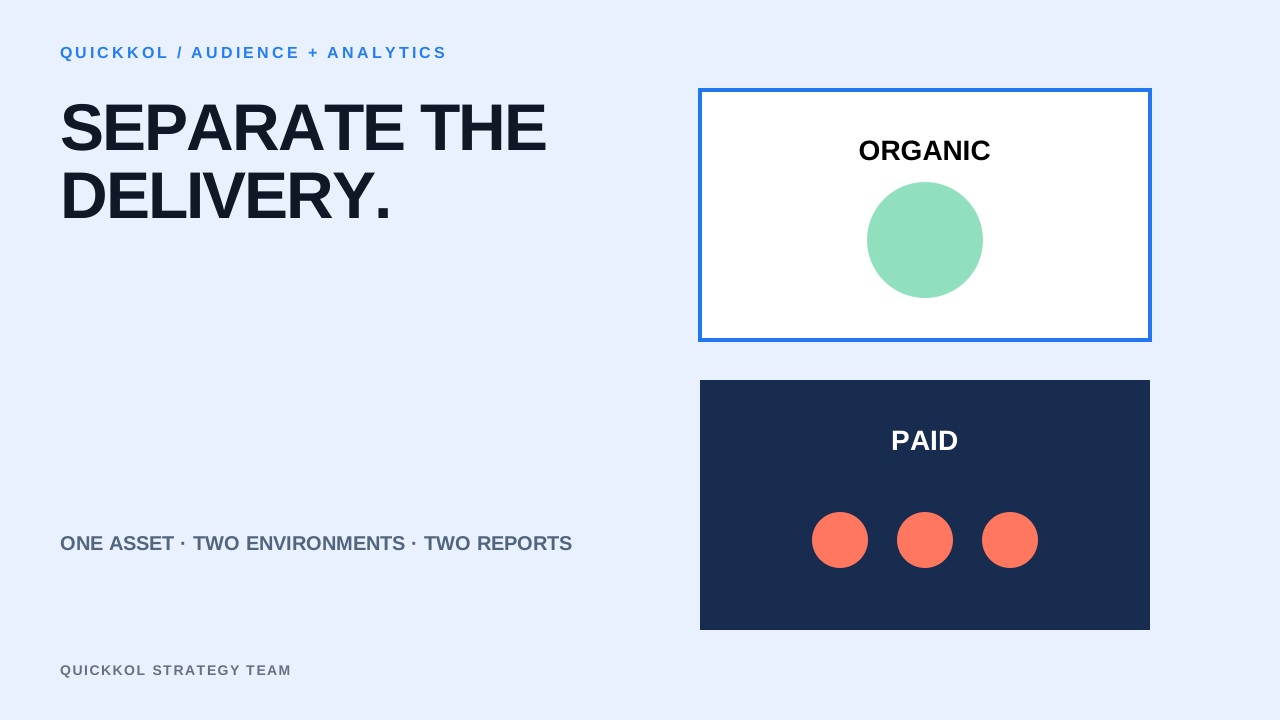
Organic publishing and paid amplification may use the same asset but operate in different data environments. Organic delivery reflects the creator’s existing audience relationship; paid delivery changes audience, frequency, objective and cost. Split views, retention, engagement, clicks and conversion by traffic source and compare equal lifecycles. Blended views cannot assess organic fit or true media efficiency.
Define traffic layers before launch
Separate creator organic, brand organic, paid amplification from the creator handle and brand-account advertising. Record account, objective, market, dates, budget and permitted version for each layer.
If platform reporting cannot fully separate them, save an organic baseline before paid delivery and mark the paid start date. State data limitations rather than filling gaps with estimates.
Compare equal lifecycles and audiences
Do not compare 28 days of organic data with three days of paid delivery. Use common windows such as 24 hours, seven days and 28 days, while recording audience scope.
When paid media expands to a broader market, lower engagement or retention may reflect audience change rather than a suddenly weaker asset. Break down market, device and audience before concluding.
Add complete cost to the paid layer
Paid efficiency includes media spend, creator fee, ad rights, edits, operations and platform cost. ROAS based on media spend alone understates the cost of acquiring content and permission.
When one asset runs across several ad groups, define cost allocation. Charging all fixed production cost to the first group also distorts comparison.
Use results to decide creative and relationship next steps
Strong organic performance with weak paid scale may mean the asset depends on original audience context. Average organic results with strong targeted paid delivery may indicate transferable creative but limited organic reach. They support different decisions.
Keep asset version, audience, delivery settings and rights term. Change one major variable next time so a new creator, creative and audience do not move simultaneously.
Organic and paid performance answer different questions
Meta describes Partnership Ads as a way for brands and creators to run ads together. Organic publishing primarily reflects fit with the creator’s existing audience, early response and community context. Paid amplification adds audience selection, auction, placement, frequency and optimization, so the two should not be blended into one average.
An asset may deliver 45,000 organic views and a 2.4% save rate, then add 300,000 paid impressions, 1.1% click-through and 420 conversions. Report the organic and paid windows separately and connect them by asset ID. If paid results are weak, inspect audience, frequency and landing page; if organic comments expose misunderstanding, fix later content even when ROAS looks acceptable.
Organic and paid performance split
Split delivery before evaluating cross-context reuse.
| Environment | Primary variables | Useful for |
|---|---|---|
| Organic | Existing audience, context | Fit and feedback |
| Paid | Targeting, auction, frequency, placement | Scale and conversion |
| Shared asset | Hook, proof, CTA | Transferable components |
| Combined conclusion | Separated windows | Next test |
CHECKLIST
Before amplifying organic creator content
Pass eight checks before amplification.
- Paid usage rights and term confirmed
- Asset version and account access are correct
- Organic comments show no major misunderstanding
- Disclosure remains clear in paid context
- Paid and organic audiences are recorded separately
- Frequency and stop rules are set
- Landing page and CTA are continuous
- Reporting separates both windows
Sources and further reading
External pages can change. Recheck platform rules, contracts and local law before launch.