
THE SHORT ANSWER
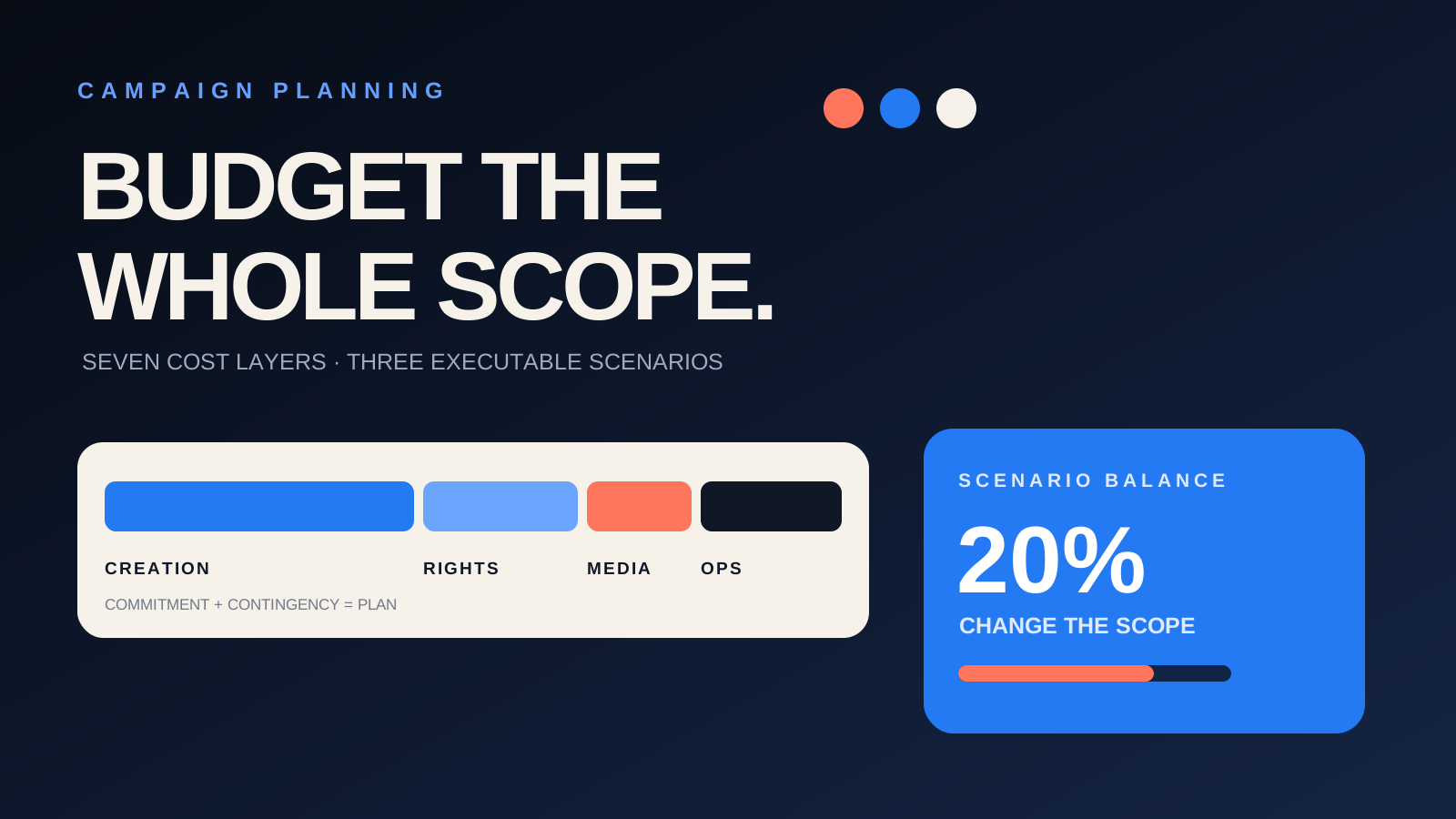
A complete budget includes at least seven categories: creation and publication, usage rights, paid amplification, product and logistics, agency or platform costs, internal execution and review, measurement and contingency. Build the required-deliverable base case, then model rights, amplification and creator replacement scenarios. Update expected outcomes with every scope change so the campaign does not discover cash, asset or staffing gaps after launch.
Start with the decision the budget must support
Awareness, product trial, asset production and direct response require different cost structures. Define content quantity, market, timing, rights and measurement before choosing creator count.
The budget should show what changes when total spend falls by 20% or rises by 20%, instead of presenting only one total.
Separate one-time and ongoing cost
Creation and publication are often paid around launch, while rights, amplification, tools and reporting may continue for weeks or months. Record payment milestones, currency, tax and rights expiry.
Extended rights may appear as one quote but should be evaluated by term and channel. Continued use after expiry is a new budget decision.
Budget for operating capacity and exceptions
Failed shipments, reshoots, currency changes, late asset specifications and creator withdrawals create real cost. Set contingency from your own exception history instead of copying an industry percentage.
Without history, use an explicit internal assumption and recalibrate it during review, documenting which events may use the reserve.
Return actual spend to the next plan
At closeout, record budget, committed, paid and forecast-to-pay amounts, explaining whether variance came from scope, volume, currency or execution. Connect cost to deliverables and results instead of filing invoices alone.
QuickKOL can preserve quotes, rights, payment status and campaign outcomes in one record, creating better scenarios for the next plan.
Connect budget, deliverables and capacity with three scenarios
The base case covers required markets, formats and volume; the reduced case shows which deliverables disappear when total budget falls 20%; the expanded case explains whether an additional 20% buys creators, rights or media. A 300,000 example might allocate 165,000 to creation and publication, 45,000 to rights, 35,000 to amplification, 20,000 to product and logistics, 15,000 to operations and measurement, and keep 20,000 for exceptions. These figures illustrate structure and must be replaced with real quotes and internal cost.
IAB estimates growing creator-economy advertising investment, but it does not prescribe the right allocation for a campaign. The approval view should also display expected live creators, asset count, rights term, target-market measurement and weekly review capacity; recalculate cost and timing whenever one changes.
Define measurement before reserving attribution and exception cost
Google Analytics recommends consistent campaign parameters when building URLs; differences in capitalization or spelling can split one campaign into separate entries. Budget for link setup, landing-page checks, data snapshots and reporting time. Attribution reports explain how conversion credit is assigned across touchpoints, but platform views, clicks and final conversions may use different windows and should not simply be added together.
TikTok One supports different collaboration paths such as invitations, applications and content syncing, each creating different discovery, communication and amplification cost. Record every use of contingency: replacement shipping, reshoots, creator withdrawal, currency movement, delayed access or an extra version. At closeout, return unused reserve and overspend reasons to the next plan instead of treating full budget consumption as success.
Complete campaign budget structure
Connect every cost to a deliverable, payment milestone and owner.
| Category | Includes | Validation question |
|---|---|---|
| Creation and publication | Assets, revisions, publication | Are scope and volume defined? |
| Rights and media | Term, channels, account access | Who owns expiry? |
| Product and operations | Product, shipping, tools, review | Is team capacity included? |
| Measurement and exceptions | Parameters, reporting, reserve | Are triggers traceable? |
PRACTICAL TOOL
Complete campaign budget calculator
Enter committed cost and contingency to check planned total against available budget.
Sources and further reading
- 01IAB 2025 Creator Economy Ad Spend & Strategy Report
- 02Google Analytics Help: URL builders and campaign parameters
- 03Google Analytics Help: Get started with attribution
- 04TikTok Business: Working with creators on TikTok One
External pages can change. Recheck platform rules, contracts and local law before launch.