
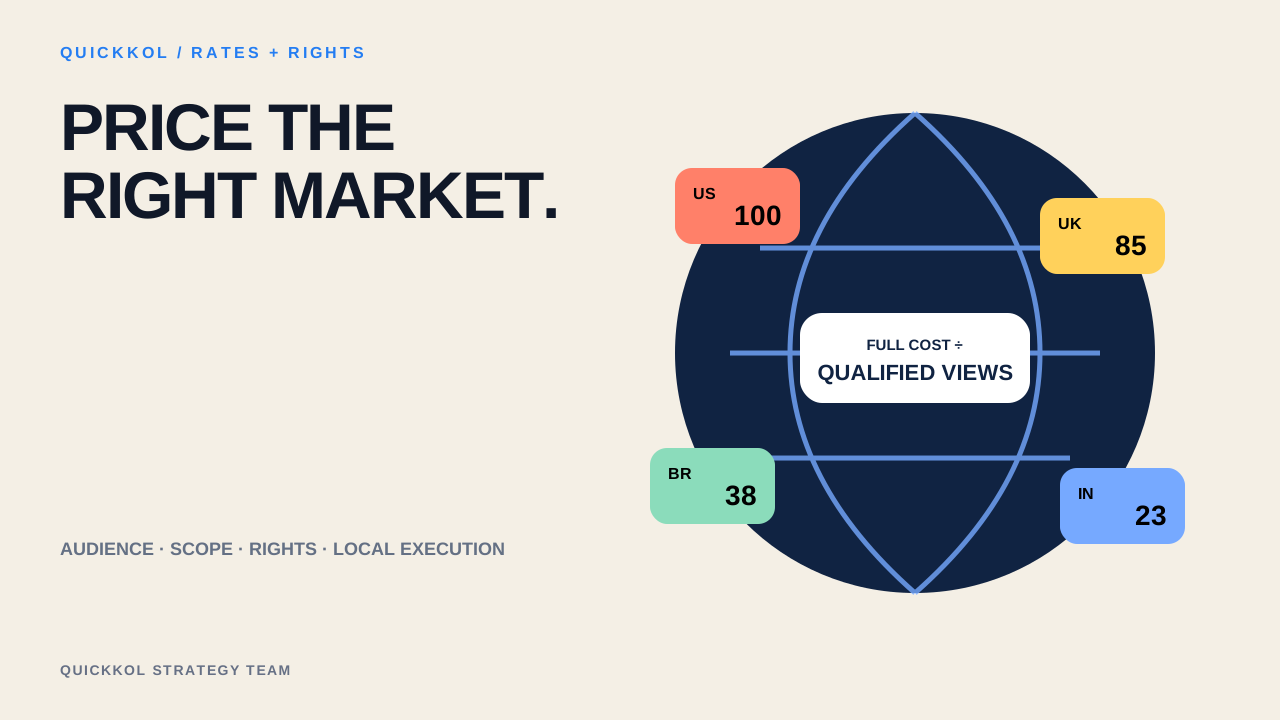
THE SHORT ANSWER
When comparing influencer rates across countries, do not begin with which country is cheapest. Separate creator residence, primary audience geography and the market where the campaign sells. Align deliverables, production difficulty, usage rights, exclusivity, tax, currency and local execution, then calculate qualified-view CPM from target-market views. A country index can frame an inquiry range, but it is not a fixed rate card.
Separate the three countries that teams often mix up
A creator may live in the UK and publish in English without having a mainly UK audience. Record the creator or contracting entity, platform audience geography and the markets where the product can sell and fulfil. Only the overlap between audience and eligible markets directly supports the campaign.
If a US creator receives 70% of views from the target market while a lower-fee creator receives 25%, the nominally cheaper option may need more content to reach the same number of qualified people. Local-market discovery also needs language, comment context, viewing time and fulfilment coverage.
Use country indexes as direction, not a rate card
Public country-rate references can help teams reason about market maturity and inquiry order, but they often mix platforms, creator tiers, categories and scopes. Record publication date, benchmark market, methodology and limitations for every index.
Use the index to create a wide starting range, then send the same brief to five to ten qualified creators. Update the range from real replies and separate creation, publishing, usage rights, exclusivity, travel, product and tax so unlike totals are not compared.
Normalize scope, currency and tax before comparison
A comparison sheet needs currency, FX date, tax treatment, paying entity, deliverables, revisions, publication window, rights term and territory. Exchange rates affect budgets, while procurement friction, cross-border fees, withholding tax and local agency cost may matter more.
Purchasing power parity can describe macro price-level differences but cannot predict an individual creator quote. Audience scarcity, content capability, category demand, availability and negotiation still shape the rate. Price usage rights and exclusivity separately and confirm lawful use in every activation market.
Compare real cost through target-market qualified views
Multiply median recent comparable views by target-market audience share to estimate qualified views. Divide creation, publishing, rights, localization and necessary execution cost by qualified views and multiply by 1,000. This is a scenario measure rather than a final outcome forecast, but it is closer to the campaign job than fee divided by followers.
Keep quality conditions beside the calculation: whether comments come from target users, content fits the use case and disclosure can meet local rules. QuickKOL should retain the quote version, audience-capture date, assumptions and final negotiation outcome in one record so future buying can be calibrated.
Build a range, then calibrate it with real quotes
InfluencerFee uses the United States as a directional index of 100 and lists ranges including the UK at 80–90, Australia 70–80, Germany 65–75, UAE and the Middle East 55–70, Brazil 30–45, India 15–30 and Southeast Asia 10–25. The page also says its estimates are algorithmic and actual pricing varies with niche, audience quality, scope and negotiation. Use the figures to form a hypothesis rather than claim a fixed national rate.
YouTube Advanced Mode can segment audience and performance by geography, supporting a target-market-share input. OECD PPP describes economy-wide price levels and should remain macro context rather than a creator-fee converter. Candidate A may cost 15,500 in total and deliver 60,000 qualified views from 80,000 median views at 75% target share, producing a qualified CPM of 258.33. Candidate B may cost 8,200 and deliver 42,000 qualified views from 120,000 median views at 35% share, producing 195.24. B is lower in this scenario, but content fit, comment quality and disclosure ability still require review.
Country rate index and verification focus
These bands come from one directional index and are only inquiry hypotheses.
| Market | Index vs US | Must verify |
|---|---|---|
| United States | 100 | Target states, audience, rights |
| UK / Australia | 80–90 / 70–80 | Currency, tax, audience geography |
| Germany / France | 65–75 / 60–70 | Language, disclosure, localization |
| UAE and Middle East | 55–70 | Specific country and cultural context |
| Brazil / Mexico | 30–45 / 25–40 | Payment, tax, fulfilment |
| India / Southeast Asia | 15–30 / 10–25 | Platform, city and language differences |
PRACTICAL TOOL
Cross-market creator full-cost calculator
Enter one candidate’s full cost, median recent views and target-market share to calculate comparable qualified-view cost.
Sources and further reading
- 01InfluencerFee: Influencer Pricing by Country 2026
- 02YouTube Help: Tips for Advanced Mode analytics
- 03OECD: Purchasing power parities
External pages can change. Recheck platform rules, contracts and local law before launch.