
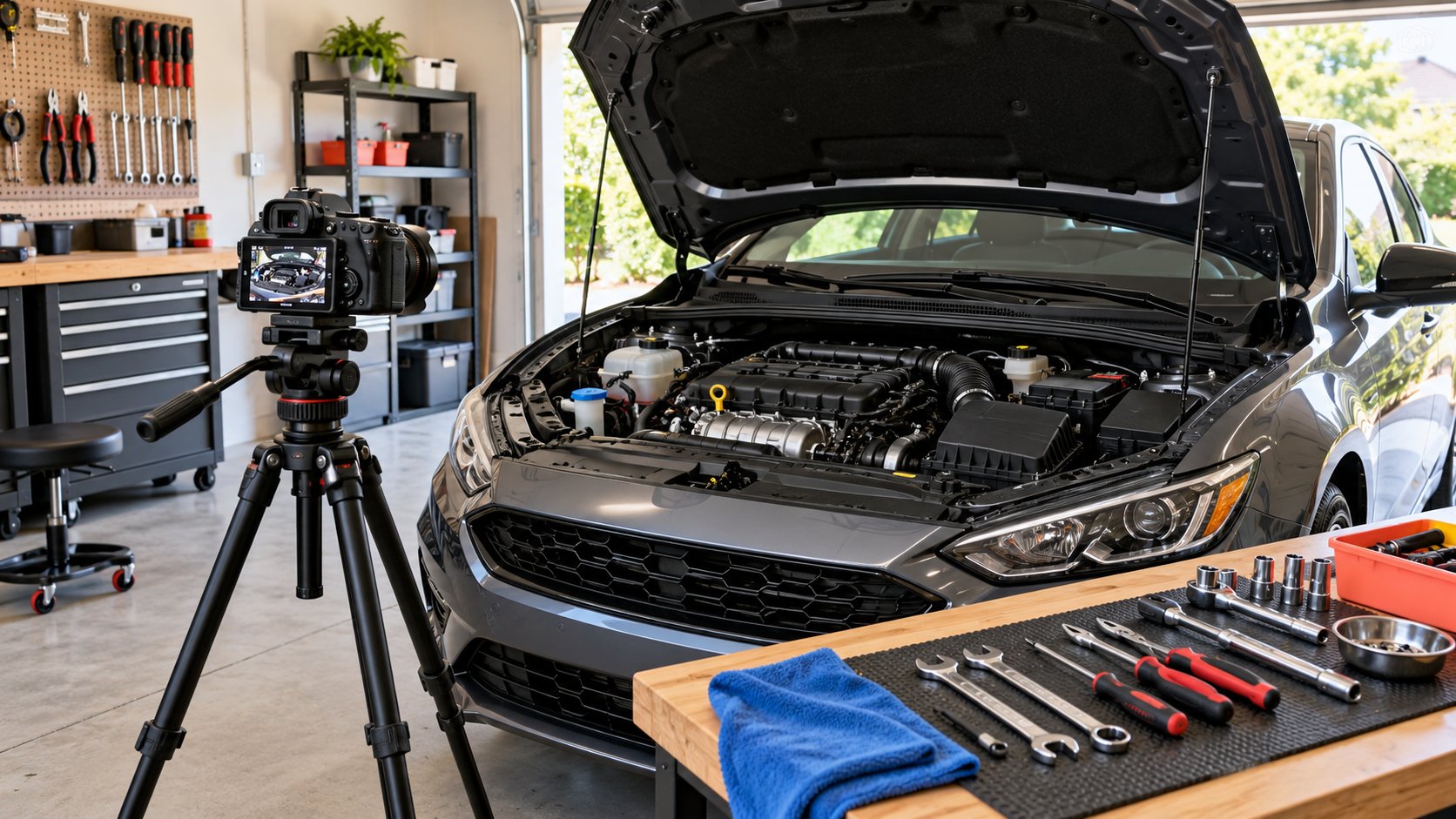
AI-generated editorial illustration; people are not the creators named in this article.
THE SHORT ANSWER
Separate automotive assignments into repair instruction, technical explanation and vehicle or driving content. ChrisFix, Engineering Explained and Throttle House can seed research into those different directions. Actual vehicle compatibility and filming conditions require confirmation. This is a brand procurement guide, not repair advice or a claim that any named channel has been commercially tested. A relevant automotive audience is useful only when the product can be demonstrated accurately within a feasible, agreed scope.
Choose the format from the product and vehicle task
Cleaning products, replacement parts, diagnostic tools, automotive software and a vehicle launch need different demonstrations. Define the vehicle context, market, use situation and customer uncertainty before choosing a format. Compatibility is a prerequisite, not a detail to discover after shipping.
A vehicle reviewer may not be the right partner for an installation tutorial. A repair channel may not provide local test-drive leads. Identify the actual task before comparing account totals. For a product that works across several models, state which version and conditions the demonstration covers so the content does not imply compatibility the brand has never established.
ChrisFix: research the documented DIY direction
ChrisFix’s official site describes automotive DIY and step-by-step demonstrations. That provides a clear starting point for researching how a practical task is explained. The brand still needs current comparable work and confirmation of the actual vehicle, tools and commercial boundaries.
Older statistics on a website should not be treated as current audience scale, and this guide does not use them to rank the channel. An established editorial direction supports research, not a guarantee of product suitability or willingness to collaborate. Study the explanatory job and use it to find other candidates when the scope or commercial conditions do not fit.
Engineering Explained: qualify the explanatory assignment
Engineering Explained’s official channel provides an identity route for technical-content research. A full current-library audit was not performed for this guide. Before buying, inspect videos comparable to the exact product question rather than relying on the channel name as proof of capability.
For a complex performance statement, the brand should provide reviewable evidence and allow the creator to explain limitations. Do not use scientific-looking diagrams as a substitute for substantiation. The proposed assignment might be a principle, a comparison or a real-use trade-off; specify which one is needed. A clear technical brief makes the commercial conversation more useful than a request to make the product “look innovative.”
Throttle House: check vehicle access and production conditions
Throttle House’s official site provides automotive video and track-content routes. Use them to research the format while separately confirming the production team, vehicle access, location, insurance arrangements and commercial terms appropriate to the actual project.
An accessory demonstration may not require the full production footprint of a vehicle feature. Conversely, an assignment involving driving and a venue should not be budgeted as a simple indoor mention. Compare proposals for the same job. The publication’s existence does not establish that every vehicle or location can be supplied within the brand’s launch schedule.
Approve compatibility, facts and rights before filming
Confirm model, version, supported use and evidence for product statements before production. Vehicles, marks, music and other participants in the content can affect later reuse. Permission to publish an organic video is not blanket permission for the brand to advertise in every market.
Separate production, venue, vehicle or equipment access, publication and licensing in the budget. Retain approval for changes rather than treating an additional test as a free revision. The contract scope guide helps distinguish a requested deliverable from optional coverage. Clear boundaries protect an honest demonstration and reduce the risk of paying for a finished asset the brand cannot use as intended.
Measure the appropriate automotive customer path
Parts ecommerce may need qualified product visits and purchases. A local workshop may need bookings. A vehicle launch can involve a longer consideration path. Cost per view across these jobs is not a standardized commercial outcome.
Suppose $3,600 in total cost produces nine hundred recorded specification-page visits: $4 per visit. That hypothetical calculation still needs lead quality or contribution evidence before it supports an economic conclusion. QuickKOL can assist discovery and content reasoning, while the brand tracks the business result. Use the conversion guide to connect the appropriate action rather than forcing every automotive collaboration into an immediate-sales claim.
Worked example: scope an automotive cleaning-product demonstration
Suppose a brand wants to demonstrate an automotive cleaning product. Confirm the supported surfaces, version, instructions and boundaries of any performance statement. The demonstration should not imply compatibility with every vehicle or material. A relevant car channel is only the first selection condition; the actual product use still needs to fit the proposed scene.
Agree on the vehicle, setting and comparison conditions, and identify any extra location or equipment cost. Keep brand-supplied factual information distinct from the creator’s observed experience. A dramatic visual difference should not substitute for supportable evidence or conceal conditions that materially affect the result.
Define what the finished asset needs to explain and what the brand intends to do with it afterward. A product-page clip, a published review and a reusable advertisement can require different scope. This example does not provide a cleaning procedure or make a product-safety claim. It shows the procurement questions that should be answered before production. By resolving compatibility, evidence and usage early, the team reduces the chance of paying for an impressive automotive scene that does not accurately represent the product or cannot be used for the intended campaign.
FAQ: should a creator be required to reach a predetermined verdict?
A brand can require factual accuracy and the agreed demonstration. It should not turn a paid assignment into a requirement for a predetermined favorable verdict. If a performance question must be resolved, establish an appropriate evidence and review process rather than writing the result in advance. The commercial relationship does not make an unsupported conclusion more reliable.
A second question concerns audience geography. An automotive audience is not automatically a pool of local vehicle buyers or workshop customers. Check the actual sales region, product compatibility and customer path. Global video views cannot be converted into local visits by applying an assumed percentage.
A creator may still be valuable for a clearly scoped explanatory asset even when local sales evidence is unavailable. Keep that production value separate from unverified lead generation. The brand can purchase the asset it needs and test distribution through a different route, provided the rights support it. This distinction makes the assignment easier to evaluate and avoids attributing every automotive business outcome to the general popularity of the channel.
Research date, evidence and limitations
Official routes checked October 21, 2026. Current full libraries, quotes and private audiences were not audited. No repair procedure is advised. Cost figures are hypothetical.
Three automotive content jobs
Editorial analysis and labeled hypothetical examples, not performance rankings, quotes or guarantees.
| Job | Verify first | Avoid assuming |
|---|---|---|
| DIY or use tutorial | Vehicle, tools and conditions | Category relevance proves compatibility |
| Technical explanation | Claims, evidence and limits | Scientific appearance proves a claim |
| Vehicle or driving content | Vehicle, venue and scope | Views equal test-drive leads |
CHECKLIST
Before you put this into practice
Record the answers in the campaign working file.
- Define vehicle and version
- Support performance statements
- Separate filming and reuse permission
- Match outcomes to the business path
Sources and further reading
- 01ChrisFix: Automotive DIY content
- 02Engineering Explained: Official YouTube channel
- 03Throttle House: Automotive videos and track content
External pages can change. Recheck platform rules, contracts and local law before launch.