
THE SHORT ANSWER
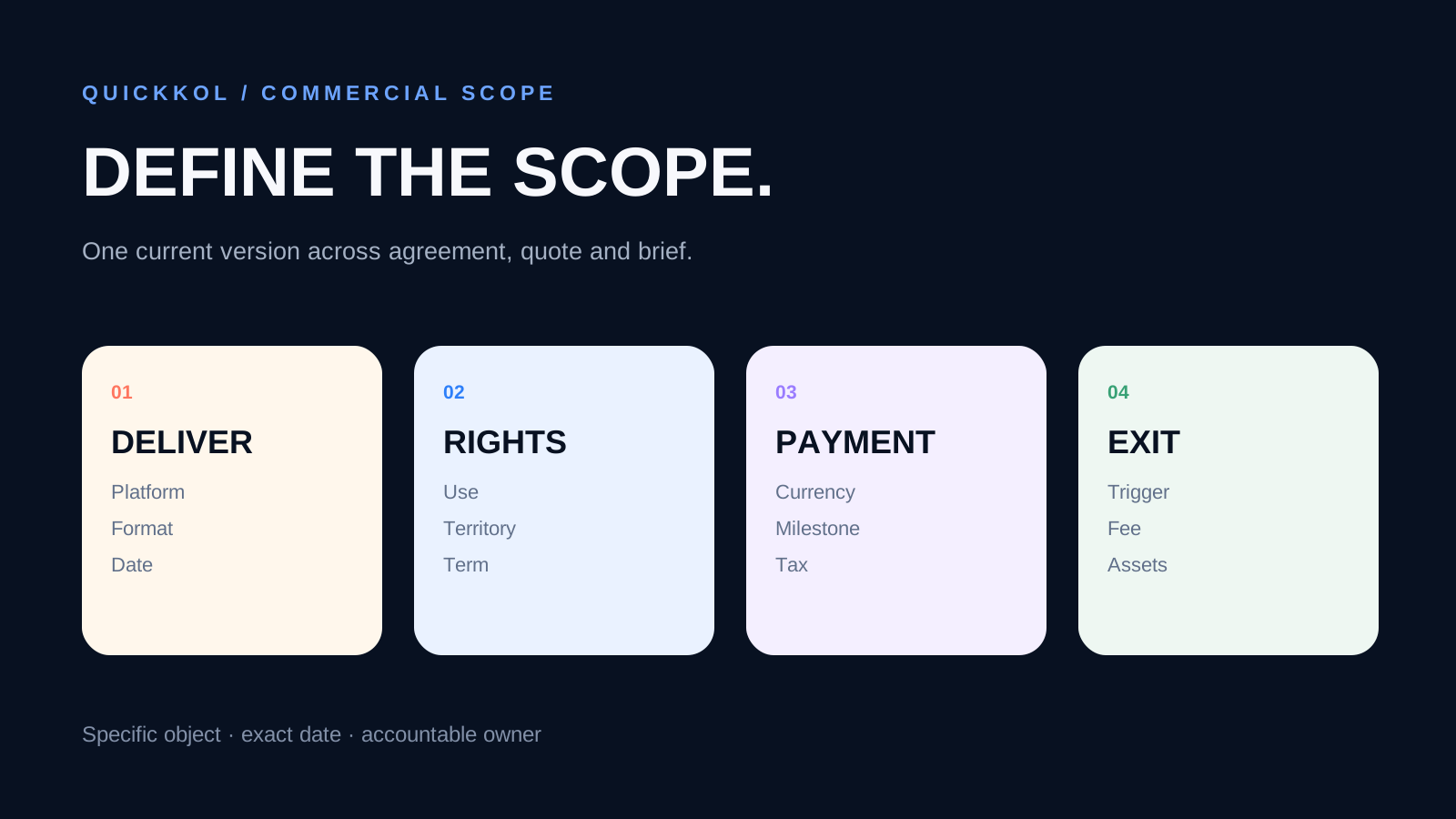
Before signature, campaign, legal, finance and creator teams should confirm ten scope groups: parties, deliverables, timing, review and revisions, fees and tax, payment, usage and amplification, exclusivity, disclosure and claims, cancellation and disputes. Every item needs a defined object, date and owner. When agreement, quote and brief differ, correct the current version before approval rather than relying on scattered email notes.
Define deliverables by platform and file
State platform, account, format, quantity, length range, language, publication time, live period, link or code, and whether subtitles, thumbnail or raw files are included. Live work also needs duration, replay and technical test terms.
“One video” does not define cross-platform versions, cutdowns or brand reposts. Every additional asset should be priced or explicitly excluded.
Define review and revision boundaries
Separate concept confirmation, rough-cut review, factual correction and final approval, including feedback deadlines, included rounds and out-of-scope fees. One brand owner should consolidate comments.
Treat authentic experience and mandatory legal corrections separately. The agreement should not allow unlimited subjective edits or prevent necessary factual and compliance changes.
Define rights by term, territory and use
Organic reposting, website use, retail pages, email, paid ads and amplification from the creator account are different uses. Define assets, allowed edits, territories, start and end dates.
Exclusivity also needs a category, competitor definition and term. Broad restrictions limit other creator income and usually increase price.
Tie payment and cancellation to clear triggers
State currency, tax, invoice requirements, deposit, milestones, payment term and late-payment handling. Product delay, brand cancellation, creator non-delivery, platform removal and force majeure need defined processes.
Keep the signed version, payment milestones, rights expiry and owner in QuickKOL. This operational checklist does not replace local legal advice.
Use a scope matrix across agreement, quote and brief
Create three columns for the agreement, final quote and execution brief. Compare deliverables, timing, fees, revisions, rights, amplification, exclusivity, disclosure, data and cancellation. If an item has three versions, pause approval and assign an owner to resolve it.
If the quote says 30 days of organic reposting, the agreement says perpetual worldwide use and the brief says nothing about rights, the team does not yet share one scope. Platform policies also change; YouTube paid-promotion and brand-deal guidance can inform execution but does not replace the parties’ agreement or local law. This is an operational alignment framework, not legal advice.
Pre-signature scope matrix
Every row needs an object, date and owner.
| Scope | Must define | Owner |
|---|---|---|
| Deliverables | Platform, quantity, format, date | Campaign |
| Fees | Currency, tax, milestones | Finance |
| Rights | Use, territory, term | Legal |
| Review | Stages, rounds, deadlines | Brand |
| Cancellation | Trigger, fee, asset handling | Both parties |
CHECKLIST
Ten checks before signature
Use this concise list for reference.
- Parties and contacts are correct
- Deliverables are complete and countable
- Milestones, time zone and feedback deadlines defined
- Fees, tax and payment align
- Review rounds and extra fees defined
- Rights, amplification and editing defined
- Exclusivity category and term defined
- Disclosure and claims have an owner
- Cancellation, delay and removal addressed
- Agreement, quote and brief share one version
Sources and further reading
External pages can change. Recheck platform rules, contracts and local law before launch.