
THE SHORT ANSWER
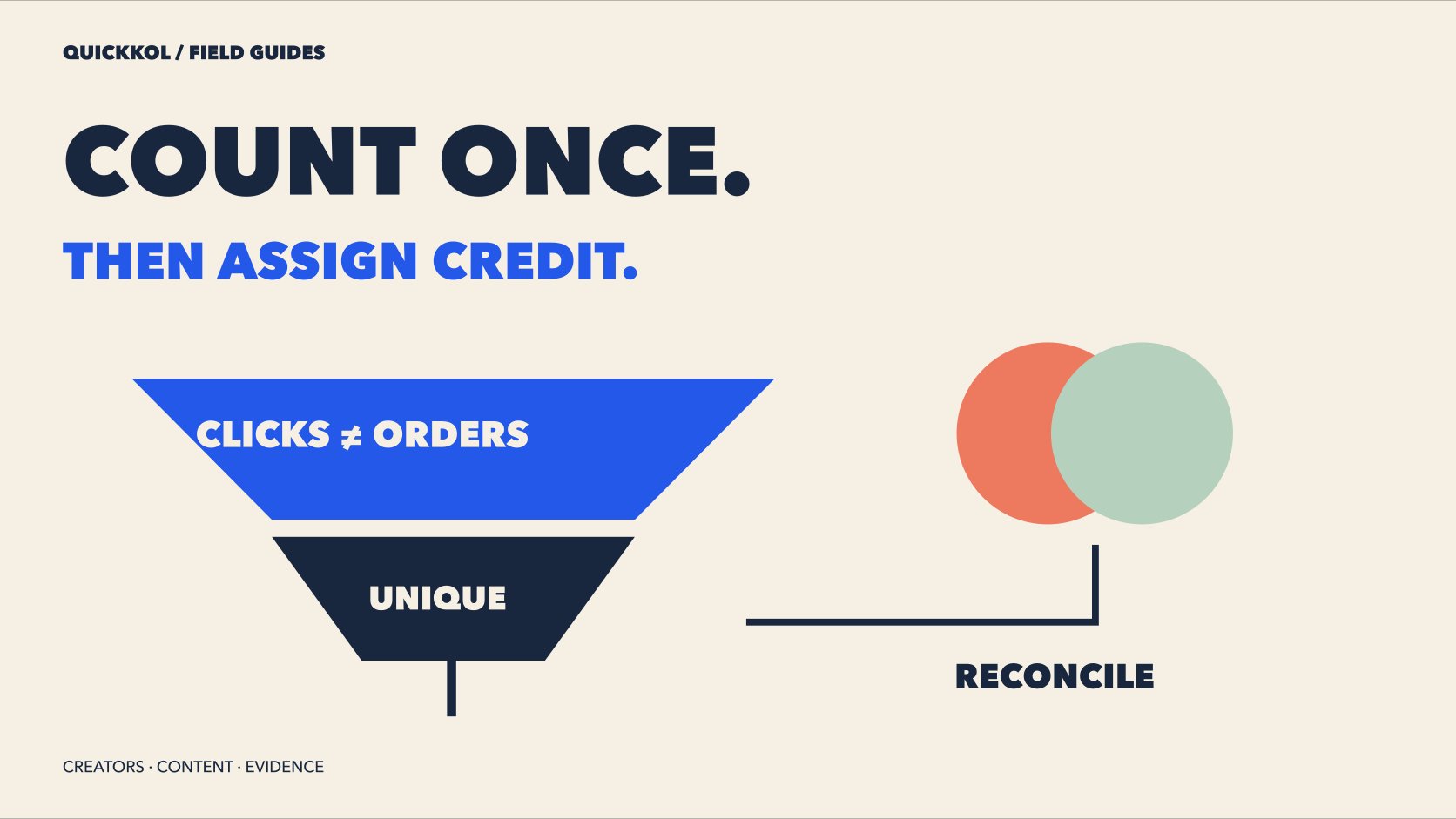
Define the conversion first, then connect content, creator and order identifiers. Use campaign parameters for traffic provenance, transaction IDs for purchase deduplication and explicit rules for discount codes, refunds and reporting windows. Attributed sales are not automatically incremental sales, and ROAS is not profit. Test the complete path before publication. A collection of creator screenshots is not a reconciled conversion system if the same order can be claimed several times or the checkout loses the source.
Define one primary conversion and the system of record
A purchase, booking, qualified lead and download are different events. Establish how the business system records completion, cancellation and refunds before choosing an analytics event. A button click is not a completed purchase merely because it is easy to track.
Use the order system as the settlement reference and analytics to understand traffic and attribution. Fix ownership, currency, timezone and observation window. For a lead program, define what makes a lead qualified and who validates it. This prevents the campaign report from shifting its success definition after launch or confusing a large number of low-quality actions with the commercial result the brand originally bought.
Give creators and assets consistent campaign identifiers
Google Analytics documents UTM parameters for identifying referring campaigns. Standardize source, medium and campaign naming, then use content to distinguish the asset. Keep an internal mapping from creator and asset IDs to the published link.
Use the brand’s existing taxonomy rather than creating new synonyms for a single project. Do not place private contact information in a URL. Prepare the full destination, including the correct product or booking page, and check redirects. A consistent identifier is more valuable than a clever campaign label because it lets the team join reporting, costs and agreements without manually interpreting names each time.
Test the entire path before the creator publishes
Run an authorized test using the final link and intended path. Inspect landing, geography, device behavior, redirects and the event after checkout. Confirm that analytics and the business system can refer to the same test transaction, then handle the test record through the normal process.
A link opening successfully is not an end-to-end measurement test. If the sale occurs on a third-party platform without order-level access, identify that limitation instead of promising complete attribution. Record the result, owner and required fix before publication. This is particularly important when several markets or storefronts route the same visitor differently and a working domestic path conceals a broken destination elsewhere.
Deduplicate purchases before assigning credit
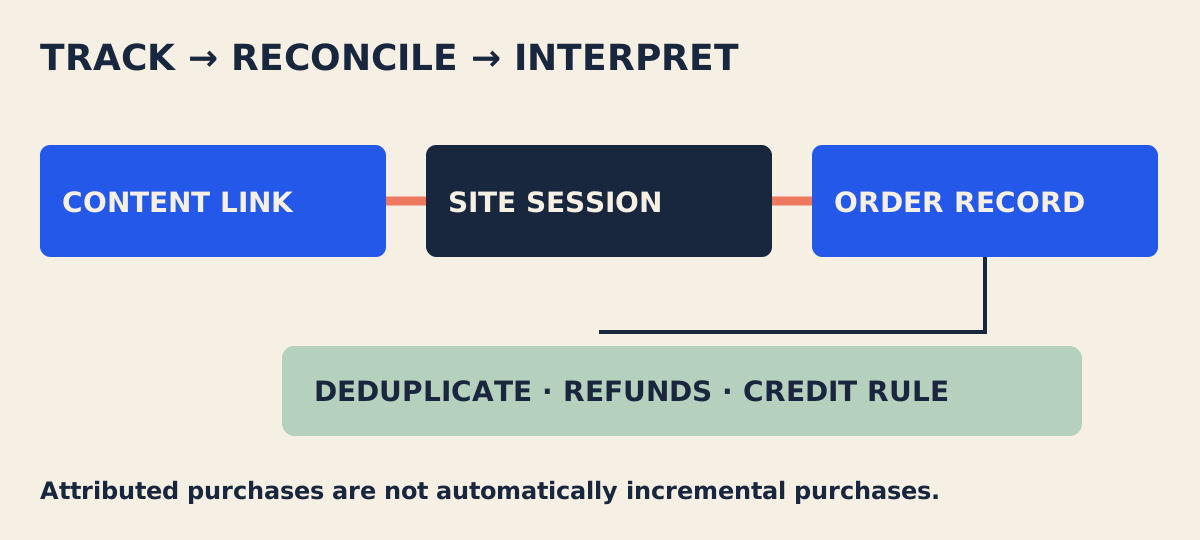
Google Analytics documents transaction IDs for minimizing duplicate purchase events from the same user. The brand should also reconcile its own order identifiers across creator and platform reports. A report row is not necessarily a unique order.
Suppose tracked links claim forty orders and discount codes claim thirty, with twelve shared order IDs. The hypothetical union is fifty-eight orders, not seventy. Deduplication precedes a decision about which touchpoint receives credit. Refunds and cancellations require their own treatment under the campaign’s revenue and commission definitions. Preserve the overlap rather than hiding it by selecting whichever report produces the larger result.
Define attribution and code conflicts before payout
A discount code can be shared or appear on a coupon site. Code use does not establish exposure to the original creator post. Define what happens when a link and code point to different partners before commissions are due. Retain analytical views of both signals even when settlement follows one agreed rule.
Google Analytics attribution assigns credit among touchpoints. It does not establish that every credited order would otherwise have been absent. Keep settlement, channel reporting and incrementality analysis clearly named. A coherent rule is better than negotiating attribution after a successful sale, when every participant has an incentive to claim the same outcome.
Separate revenue efficiency, contribution and the next test
Suppose reconciled net revenue is $6,000 and creator plus operating cost is $3,000. Revenue divided by that cost is two. If contribution after product, payment and fulfillment costs is forty percent, contribution is $2,400; subtracting marketing cost leaves negative $600. These are hypothetical economics, not a client case study.
Identify the limiting stage before changing audience, content, offer or landing page. A campaign can have attractive revenue efficiency and still lose contribution. QuickKOL can support discovery and outreach preparation, but this article promises no unverified direct GA4 integration. Preserve the measurement plan independently so product choices do not change the meaning of a conversion.
Worked example: reconcile visits, purchases and refunds
Suppose a campaign link has four hundred recorded visits and twenty associated orders appear in the order system. Two orders are canceled and three are refunded. Preserve the original order records and status history, then apply the reporting definition agreed before launch. Do not rename twenty gross associated orders as twenty net new customers.
A discount code can be shared beyond the creator’s audience. A viewer may also purchase later without using the link or code. Keep those routes distinct and define how overlaps are reconciled instead of adding their totals. A transaction identifier helps connect records, but the team still needs a rule for the population and status being reported.
If revenue is the decision criterion, specify gross versus net revenue and the treatment of discounts, refunds and relevant costs. If customer acquisition is the criterion, establish whether the buyer is new under the brand’s definition. This hypothetical reconciliation does not solve every attribution limitation. It prevents a common reporting error: letting a convenient tracking label silently change an observed event into a stronger commercial claim than the evidence supports.
FAQ: what should happen to purchases that cannot be tracked?
Record the measurement gap rather than applying an arbitrary multiplier to fill it. An optional source survey or another research method may add context, but state its sample and limitations. Do not attribute all growth during the publication period to creators simply because the campaign was active at the same time.
If the question concerns incremental sales, consider whether an appropriate comparison or experiment is feasible. Attribution reports describe a rule for assigning credit; they do not automatically show what would have happened without the campaign. A small program may not generate enough evidence for a precise causal estimate, and that limitation should remain visible.
The practical decision is whether the available evidence and full cost justify another scoped test. A team can improve tagging, destination continuity or order reconciliation before increasing spend. It can also decide that a particular content asset is useful while its sales contribution remains uncertain. Keeping those conclusions separate makes the report more useful than forcing a single return figure that combines observed purchases, inferred purchases and unexplained assumptions.
Research date, evidence and limitations
Official documentation checked October 21, 2026. Orders, revenue and costs are hypothetical. No brand analytics or order system was accessed and no live implementation is claimed.
Four numbers that should not all be called ROI
Editorial analysis and labeled hypothetical examples, not performance rankings, quotes or guarantees.
| Metric | Purpose | Does not prove |
|---|---|---|
| Sessions | Traffic provenance | Purchase completion |
| Unique orders | Transaction reconciliation | All were incremental |
| Revenue efficiency | Net revenue over defined cost | Profit |
| Incrementality | Additional outcome versus a counterfactual | Established by code use alone |
CHECKLIST
Before you put this into practice
Record the answers in the campaign working file.
- Align conversions with the business system
- Test the full path before launch
- Define order deduplication
- Agree on refunds and commission conflicts
Sources and further reading
- 01Google Analytics: Campaign URL parameters
- 02Google Analytics: Transaction-ID deduplication
- 03Google Analytics: Attribution models
External pages can change. Recheck platform rules, contracts and local law before launch.