
THE SHORT ANSWER
A brand ambassador management platform should expose current commitments, historical changes, expiring permissions and next owners. Unlike a recruitment entry point, it must make long relationships traceable, adjustable and closable. Test renewal, role changes and exit as well as onboarding.
Separate member identity from each engagement
A member may hold an ongoing role while quarterly deliverables, fees and rights change. Keep identity and preferences in a member record and scope, approval date and agreement version in each engagement. A new quote should not rewrite historical delivery costs, and exit should not delete history.
Link accounts and engagements through a stable ID, retaining source evidence and approval before identity merges. Keep namesakes separate. Preserve selection reasoning as candidates enter management so a successor inherits relationship context rather than handles alone.
Test management through a renewal demonstration
Aspire ambassador program guidance presents contact organization and long-term tracking. Test active, paused, renewal-pending and exited members. Inspect role visibility and whether changing one member accidentally changes unrelated engagements. A status field alone does not establish reliable management.
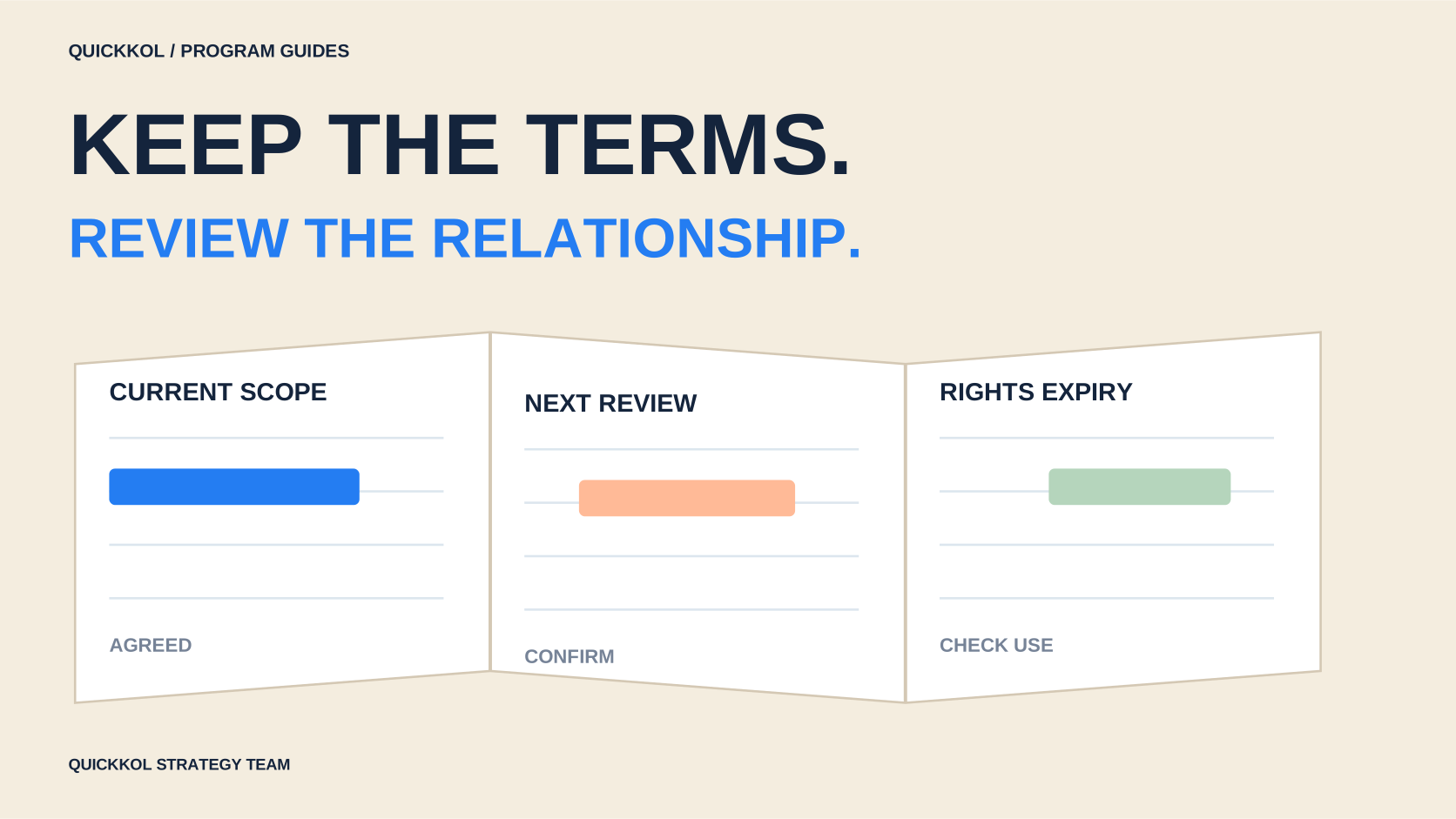
Retain separate review and rights-expiry dates: one supports relationship decisions, the other governs asset use. Preserve QuickKOL outreach and selection records at handoff, while the contract and relationship owner confirms renewal rather than treating a score as authorization.
Map commitments to capacity and ownership
Fifteen members submitting two assets monthly create thirty assets. Twelve minutes per first review requires six hours, excluding later rounds. Check review, feedback and payment capacity before expansion rather than budget alone. Record delayed or conflicting brand feedback as well as creator rework.
Stagger delivery by launch wave and assign exception owners and next checks. Retain reasons for absence, stockouts and scope changes. Clear IDs and states may outperform elaborate automation; automate reminders only after rules are stable.
Give finance a distinct transaction identity
Tipalti payee-management guidance uses unique payee IDs and payment details, illustrating why social handles alone cannot reconcile finance. A renamed account should not redirect invoices, and a partnership ID should connect fees, milestones and transaction states. Verify actual integration fields.
Marketing needs payment blockers, not necessarily full bank details. Separate visible states from sensitive access. Retain commission holding rules and relevant orders. Approved, sent and received payments should not all be labeled paid, since they describe different progress.
Reconcile assets, representation and open payments on exit
Exit may pause new tasks, close invitation links, update website representation and review active assets under the agreement. Non-renewal does not automatically cancel payment for completed work; final payment does not create perpetual rights.
Retain the reason, notice date, remaining obligations and owners. A pause needs a review condition so automation does not continue invitations or follow-ups. Test exports of history and current commitments. Contact-only exports are insufficient for handing over a long-running program.
Measure reliable handoffs rather than logins
Review ten members for retrievable scope changes, next actions and payment blockers. This working sample cannot establish database-wide accuracy. Expand checks for conflicting record types and identify the authoritative version instead of allowing silent overwrites.
Assess repeated questions, missed permissions, rework and handoff time. A larger roster that still requires rebuilding context each cycle lacks a functioning management chain. Retire obsolete automation and retain unknowns and historical versions so long-term relationships accumulate useful context rather than repeated mistakes.
Evidence and calculations
Counts and review times are working examples. Official ambassador and payee sources were checked October 15, 2026; no direct integration between those products is implied. Verify access, exit and payment obligations against actual software, agreements and responsibilities.
Four management states for ambassador relationships
Relationship states do not automatically determine finance or rights.
| Decision area | What to verify | Action or boundary |
|---|---|---|
| Active engagement | Current scope, fees and permissions | Continue agreed work |
| Renewal pending | Review evidence and expiring items | Owner confirms the next scope |
| Temporarily paused | Reason, obligations and review condition | Pause unsuitable automation |
| Exited relationship | History, assets and unsettled payments | Stop new work; fulfill existing obligations |
CHECKLIST
Renewal and exit acceptance checks
Use these numbered checks with evidence and ownership in your working records.
- Separate identity from engagement commitments
- Retain scope-change history
- Separate review and rights-expiry reminders
- Separate payment visibility and sensitive access
- Retain obligations and owners after exit
- Ensure exports support a successor
Sources and further reading
External pages can change. Recheck platform rules, contracts and local law before launch.