
THE SHORT ANSWER
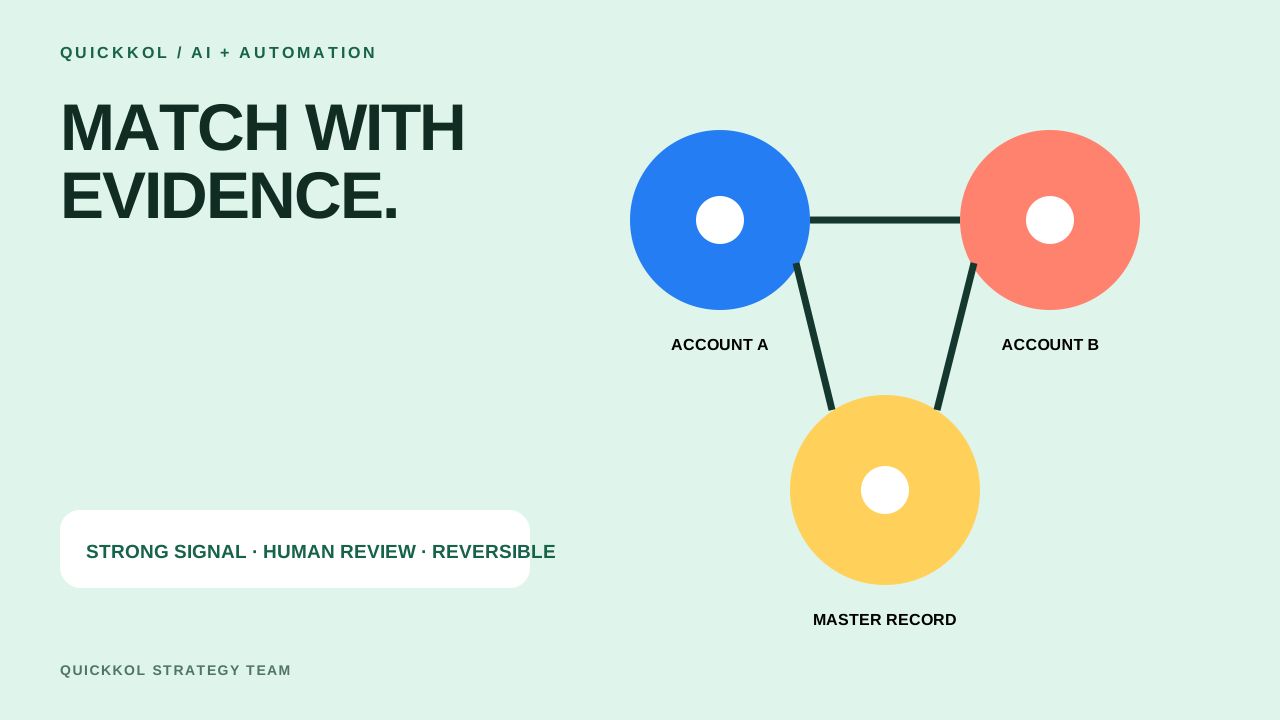
Creator identity deduplication cannot rely on display name. Preserve platform and stable account ID, then normalize profile URL, username, public email, site and self-links. Auto-cluster only strong combinations such as mutual links plus the same public business email. Similar avatars, names or bios trigger human review. Every merge keeps source, confidence and rollback history.
Normalize account-level fields first
For every platform save platform, account_id, canonical_url, handle, display_name, business_contact and captured_at. Remove URL tracking, normalize domains and handle case, while preserving raw values.
Display names and handles change and are not permanent keys. Historical snapshots help detect account transfer or renaming.
Build match rules by evidence strength
Strong evidence includes mutual links, one official site listing both accounts, the same public business email and consistent self-identification. Medium evidence includes name, city, content and face; weak evidence includes avatar or similar bio.
Automatic merge needs at least one strong signal and no material conflict. Multiple weak signals enter human review rather than AI guessing.
Preserve conflict and uncertainty explicitly
Same names, shared agency email, team accounts and brand accounts create false merges. When geography, self-identification or ownership conflicts, preserve conflict field and evidence date rather than overwriting by majority.
A master profile can contain confirmed, possible and excluded relationships. Search and outreach use confirmed accounts by default.
Audit merge and missed-match quality
Sample automatic clusters for false merges and unmerged records for missed matches. Reviewing clusters alone hides duplicate records that remain separate.
Every human split records error cause and updates rules. QuickKOL versions identity clusters so campaign history remains intact when the master record changes.
Identity deduplication is evidence-backed merging, not name matching
One creator may use different platform names, agency email, language and company entity, while different creators may share similar names. AI can propose matches, but high-impact merges preserve features, confidence and human confirmation. NIST AI RMF emphasizes governing and measuring risk; here that means the system explains why two records may match and supports reversal.
Weight strong identifiers such as mutually linked official accounts, the same public business email, agency confirmation or shared website. Similar faces, names and topics are weak signals. Two strong and two weak signals may enter human confirmation; weak signals alone remain separate. Preserve source records, conflicts and master-record choice during merge so rates or opt-out requests are not lost.
Creator identity match evidence
High-impact merges need at least one strong signal and human review.
| Signal | Strength | Handling |
|---|---|---|
| Mutual account links | Strong | Verify public pages |
| Business email or agency confirmation | Strong | Keep source and date |
| Similar name, image, topic | Weak | Candidate only |
| Field conflict | Risk | Pause auto-merge |
CHECKLIST
Before merging creator identities
Every merge should be explainable, traceable and reversible.
- At least one strong identity signal
- Public source and date are saved
- Image is not the sole basis
- Email, rates and opt-out state are compared
- Conflicts go to human review
- Master record choice has a reason
- Source records remain traceable
- An incorrect merge can be reversed
Sources and further reading
External pages can change. Recheck platform rules, contracts and local law before launch.