
THE SHORT ANSWER
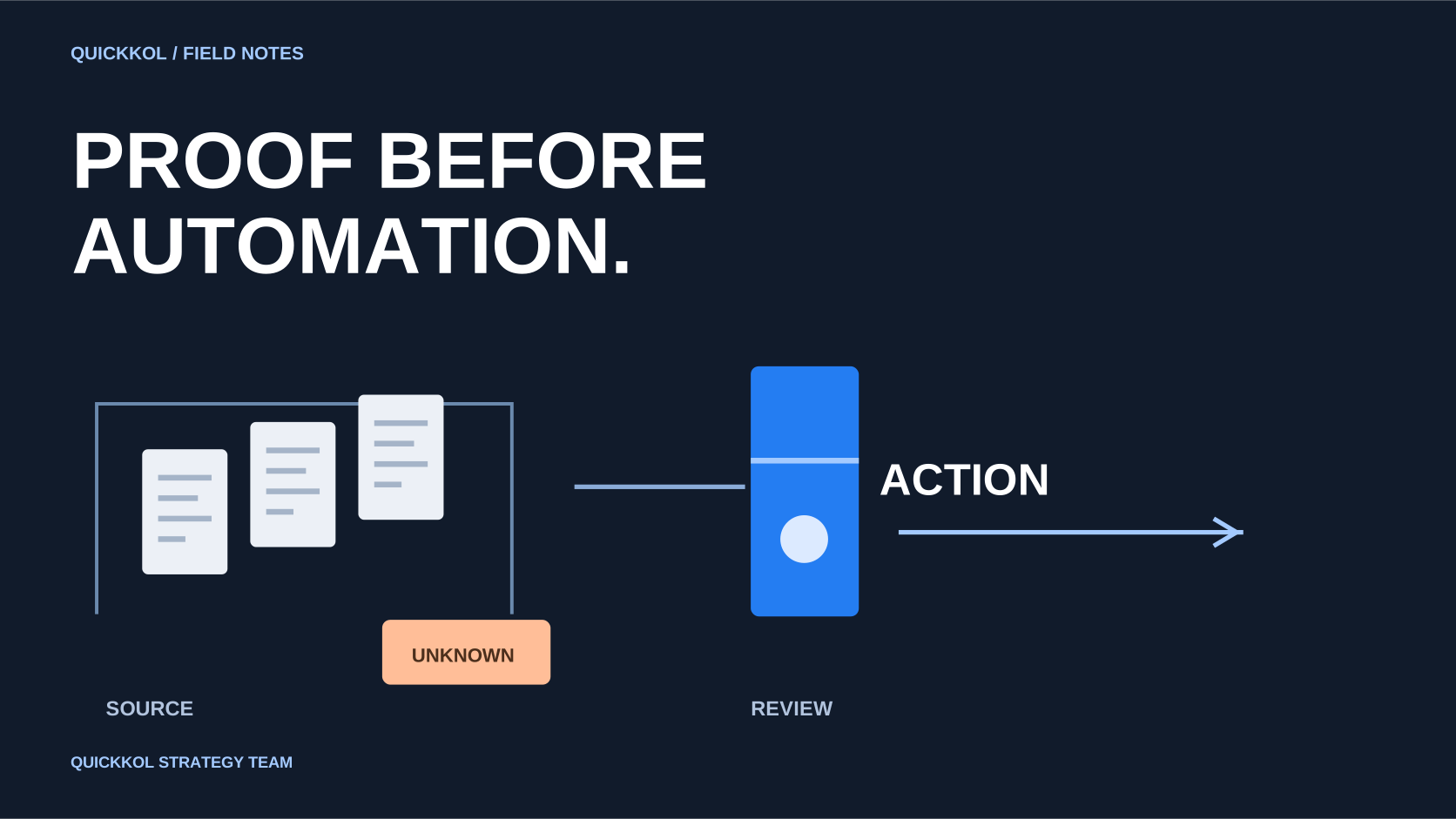
An AI influencer marketing platform should show original evidence, unresolved information and approval ownership. Natural-language search, scores and generated messages do not establish reliable decisions. Test a real task with exceptions and automate only steps whose evidence and permissions are clear.
Separate discovery, judgment and action
Discovery translates a need into search; judgment explains fit; action sends messages, changes states or commits resources. Each needs different evidence and permissions. A conversational interface does not establish autonomous campaign management. Ask which outputs are drafts and which change external state.
Aspire campaign management also presents natural-language AI discovery. That confirms a advertised capability, not recommendation accuracy. Apply the same source and approval checks to QuickKOL. Compare the working chain rather than model names, response length or impressive demonstration wording.
Separate evidence, interpretation and unknowns
A recommendation should retain original links, observation dates, relevant excerpts and a concrete explanation. A claim that someone explains sensitive-skin products needs supporting content, not merely a beauty label. Mark purchasing power, willingness and rates unknown when evidence is absent.
Open the original content before checking whether the summary omits limitations or mistakes sponsor language for personal experience. Request reasons against fit as well as reasons for it. Scores can order review queues, but should not hide incompatible platforms, periods and estimates inside an unexplained total.
Evaluate with an exception-rich test set
Prepare thirty anonymized records with duplicate identities, stale data, namesakes, multilingual content and opt-outs. Establish a human reference judgment before running the same task through the product. Track missed relevant candidates, incorrect inclusions and unverifiable reasoning separately.
Six issues in thirty records gives a 20% sample issue rate; one wrong-person contact risk may block action. An intentionally exception-rich set cannot estimate the whole database’s error rate. Investigate mechanisms and expand relevant reviews rather than advertising the remainder as model accuracy.
Include governance in actual operation
The NIST AI Risk Management Framework offers voluntary risk-management guidance, not an accuracy certification for a marketing product. Applied here, it suggests documenting use cases, failure consequences, ownership and monitoring. This guide’s acceptance checks do not constitute NIST review or certification.
External sending, identity merging, payment changes and rights permissions need explicit action controls. Unknowns do not become facts because a screen reports success. Test pause, draft withdrawal and human handoff paths alongside successful demonstrations.
Detect stale data and changing permissions
Distinguish source, collection date, reporting window and access conditions for important fields. A refreshed follower count does not establish refreshed demographics. Deleted videos, renamed accounts and withdrawn authorization may invalidate old recommendations. Public-only access should remain explicit.
YouTube Advanced Mode requires appropriate account access, illustrating why native data and external estimates need separate treatment. Demonstrate stale-evidence warnings, missing links and blocked actions. Retain the evidence and reasoning used at the decision date for later review.
Adopt based on reviewable operating benefits
Measure search, organization, review and correction separately while checking evidence completeness. Saving two hours of organization while adding three hours of verification increases total work. Faster output also cannot compensate for weaker fit. These are illustrative hours; observe real repeated tasks.
Begin with bounded, low-risk work such as formatting and missing-field prompts. Recheck the fixed evaluation set after model or search changes. A sustainable AI product should make facts and responsibility easier to explain, not simply generate untraceable answers faster.
Evidence and scope
This acceptance method draws on official product and risk guidance checked on October 14, 2026; it is not an independent model benchmark. Sample rates and hours are examples. Exception-rich samples cannot establish overall error rates, and NIST does not endorse this guide or product.
Evidence and action boundaries for AI workflows
Controls should describe concrete actions; having AI does not authorize automation.
| What to inspect | Evidence needed | Decision supported |
|---|---|---|
| Candidate discovery | Query, original links and date | Review relevance |
| Recommendation reasoning | Supporting excerpts and unknowns | Retain reasons against fit |
| Outreach preparation | Sources, contact states and draft | Require sending approval |
| Subsequent actions | Permissions, logs and blockers | Bound automation by risk |
PRACTICAL TOOL
AI acceptance-sample check
Issue rates describe the reviewed sample. Exception-selected samples cannot estimate the whole population; pause affected actions when blocking issues exist.
Sources and further reading
External pages can change. Recheck platform rules, contracts and local law before launch.