
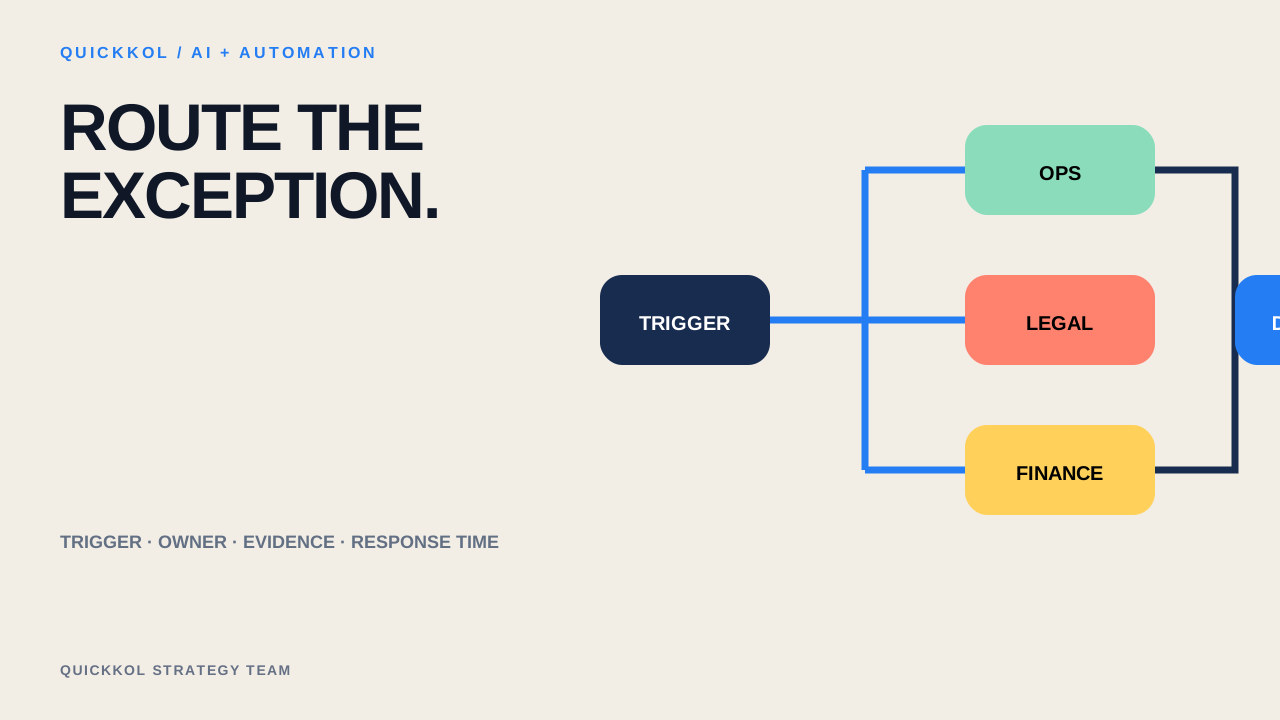
THE SHORT ANSWER
AI should not continue on a best-effort basis when exceptions occur. Define machine-detectable triggers and human owners for missing data, identity conflict, duplicate outreach, budget overrun, unclear rights, claim risk, publication delay and safety incidents. An exception record includes object, time, evidence, severity, paused action, owner and deadline. Automation resumes only after explicit recovery criteria are met.
Classify exceptions by risk source
Data includes missing, stale or conflicting fields; relationship includes duplicates, stop requests and agency authority; commercial covers budget, quote and payment; content covers claim, disclosure and version; operations covers logistics, timing and publication.
Category assigns ownership but not severity. A stale phone number may be low risk, while stale rights expiry may immediately block advertising.
Give triggers evidence and thresholds
“Possible issue” cannot be routed. Use observable conditions such as forecast budget above approval by 5%, a second outreach to the same creator within 14 days, or ad scheduling within seven days of rights expiry.
Every trigger includes source, current value, threshold, time and affected object. AI may suggest severity; designated owners confirm higher-risk decisions.
Pause only affected actions
Unclear rights can pause one asset without stopping the entire campaign; identity conflict can block outreach while internal research continues. Define pause scope so a small issue does not freeze everything.
Safety, privacy or consumer risk can justify broader pauses. Predefine notification channel and response SLA for each severity.
Close exceptions with recovery criteria
“Handled” is not closure. Require completed data, authorized conflict resolution, renewed budget approval, updated rights evidence or approved content version, with proof.
Beyond exception count, monitor recurrence, resolution time, false positives and misses. QuickKOL feeds common exceptions back into briefs, data sources and automation boundaries.
Automation handles the normal path; exceptions need routing
Creator campaign exceptions include out-of-range quotes, rights conflicts, missing disclosure, invalid payment data, risky claims, delay and opt-out. NIST AI RMF governance maps to four operating requirements: who owns the rule, what triggers it, who decides and how the decision is recorded and reviewed.
Automation may return an invoice missing a purchase-order number, but a paying entity different from the contract should pause payment and route to finance and the project owner. Give every exception a severity, response time, required evidence and backup owner. If one rule triggers 40 times in 30 days, the process or form may be broken; adding more reviewers is not the only answer. QuickKOL preserves trigger, decision, override and close reason.
Campaign exception routing table
Every automated action needs a stop and human takeover condition.
| Exception | Automated action | Human owner |
|---|---|---|
| Missing information | Return with named field | Operations |
| Scope conflict | Pause next step | Project lead |
| Compliance or claim risk | Block publication | Specialist |
| Payment identity mismatch | Pause payment | Finance and project |
CHECKLIST
Before an exception rule goes live
Use ten checks for controllable automation.
- Trigger can be explained by the team
- Normal and exception paths are separated
- Severity and response time are defined
- Owner and backup are assigned
- Required evidence is explicit
- High-impact actions require human approval
- Creator receives a clear explanation
- Overrides and reversals are logged
- Rule has false-positive and false-negative review
- A 30-day rule review is scheduled
Sources and further reading
External pages can change. Recheck platform rules, contracts and local law before launch.