
THE SHORT ANSWER
An influencer payment platform should connect the correct payee, agreed amount, approval, sending and receipt evidence with clear fee responsibility. Confirm countries, currencies, payment types and actual charges, then test failures, returns and changes. Bulk sending does not establish settlement or reconciliation.
Identify the obligation being paid
Fixed production, commission, expenses and licensing may need different evidence and timing. Retain partnership ID, scope, currency and milestone rather than one undifferentiated creator expense. An earned production payment should not silently depend on an unrelated sales target.
Verify agreement and fulfillment before authorized approval. Equal amounts may represent two milestones rather than duplicates, while two handles may belong to one payee. Finance needs evidence beyond social names or marketing labels.
Prioritize stable payee identity
Tipalti payee-management guidance describes unique payee IDs, related information and payment-management workflows. Use that to design acceptance tests while confirming countries, currencies, methods and fees. Imported email does not establish verified identity, payment access or complete information.
Verify changes through finance and retain dates and approvers. Marketing needs blockers and owners rather than full bank details. Passing a QuickKOL partnership record ID to finance can preserve scope, without implying QuickKOL performs fund settlement.
Separate approval, sending and receipt
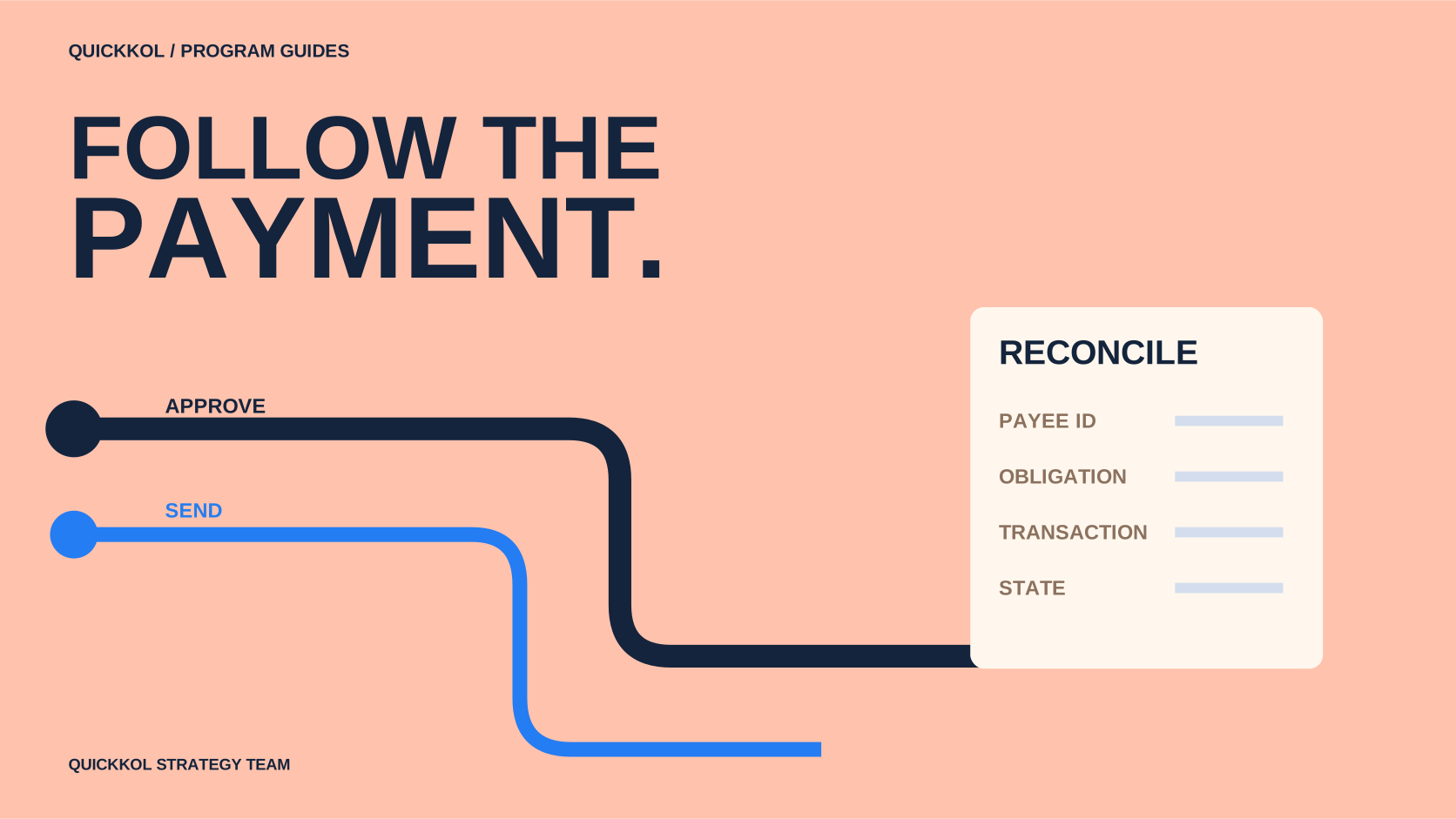
A payment may await approval, be submitted, processing, failed, returned or settled; verify the provider’s states. Distinguish internal actions from payment-service evidence. Sending is not receipt, and an absent confirmation should not become permanent completion.
Assign missing-information contact, retry authority and duplicate prevention. Give creators understandable progress and a next check without promising an unverified arrival date. Exceptions reveal suitability for recurring work better than a successful demonstration alone.
Check commission holds and fee bases
Collabs payment documentation describes a default thirty-day commission hold, adjustable within its stated settings, with billing and creator activation conditions afterwards. This is not a universal term for production fees; explain the actual product workflow.
The same guidance applies 2.9% processing to automatic commission payments. Commission of 5,000 creates a base fee of 145, not 2.9% of all associated sales. Confirm conversion and other charges separately. A zero-fee claim still needs thresholds, conditions and responsibility.
Compare payment overhead on an explicit basis
The calculator applies processing and FX scenario percentages to the entered principal, adds a fixed fee and assumes the brand pays these costs separately. On 5,000 principal, 2.9% processing, a fixed fee of two and 1% FX scenario, overhead is 197 and payer outflow is 5,197.
This simplified model excludes sequential conversion, recipient deductions and tax. Different charge bases require recalculation from the provider quote. Do not deduct every fee from agreed creator income for convenience; confirm fee responsibility before settlement.
Reconcile transactions and preserve portability
Map provider transaction IDs, applicable confirmations, partnership IDs and accounting states. Retain return and dispute reasons instead of overwriting earlier attempts. Exports should support amount, currency and duplicate checks with appropriate access.
Test failure, payee changes and a partially due obligation, including recovery and support ownership. Document coverage, costs, timing conditions and manual work separately. Good payment software reduces uncertainty and chasing while explaining where funds are, rather than only accelerating initiation.
Evidence and calculations
Official sources were checked October 15, 2026. Thirty days and 2.9% are product-specific, not universal. The outflow example assumes payer-borne fees. This guide does not execute payments or determine local tax treatment.
Four things payment software must explain
Verify countries, currencies, timing and fees with the actual provider and agreement.
| Decision area | What to verify | Action or boundary |
|---|---|---|
| Payee | Verified identity, ID and changes | Prevent misdirected obligations |
| Obligation | Scope, milestone and approval evidence | Pay under agreed terms |
| Fee responsibility | Percentage basis, fixed fee and FX | Agree principal and outflow definitions |
| Current progress | Internal states and transaction evidence | Sending is not receipt |
PRACTICAL TOOL
Payer payment-overhead calculator
Percentages use the same-currency principal and assume payer-borne fees. This is not a provider quote or FX promise.
Sources and further reading
External pages can change. Recheck platform rules, contracts and local law before launch.