
THE SHORT ANSWER
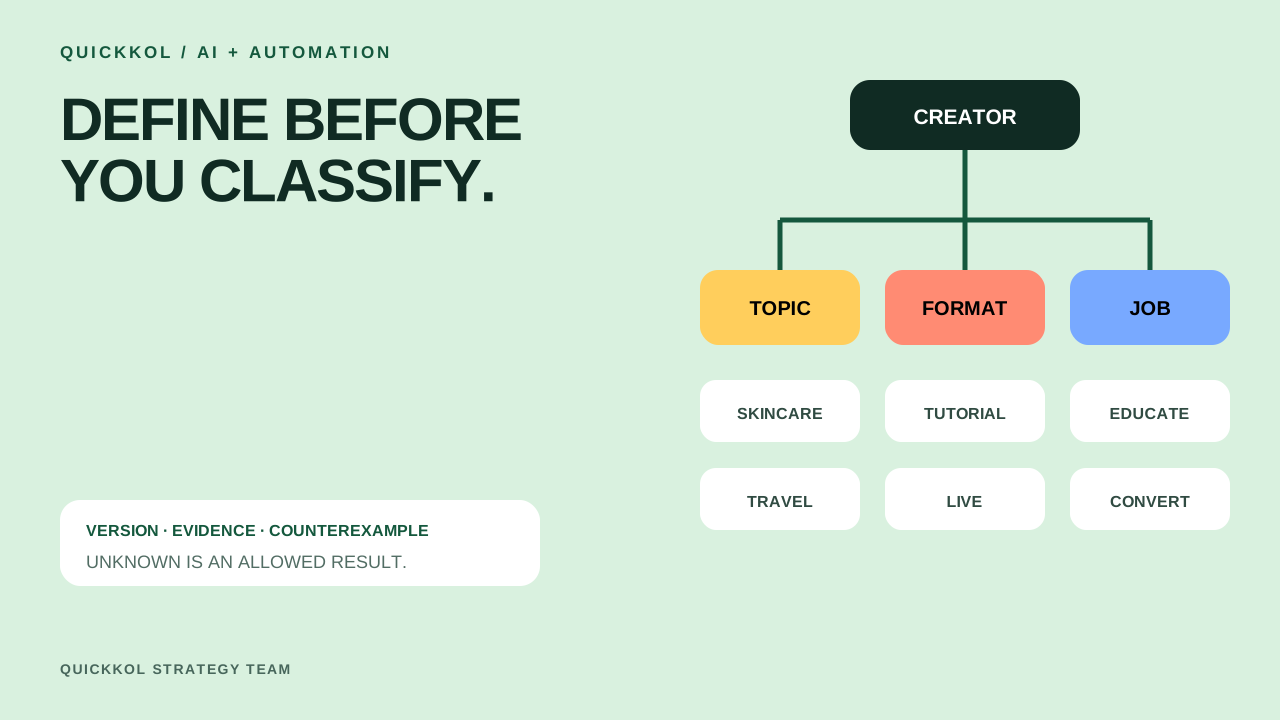
A taxonomy serves business decisions before AI. Every dimension needs name, definition, inclusion, exclusion, examples, counterexamples and an allowed unknown. Use one primary theme and optional secondary tags; keep format, market, language, content job and risk separate so one label does not express several things. Have two people independently classify 50 samples, resolve disagreements and then evaluate AI. The model must return unknown rather than guess.
Start from real search and reporting questions
Collect common requests such as “UK sensitive-skin tutorial creators” or “B2B explainers who can license assets.” Split each condition into separate dimensions.
If a tag cannot change search, grouping, outreach or reporting, it may not be worth maintaining. Avoid dozens of unused fields.
Keep primary categories exclusive and tags flexible
Primary themes support reporting and should be mostly exclusive; formats and secondary themes can be multi-select. When direction changes, save the effective date instead of overwriting history.
“Beauty creator” and “short-form creator” belong to different dimensions and should not compete in one hierarchy.
Write counterexamples for every label
Examples show inclusion; counterexamples reveal boundaries. A review is more than packaging-only unboxing, and a tutorial needs steps a viewer can follow.
Consistency becomes meaningful only when boundaries are clear. Label names alone invite the model to extend them from general assumptions.
Continuously measure classification disagreement
Sample new records monthly and compare AI to human and human to human. Classify disagreement as unclear definition, insufficient content, model error or genuine ambiguity.
NIST AI RMF emphasizes ongoing governance, measurement and management. Save taxonomy version and human changes in QuickKOL so search results remain traceable.
A taxonomy needs versions, definitions and counterexamples
AI classification can freeze a creator into one permanent label. Separate content topic, format, audience problem, commercial job and risk status. Give every field a definition, positive example, counterexample, evidence window and confidence. NIST AI RMF’s Govern, Map, Measure and Manage structure emphasizes use context, measurement and ongoing risk management; the taxonomy likewise needs an owner and review cycle.
Double-label a sample of 40 from 200 accounts. If reviewers agree on 32 “tutorial” labels and disagree on eight, simple agreement is 80%. Review definitions and edge cases before scaling automation. Do not substitute follower count for missing topic evidence or let generated labels overwrite human-confirmed fields.
Creator taxonomy layers
Each layer answers one type of question.
| Layer | Example | Evidence window |
|---|---|---|
| Topic | Skincare, productivity, travel | 20 recent posts |
| Format | Tutorial, live, review | Comparable sample |
| Audience problem | How to choose / use | Comments and search |
| Commercial job | Education, conversion, creative | Partnership record |
CHECKLIST
Before deploying an AI taxonomy
Ten checks keep classification explainable and maintainable.
- Every label has a clear one-line definition
- Positive and negative examples are saved
- Multi-label and exclusivity rules are clear
- Evidence window and minimum sample are defined
- Unknown and indeterminate are allowed
- At least 40 records are double-labeled
- Disagreements update the rules
- Model output cannot overwrite confirmed facts
- Version, owner and date are recorded
- Review cycle and rollback path exist
Sources and further reading
External pages can change. Recheck platform rules, contracts and local law before launch.