
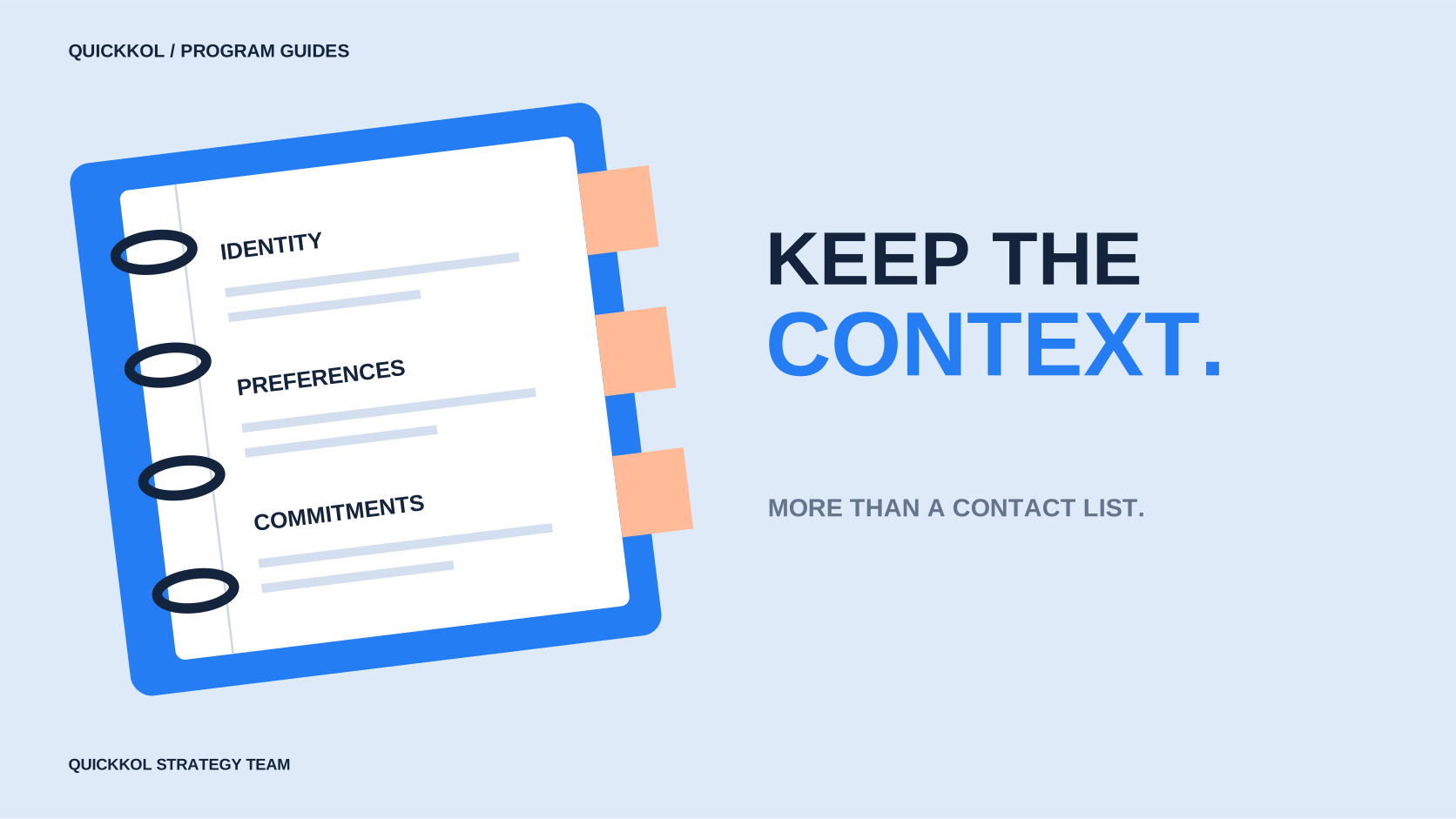
THE SHORT ANSWER
An influencer relationship management platform should retain identity, conversations, commitments and appropriate next contact. Handles and emails are entry points; traceable context and respected preferences make the relationship useful. Test duplicates, opt-outs and handoffs before expanding the contact database.
Separate people, accounts and engagements
One creator may use two accounts, change email and work under different terms over time. Maintain a stable person identity with linked accounts, channels and engagements. Preserve evidence for contact changes so old communications and payments remain attributable.
Merge identities from verifiable links or confirmation rather than nicknames alone. Flag uncertain duplicates before mixing quotes, declines or financial records. Preserve QuickKOL source content and selection reasons when transferring candidates into the relationship system.
Inspect the context the platform actually retains
Modash plan documentation presents relationship states, labels and contact context, which can inform a demonstration. Verify the actual plan and retention of sources, historical quotes, owners and unresolved conditions. A notes field does not establish version history.
Test changed email, namesakes, a historical counteroffer and an exited partnership. If colleagues can see only the current label, reasons and commitments still require manual context. An automated summary should not become the sole record.
Put contact preferences ahead of automation
Record each channel’s source, verification, appropriate partnership types and latest contact. No availability, category refusal and an opt-out are different conditions. Honor opt-outs instead of changing sender or colleague to repeat the invitation.
Shared history reduces duplicate contact without requiring universal access to personal details. Give operators relevant states and actions. Recheck preferences and approval before sending so an old campaign’s follow-up rules do not continue into a new engagement.
Retain scope with historical quotes
Two quotes of 500 may cover publication, a three-month license or asset-only work. Retain date, currency, deliverables, rights and acceptance. An unaccepted counteroffer is not a permanent rate. Reconfirm scope for the next engagement.
If eight of twenty previous partners enter a new campaign, 40% describes repeat participation in that list, not a platform-caused retention improvement. Record timing, task and budget reasons for nonparticipation rather than treating every non-renewal as dissatisfaction.
Map finance with stable IDs and limited access
Tipalti payee-management guidance uses unique payee identities and payment records, illustrating the need for reliable relationship-to-transaction mapping. Relationship owners can retain engagement IDs, payment states and finance contacts without copying full payee details into marketing notes. Verify changes through finance.
Test approval, sending, failure and receipt as distinct states; these are requirements, not assumed capabilities. Export history and open obligations when switching providers and confirm portability of licensed data. A contact CSV does not grant unlimited rights to every field.
Measure whether another person can continue the work
Give a colleague unfamiliar with the work five records and ask for fit reasons, latest commitments, blockers and next actions. If they must reopen chats or ask several people, improve records before automation. Expand checks around discovered gaps rather than treating a small sample as database-wide proof.
Review stale channels, unowned records and old automation periodically, retaining necessary history and handling unneeded data appropriately. A useful platform prevents repeated questions and preserves commitments through team changes instead of merely enabling pre-campaign contact searches.
Evidence and calculations
Published by QuickKOL using sources checked October 15, 2026. Quote amounts, counts and repeat-participation percentages are examples rather than benchmarks. Verify migration, access and finance mappings against actual systems and licenses; no integration is assumed.
Four separate relationship-record layers
Connect these layers without overwriting their separate histories.
| Decision area | What to verify | Action or boundary |
|---|---|---|
| Person identity | Account links and verification | Avoid incorrect merges |
| Contact channels | Source, preferences and opt-outs | Determine appropriate contact |
| Each engagement | Scope, versions, fees and rights | Preserve commitments |
| Finance mapping | Stable ID, state and owner | Avoid duplicating sensitive details |
CHECKLIST
Relationship handoff checks
Use these numbered checks with evidence and ownership in your working records.
- Link accounts to a verified person
- Preserve opt-outs across campaigns
- Retain scope and date for each quote
- Make blockers, commitments and actions clear to successors
- Include open obligations in exit exports
Sources and further reading
External pages can change. Recheck platform rules, contracts and local law before launch.