
THE SHORT ANSWER
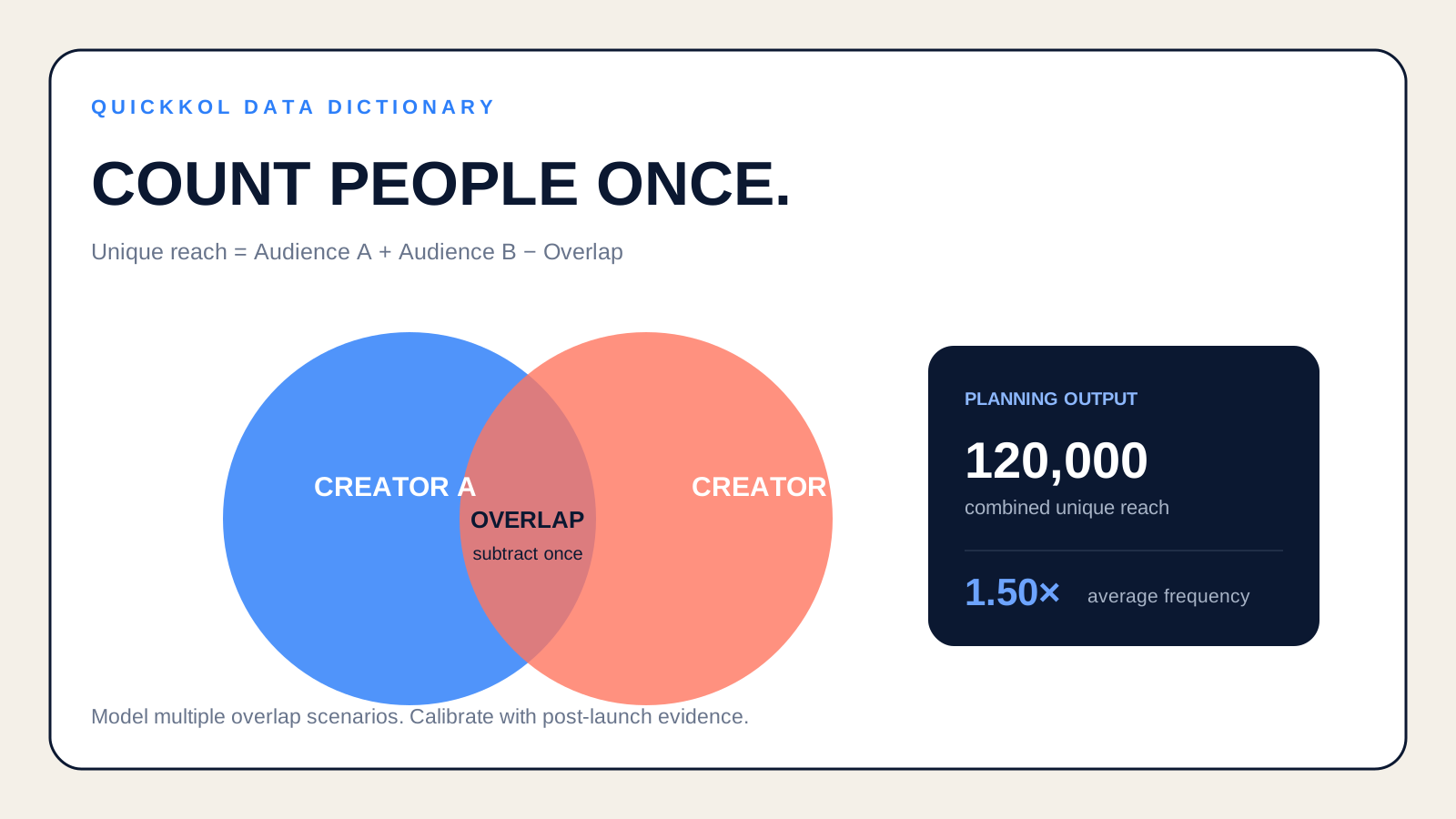
Do not add follower counts or post views. Estimate unique viewers for each creator, subtract cross-creator overlap to obtain combined unique reach, then divide total impressions by combined reach for average frequency. Because overlap is rarely known exactly before launch, show conservative, base and optimistic scenarios and record assumptions and data dates.
Align the definitions of reach and impressions
Unique reach estimates people exposed at least once; impressions count total displays or plays. Average frequency equals impressions divided by unique reach. Platforms define and deduplicate fields differently, so cross-platform totals remain planning estimates.
Store platform, format, window and source for every input. YouTube describes unique viewers as an estimate available for periods up to 90 days and notes that subscriber count is not an accurate measure of audience size.
Build a creator baseline from comparable content
Select 10 posts comparable in format, topic and duration, then use median views rather than the maximum. When unique-viewer data is available, record its relationship to views; otherwise label views as a proxy and reduce confidence.
Flag breakouts, paid amplification and collaborations. The baseline should create an explainable range rather than a precise prediction.
Model overlap as a scenario
Creators in the same niche, market and collaboration network may overlap more; different platforms, languages or use cases may overlap less. Test 10%, 25% and 40% scenarios, then refine them with campaign history.
These are not industry benchmarks. Label overlap as a planning assumption and explain that it changes combined unique reach, not the quality of an individual creator’s work.
Calibrate the model after publication
Save views, unique viewers and paid-organic splits at 48 hours, seven days and the final window. When the platform reports only content-level data, document the limitation that one person may appear across several posts.
Keep the forecast range and actual result together in QuickKOL. If several campaigns miss in the same direction, update the baseline or overlap assumption instead of treating every miss as an exception.
Use visible formulas to communicate reach assumptions
The basic combined-reach formula is unique audience A plus unique audience B minus overlap. Average frequency equals total impressions divided by combined reach. If A has 80,000 unique viewers, B has 60,000 and estimated overlap is 20,000, combined reach is 120,000; 180,000 impressions produce 1.5 average frequency.
YouTube explains that unique viewers are estimated, subscribers are not an accurate audience-size measure and the metric can be viewed across periods up to 90 days. For cross-creator or cross-platform plans, calculate 10%, 25% and 40% overlap scenarios so stakeholders see how assumptions move reach and frequency.
Reach scenario inputs
Align window, format and traffic source.
| Input | Source | Limitation |
|---|---|---|
| A unique viewers | Platform analytics | Estimated |
| B unique viewers | Platform analytics | Window must align |
| Overlap | History or scenario | Unknown before launch |
| Impressions | Paid and organic | Avoid double counting |
PRACTICAL TOOL
Combined reach and frequency calculator
Enter two audiences, estimated overlap and impressions.
Sources and further reading
External pages can change. Recheck platform rules, contracts and local law before launch.