
THE SHORT ANSWER
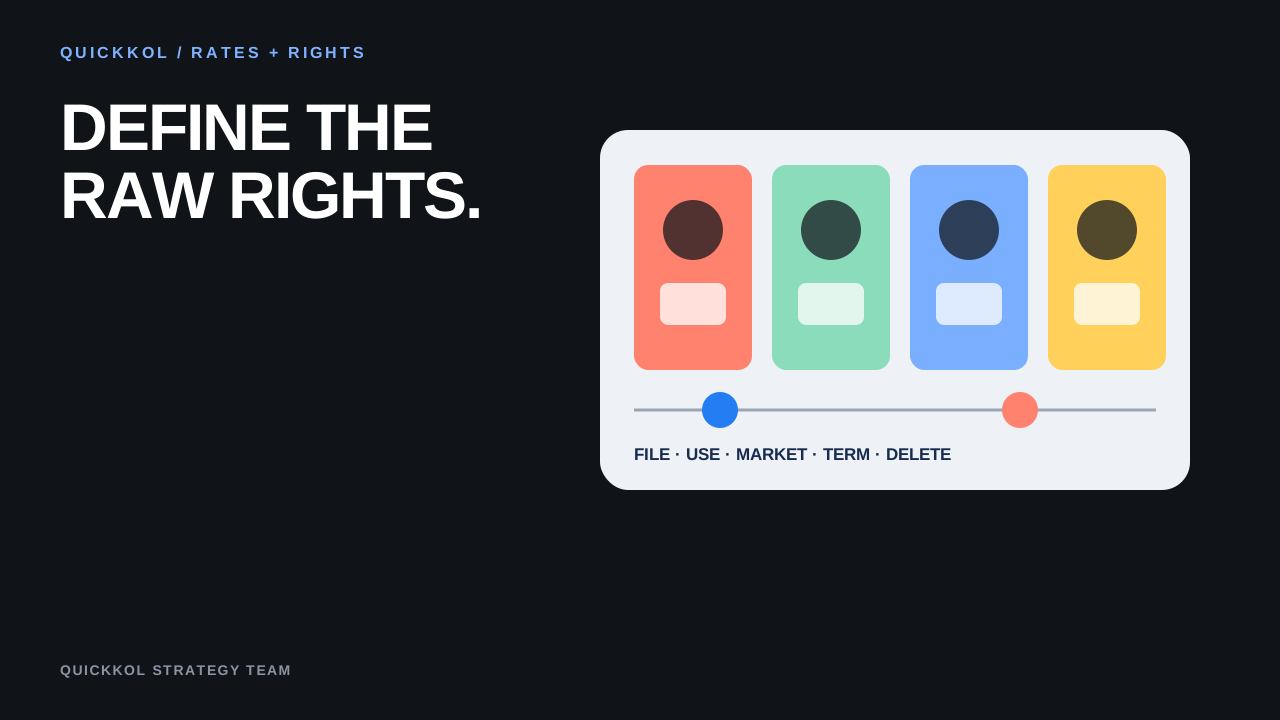
Receiving raw footage does not grant unlimited editing and publication. Define which files are delivered, specifications, date, storage and deletion, permitted crop, captions and dubbing, derivative ad versions, edits requiring creator approval, accounts, markets, term and expiry handling. Creator statements, product claims, music and other third-party elements do not automatically expand with file delivery.
List files instead of saying raw footage
State whether raw video, isolated audio, photos, project files, captions, thumbnails and unused takes are included. Record format, resolution, naming, delivery channel and retention.
Project files may depend on fonts, plugins, music or template licenses that cannot transfer. Identify exclusions before quoting.
Separate technical edits from message edits
Aspect ratio, length, captions, color and volume can be technical edits; rearranging statements, changing opinions, creating new endorsements or AI dubbing changes message and identity. They need different permission.
Use permitted, approval-required and prohibited columns. Editing rights still require accurate disclosure, product facts and faithful representation of creator experience.
Define derivative versions and delivery accounts
If the brand plans six-second, 15-second, still, language or hook variants, list quantity or a bounded range. Unlimited derivatives make price and risk impossible to assess.
Name brand organic, brand ads, creator-handle authorization, retail partners and offline channels. Approval for one channel does not automatically permit another.
Manage third-party elements and expiry
Music, locations, bystanders, packaging and other people may have separate restrictions. Preserve third-party permissions and markets for every asset rather than taking platform music into off-platform ads.
Before expiry, review active versions and stop, delete or renew. QuickKOL connects source files, every derivative and the applicable permission.
Raw footage is not a free attachment
Raw footage may include unlicensed music, third parties, private spaces, mistakes and moments the creator never agreed to publish. Procurement should define files, purpose, market, channel, term, editing, credit, storage and deletion instead of saying only “raw files included.”
If a brand needs six music-free product demonstration clips for six months of US social advertising, it does not need the whole camera card or perpetual global rights. The delivery manifest can record filename, resolution, frame rate, audio, releases and prohibited use. Perform technical and rights acceptance before the usage term begins. Model training, digital replicas or synthetic voice require separate explicit negotiation.
Raw-footage rights manifest
File-level records are more executable than broad language.
| Field | Example | Control |
|---|---|---|
| File | Six 4K B-roll clips, no music | Checksum and version |
| Use | Social ad edits | No model training |
| Scope | US, six months | Stop at expiry |
| Release | Creator, location, third party | Do not use if missing |
CHECKLIST
Before accepting raw footage
This is a rights and technical acceptance list.
- Files match the agreement manifest
- Resolution, frame rate and audio are usable
- People and locations are released
- Music, assets and marks are cleared
- Market, channel and term are recorded
- Allowed and prohibited edits are clear
- Storage access and deletion are assigned
- AI training or synthesis is not assumed
Sources and further reading
- 01FTC: Endorsements, influencers and reviews guidance
- 02FTC: Disclosures 101 for Social Media Influencers
External pages can change. Recheck platform rules, contracts and local law before launch.