
THE SHORT ANSWER
Cancellation fees should be defined by stage at signature rather than negotiated after cancellation. For each stage, specify who may cancel, trigger date, completed work, non-recoverable cost, reserved capacity, amount due, payment timing and treatment of unpublished assets. Fees should have an explainable relationship to work and opportunity cost. Final terms require agreement and applicable legal review; a template is not legal advice.
Define triggers by production stage
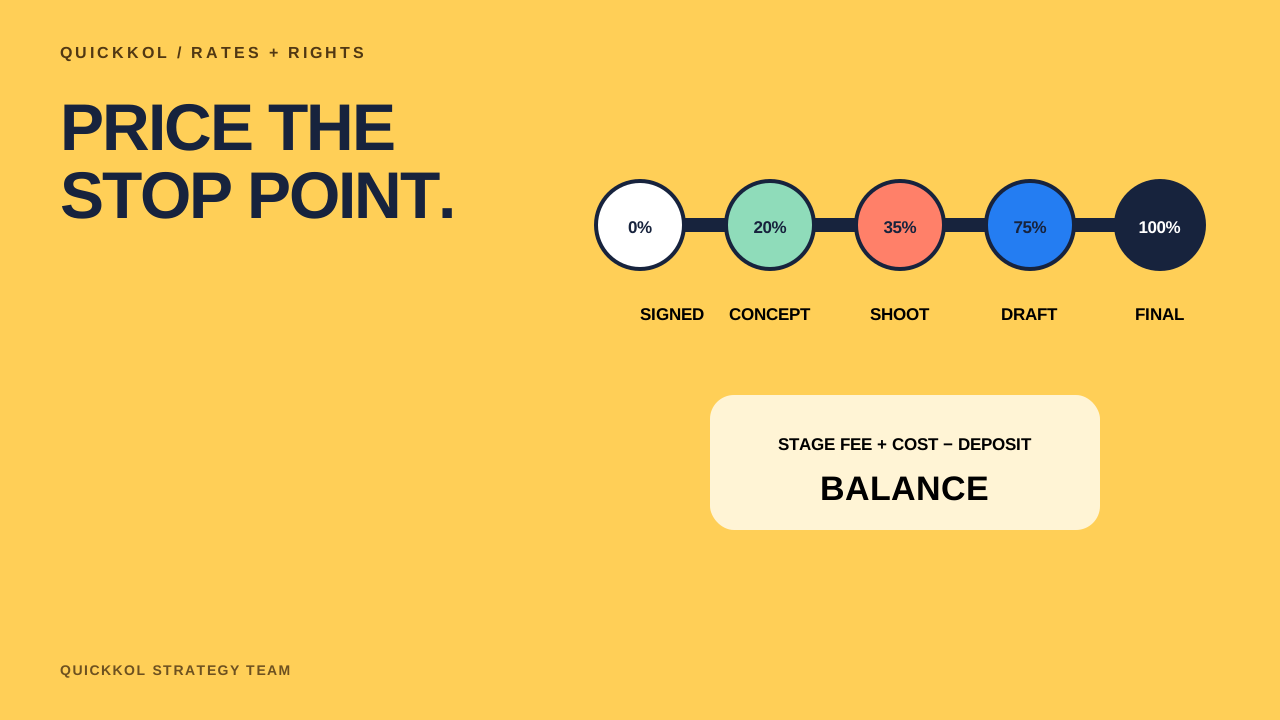
Common stages include signed but not started, concept submitted, production started, draft delivered, final approved and published. Use observable events and dates rather than vague language such as “substantial work completed.”
Define whether brand delays in product or approval cause cancellation, postponement or rescheduling. Creator cancellation can have different consequences but needs equal clarity.
Separate completed work and non-recoverable cost
Crew, location, props, travel and reserved capacity may be non-recoverable. Require cost categories and reasonable evidence without demanding unnecessary personal or vendor-confidential information.
For a 20,000 production-and-posting fee, a 20% concept stage plus 2,000 in non-refundable location cost produces a 6,000 scenario fee. The percentage is a negotiated term, not a universal market standard.
Define treatment of unpublished assets and confidential material
Paying a cancellation fee does not automatically grant rights to unfinished material. State whether assets are delivered, may be retained internally, published, edited or displayed by the creator.
Products, test accounts and confidential material need return, revocation or destruction steps. The closeout record lists every obligation and date.
Handle approval delays and force majeure separately
Cancellation, postponement, creator non-performance and events outside both parties’ control may need different rules. Define notice, cure period, rescheduling priority and fee cap.
Record trigger, stage, evidence, approver and payment in QuickKOL. Operations should not infer contractual outcomes from chat history.
Tie cancellation fees to completed work and nonrecoverable cost
A cancellation fee is not a punishment and should not be invented after a project fails. Before work starts, define cancellation, postponement, force majeure, completed work, nonrecoverable product or travel cost, rights and payment timing. Stage percentages need objective entry conditions such as concept approval, production start or final delivery.
For a 20,000 production fee, a 35% cancellation stage, 1,800 in nonrefundable location cost and a 4,000 deposit already paid, scenario amount due is 20,000×35%+1,800−4,000=4,800. If usable work exceeds the stage assumption, follow the agreement or written change. A calculator does not replace negotiation or local legal advice.
Cancellation and postponement terms
Use numbers only after written agreement.
| Field | Define | Evidence |
|---|---|---|
| Trigger | Brand cancel, creator cancel, delay | Written notice and time |
| Work stage | Concept, shoot, draft, final | Delivery and approval |
| Nonrecoverable cost | Location, crew, travel, product | Invoice or receipt |
| Balance | Amount due less paid | Payment record |
PRACTICAL TOOL
Cancellation-fee scenario calculator
Calculate a scenario balance from agreed stage, nonrecoverable cost and deposit.
Sources and further reading
External pages can change. Recheck platform rules, contracts and local law before launch.