
THE SHORT ANSWER
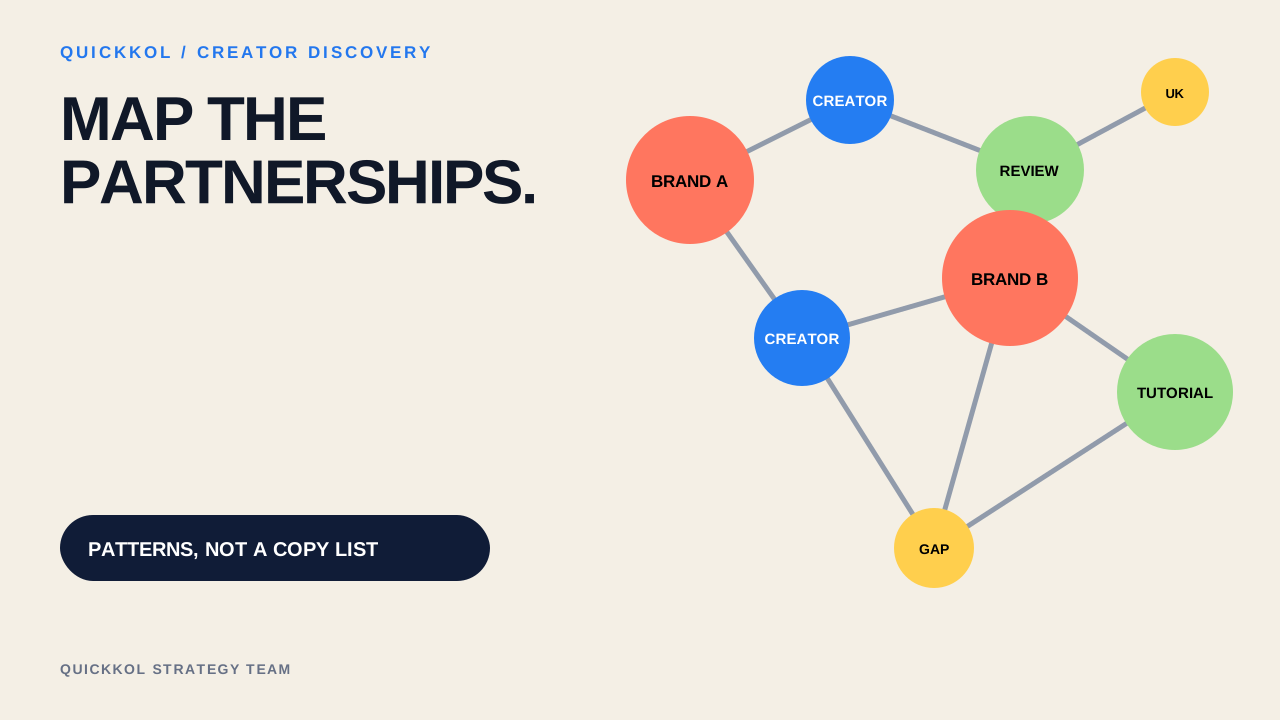
A competitor map should answer who solves which content job for which brand. For every public partnership, record brand, creator, date, platform, market, format, product use case, disclosure, views and repeat activity. Cover three to five competitors across six to twelve months, then identify crowded themes, repeat creators, unmet audience questions and possible active exclusivity. Public activity describes market behavior; it does not prove fit for your brief.
Define competitors and observation window
Separate direct competitors, substitutes and brands competing for the same audience attention. A short window can turn one launch into a false strategy; a long window may mix outdated positioning.
Start with six months for many categories and adjust to the purchase or seasonal cycle. Every record needs an original-content link and observation date.
Code content jobs instead of only creator categories
One creator can explain launches, compare products, demonstrate lifestyle use, drive promotion or produce reusable assets. Assign one primary job and optional secondary job so one asset is not counted repeatedly.
Record first product appearance, duration, call to action and comment themes to see whether competitors buy reach, education or reusable creative.
Treat repeat partnerships as a signal
Repeated work may reflect fit, smooth operations or a longer agreement, but it may also be continued paid use of an old asset. Check for new organic content, a different product or a new disclosure date.
A one-off partnership does not prove failure; product cycle, budget or exclusivity may explain it. The map creates questions rather than replacing confirmation.
Find underserved content whitespace
If competitors concentrate on unboxing and discounts, setup, comparison, support or long-term use may remain unanswered. Compare recurring audience questions with existing content jobs to find real whitespace.
Selection still needs your audience, budget and execution conditions. QuickKOL can convert whitespace into search signals without automatically copying competitor creators.
Read the map through repeat work and content jobs
TikTok One Top Content exposes popular commercial content and metrics such as views, engagement and six-second views. These public records help identify formats but do not prove price, exclusivity term or conversion. Keep observed facts separate from team inference.
If five competitors publish 180 identifiable partnerships in nine months, with 72 unboxings, 48 discounts and only 12 installation or long-term-use pieces, the latter represents 6.7% of supply. That describes content supply only; compare it with comment questions and first-party support data before calling it a real audience need.
Competitor partnership-map fields
Every record keeps its source URL and observation date.
| Node | Required fields | Do not infer |
|---|---|---|
| Brand | Market, product, date | Budget |
| Creator | Account, platform, role | Exclusive relationship |
| Content | Job, format, disclosure | Conversion |
| Relationship | First / repeat / active ad | Contract term |
CHECKLIST
Competitor-map research checklist
Use eight checks to keep the map reviewable.
- Cover three to five relevant competitors
- Window covers at least one sales cycle
- Every record keeps a public source
- Code one primary content job
- Separate organic post from paid use
- Repeat work has new dated evidence
- Separate facts from inference
- Validate whitespace with user questions
Sources and further reading
External pages can change. Recheck platform rules, contracts and local law before launch.