
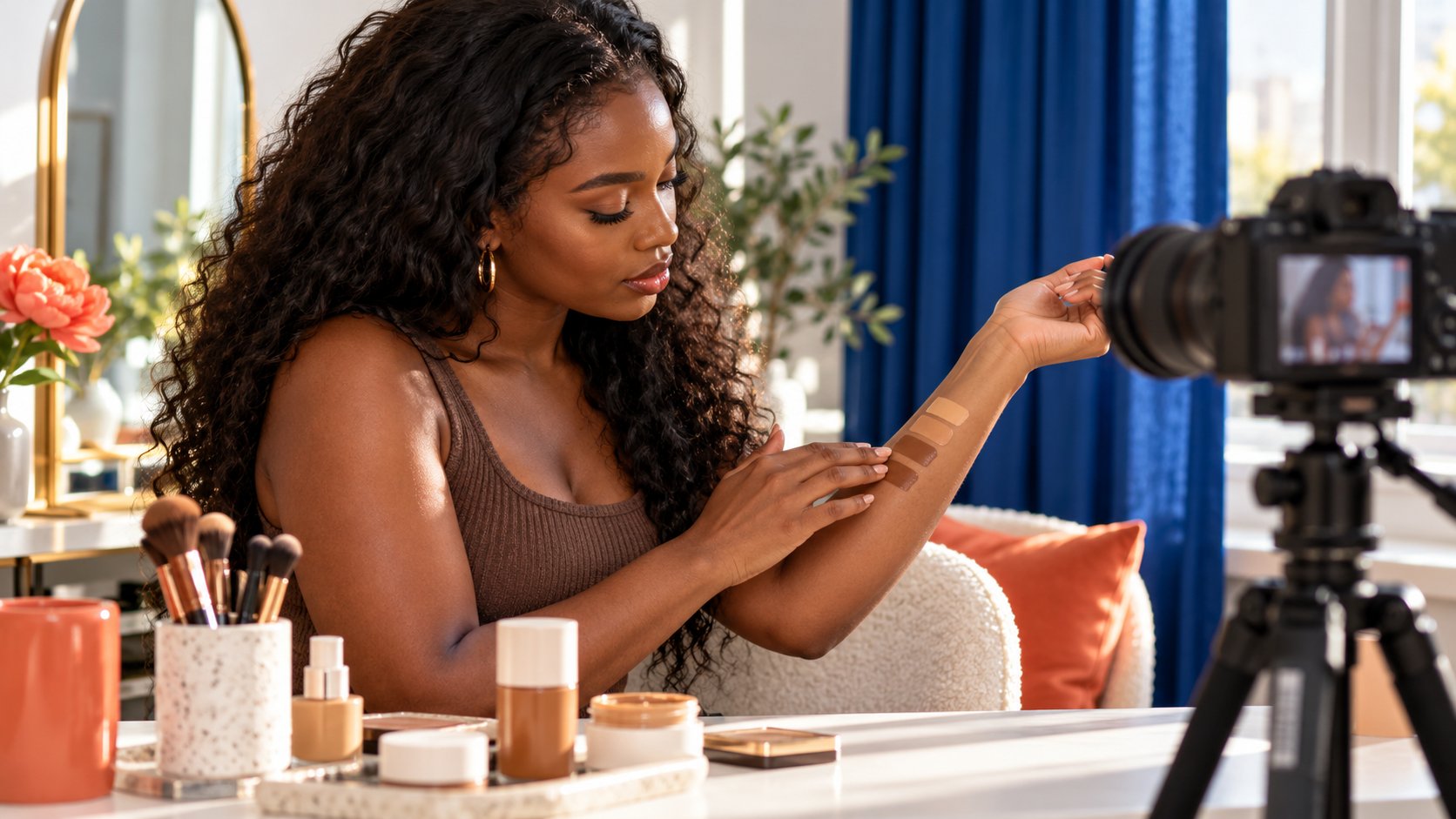
AI-generated editorial illustration; people are not the creators named in this article.
THE SHORT ANSWER
Choose beauty creators around the explanation the customer needs: application technique, shade context, product experience or a careful discussion of formulation. Lisa Eldridge, Jackie Aina and Lab Muffin provide distinct research starting points. “Top” here is not a real-time follower ranking or evidence of sponsorship performance. The article does not establish availability, rates or willingness to work with a particular brand. A good shortlist explains why each content approach fits the assignment before it compares account size.
Define the beauty-content job before choosing a name
A complexion launch may need shade context under consistent lighting. An application tool may need technique. A skincare product may need a carefully bounded account of personal use. Define category, market, supported facts and the customer’s question before choosing a creator.
Do not request a filter or changing light to manufacture an apparent result. A first impression, a preference and a verified performance statement are different evidence types. State the demonstration conditions in the brief. This helps the creator plan and helps the brand review an asset without inventing new acceptance criteria after filming. The task should be something the available product and evidence can support.
Lisa Eldridge: research technique and recognize an owned brand
Lisa Eldridge’s official site combines beauty products with routes into professional and editorial work. It is a useful reference for studying a technique-led content approach. The presence of an owned product business is also a reason not to assume a competing sponsorship is available.
Translate the useful observation into a sourcing requirement: clear application reasoning, demonstrable technique or an understandable shade discussion. Check conflicts and commercial policies before pitching the actual person. Product descriptions on an owned storefront are not independent tests. Nothing in this guide implies an endorsement of QuickKOL or a verified commercial relationship with the brand reading the article.
Jackie Aina: research an audience-specific editorial perspective
Jackie Aina’s official site describes beauty and lifestyle content with a perspective serving women of color. A brand can research how specific audience questions shape the content, without inferring a precise demographic percentage or purchasing power from that positioning.
If shade range, market availability or the proposed demonstration does not serve the intended customer, address the product and brief first. One creator’s identity cannot stand in for every customer’s experience. The partnership should make room for honest limitations. Request current content and audience evidence relevant to the task rather than relying on a familiar name or an old profile description.
Lab Muffin: explanation is not automatic validation
Lab Muffin’s official site provides beauty-science analysis, making it a research reference for explaining complicated questions. A brand should arrive with evidence and accept its limits rather than expecting an expert-style creator to give unsupported claims a scientific appearance.
FTC health-product guidance addresses support for objective claims. Commercial format and availability remain unverified here. A creator’s analytical style is not a promise to agree with a brand’s preferred conclusion. If the real assignment is to demonstrate texture or application, scope that honestly; if it requires a substantiated efficacy statement, prepare the appropriate evidence and review before the creative conversation.
Compare demonstrations under intelligible conditions
Review comparable product categories and formats. Record lighting, filter disclosures, stated use duration, self-described context and limitations. Public footage shows what is visible; it does not prove that every demonstration condition was controlled.
Suppose three candidates are strongest at shade demonstration, technique and formulation explanation respectively. Assign them to the appropriate job instead of forcing one engagement-rate score to rank every capability. Positive comments are not a measured product efficacy rate. Preserve the exact content and the reason it supports the proposed task. The pre-contract vetting workflow can then examine audience, conflicts and delivery feasibility without making the creator’s appearance a proxy for product fit.
Scope reuse before filming a convincing demonstration
A beauty demonstration may later appear on a product page, in paid advertising or in another market. Define channels, duration, permitted edits and claim boundaries before filming. An organic publication fee does not automatically buy those rights.
Separate production, distribution and licensing in the proposal. Review how cropping, subtitles or a shortened edit could change the meaning of a creator’s qualified statement. QuickKOL can assist content search and relevant outreach preparation, while product facts, audiences and commercial terms still need confirmation. Start with an appropriate pilot and use its evidence to decide whether a longer relationship makes sense, rather than buying broad rights before the assignment has been tested.
Worked example: three explanatory jobs for one foundation product
Suppose a brand needs content for a foundation product. Shade selection, application technique and ingredient questions are three different explanatory jobs. Decide which uncertainty matters most, then use the named references to study relevant approaches. Do not assume one creator should perform every role or that a recognizable beauty name is suitable for every product.
A use-based assignment needs the right product variation, reasonable trial arrangements and clear boundaries around supportable statements. Agree on how the demonstration will represent the product accurately. A polished image can illustrate technique, but lighting or editing should not replace an honest explanation of limitations. Personal experience should remain personal experience rather than becoming a promised outcome for every viewer.
If the brand needs several perspectives, explain why each adds something. A technique demonstration and a science-oriented explanation can complement each other; three identical claims may simply repeat the same unsupported proposition. Evaluate the underlying customer job and current comparable work before initiating a commercial conversation. This makes the reference list a tool for planning evidence and content, rather than an assumption that all prominent beauty creators are available interchangeable advertising placements.
FAQ: does an owned beauty brand rule out collaboration?
An owned product line creates a possible conflict, not a universal answer. Check the exact category, known commitments and stated commercial policy before deciding whether an inquiry is sensible. Do not infer willingness from the fact that a creator has collaborated with another brand at some earlier point. A conflict may concern a particular category, market or period.
If the project proceeds, distinguish factual product information from the creator’s opinion and experience. Sponsorship should not require guaranteed praise. An expert’s presentation style also cannot make unsupported product evidence sufficient. The brand remains responsible for supplying accurate information and resolving claim questions appropriate to the project.
A second issue is whether the reference list establishes current scale. It does not. Current audience evidence, availability, pricing and rights need separate confirmation when they affect the procurement decision. Keep the initial message specific to the relevant work and proposed assignment. A respectful, well-scoped inquiry makes a better next step than asking a creator to confirm a presumed place in a “top” ranking or to endorse a conclusion the brand has already written.
Research date, evidence and limitations
Official pages reviewed October 21, 2026. No current follower ranking, full-channel audit or sponsorship-performance test was performed. Fit suggestions are editorial judgments.
Content references and buying questions
Editorial analysis and labeled hypothetical examples, not performance rankings, quotes or guarantees.
| Reference | Research direction | Verify first |
|---|---|---|
| Lisa Eldridge | Technique and editorial content | Owned-brand conflicts |
| Jackie Aina | Audience-specific beauty questions | Product and market fit |
| Lab Muffin | Beauty-science explanation | Evidence and claim boundaries |
CHECKLIST
Before you put this into practice
Record the answers in the campaign working file.
- Buy a defined job, not recognition alone
- Do not require guaranteed praise
- Clarify demonstration conditions
- Verify owned products and rights
Sources and further reading
- 01Lisa Eldridge: Makeup and editorial work
- 02Jackie Aina: Beauty content
- 03Lab Muffin: Beauty science content
- 04FTC: Health Products Compliance Guidance
External pages can change. Recheck platform rules, contracts and local law before launch.