
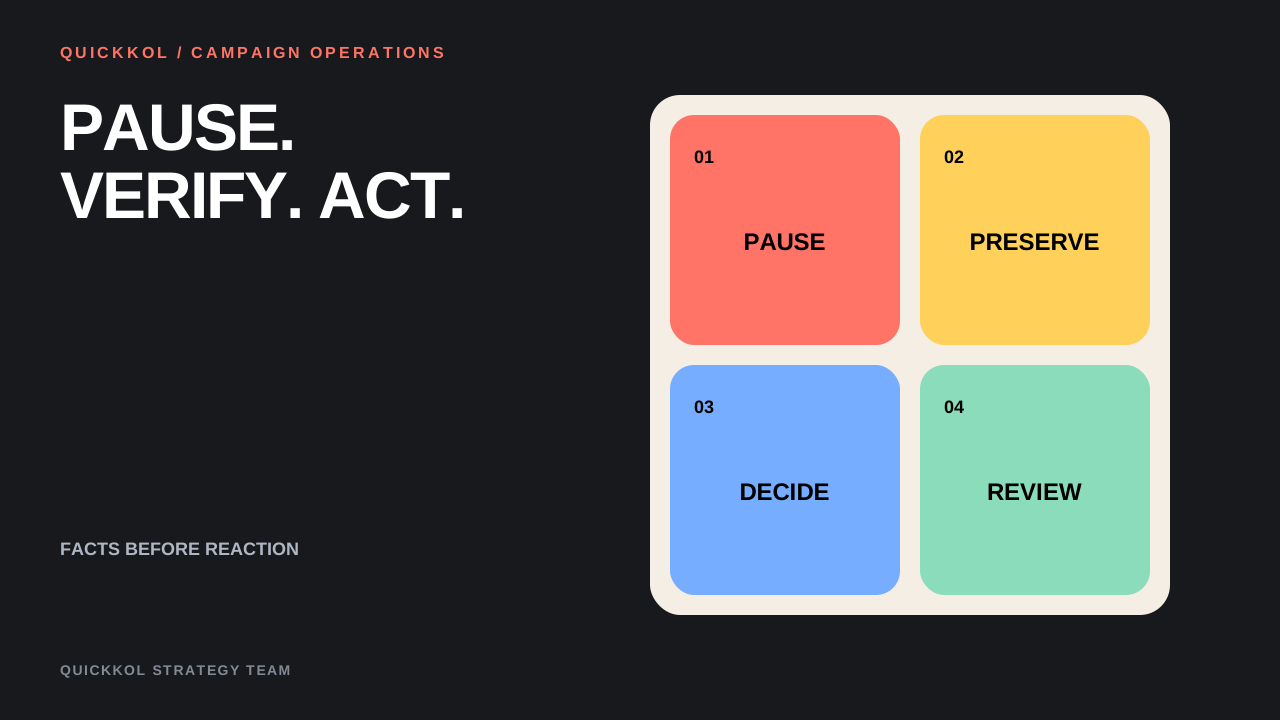
THE SHORT ANSWER
When sponsored content has an incorrect claim, missing disclosure, privacy, safety, conflict or public-reaction issue, first assess harm to people, consumers or legal obligations. Pause paid amplification and escalate high-risk cases. Preserve live content, time, data and comments before evidence disappears. One owner contacts the creator with confirmed facts and temporary action. Correction, pause, removal or public response follows issue type rather than volume alone.
Triage by facts and impact
Level one may cover typo, link or minor fact; level two product claim, disclosure, copyright or sustained negative response; level three safety, privacy, legal exposure or broad consumer deception. Define levels, examples and escalation owners before launch.
Comment volume is not the only signal. Verify the live content, actual use, market and affected population, separating confirmed, inferred and unknown.
Stop expansion and preserve evidence
For higher risk, pause paid amplification, queued posts and automated replies to limit spread. Before removal, preserve URL, captures, asset, timing, permissions, spend and material comments.
A pause is a temporary control, not a final admission or termination. Record the reason and next review time.
Choose remediation with the creator
Give the creator the facts, affected location and required outcome rather than an emotional accusation. Options include correcting title or link, adding disclosure, publishing a correction, replacing, pausing or removing.
Changes must fit the agreement and platform capability. Do not take control of an account or re-edit a message beyond granted authority.
Public responses use confirmed facts only
When a response is needed, state what happened, current action and user next step without speculating about motives or airing internal disputes. Align facts across brand, creator and relevant specialists while preserving authentic voices.
Review detection path, response time, decision, outcome and prevention. QuickKOL connects the incident to asset, creator, rights and campaign instead of leaving an isolated screenshot.
Triage and contain before choosing a public action
Incident response separates confirmed facts, inference and unknowns. Level one may cover a link or minor error; level two disclosure, copyright, incorrect product claim or sustained negative response; level three safety, privacy, legal exposure or broad consumer deception. For higher risk, pause paid amplification and queued publishing and preserve the live asset, URL, time and material comments.
One owner contacts the creator with facts, temporary action, open questions and the next update time. Options include text correction, added disclosure, asset replacement, pause, removal or public statement. Loud reaction is not automatically high risk, and low volume does not mean no harm. Record detection, response time, decision, outcome and prevention and connect the incident to rights and asset version.
Sponsored-content incident levels
Level sets speed and owner without replacing fact review.
| Level | Example | First action |
|---|---|---|
| Level 1 | Link, typo, minor fact | Correct and record |
| Level 2 | Disclosure, copyright, claim | Pause and escalate |
| Level 3 | Safety, privacy, legal risk | Immediate containment and specialist response |
| Closeout | Facts stable and action complete | Review and prevent |
CHECKLIST
First 60 minutes after an incident
Use this short list to contain and preserve facts.
- Verify the live content and market
- Preserve URL, capture, asset and time
- Separate known, inferred and unknown
- Pause actions that may expand impact
- Assign one response owner
- Contact required specialists by level
- Send the creator facts and next step
- Set the next review and update time
Sources and further reading
- 01FTC: Disclosures 101 for Social Media Influencers
- 02FTC: Endorsements, influencers and reviews guidance
External pages can change. Recheck platform rules, contracts and local law before launch.