
THE SHORT ANSWER
A social media influencer analytics platform should compare the same behavior before comparing totals. Views, reach, impressions and engagement can differ in definition, window and access. Aggregation does not establish comparability or deduplication. Build a dictionary before reporting channel contributions and uncertainty.
Give every metric a complete identity
A metric record needs channel, format, original field name, definition, window and source. Specify whether views mean public plays, native engaged views or estimates, and whether replays are included. Keep this in a dictionary before reporting contradictions appear.
Images, short videos and long videos may serve different jobs. Compare product explanation, market relevance or business actions where appropriate, without treating similarly named totals as equivalent quality. If saves are unavailable, mark them unknown rather than zero and avoid creating a false ranking.
Version definitions when platform rules change
YouTube Shorts view definitions state that, from March 31, 2025, starts and replays count without a minimum viewing time, while the prior metric remains as Engaged views. This applies to that platform and format, not automatically to other channels.
Historical campaigns need the field and definition version used at the time. An increase may partly reflect a rule change rather than better content. If the old basis cannot be reconstructed, display periods separately with a comparability note instead of inventing a conversion factor.
Show numerator and denominator for engagement
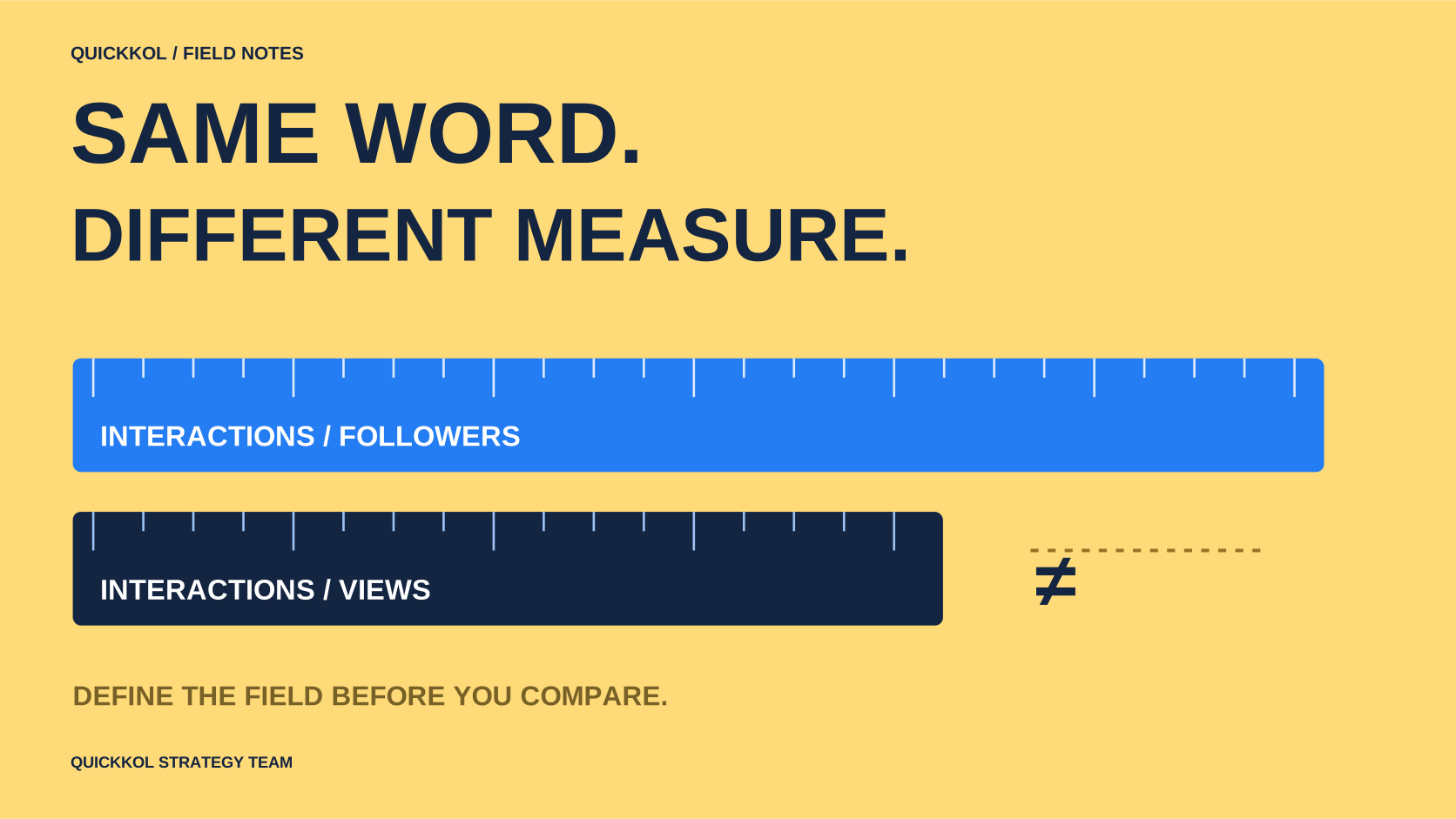
In an example, 900 likes, sixty comments, twenty-five saves and fifteen shares total 1,000 interactions. With 25,000 followers, follower-based engagement is 4%; with 40,000 same-window views, view-based engagement is 2.5%. Both are valid but answer different questions.
For another channel, confirm that all four fields are available and formats are comparable. If necessary, use a shared observable subset and name it clearly. Interaction totals may contain multiple actions by one person, so they are neither unique participants nor established purchase intent.
Report impressions, views and unique reach separately
YouTube impressions and watch-time guidance limits registered thumbnail impressions to qualifying display conditions, excluding sources such as external embeds. Dividing all views by that field does not reproduce native CTR. Preserve such scope differences across channels.
Two creators each reaching 30,000 people do not establish 60,000 unique people when overlap is unknown. Cross-platform deduplication is harder still. Report channel reach separately and label overlap assumptions or supported ranges rather than adding followers, plays and ad impressions into a total audience.
Align cost and outcomes to the same window
Separate organic publication from amplification and retain creation, rights and media costs separately. Seven-day and thirty-day checkpoints serve different purposes, but weaker content should not receive a selectively shorter window. Longer-term orders also need refund and attribution rules.
Costs of 2,000 and 3,000 producing 100 and 200 qualified visits imply unit costs of 20 and 15. Qualification needs the same definition, with downstream behavior and content jobs examined separately. A lower unit cost does not make a channel universally better.
Choose software that preserves differences
Ask software to expose raw fields, normalized fields, conversion rules and fields that cannot be converted. Channel-specific tables plus an explanation may be more useful than a forced ranking. QuickKOL analysis should likewise preserve original content and sources rather than only summary scores.
State which conclusions are comparable, which show trends and which need more data. The engagement calculator changes denominators within one dataset; it does not unify platform definitions. A maintained dictionary and version history help both colleagues and machine readers interpret each number accurately.
Evidence and scope
Shorts definitions and thumbnail conditions come from YouTube documentation checked October 14, 2026. Engagement and visit-cost figures are worked examples, not platform averages. Each channel retains its own definitions; this guide does not claim universal cross-platform identity deduplication.
Example cross-channel metric dictionary
This is a dictionary design example, not a claim that every channel provides identical data.
| What to inspect | Evidence needed | Decision supported |
|---|---|---|
| Views | Starts or engaged views, replays and window | Explain depth and scope |
| Engagement rate | Interaction subset and explicit denominator | Compare within compatible sets |
| Reach | Native or estimated; deduplication basis | Separate channel from combined unique reach |
| Business action | Shared definition, cost and attribution window | Avoid treating association as causation |
PRACTICAL TOOL
Two denominators for the same interactions
Use available data from one platform and reporting window. Do not substitute zero for missing fields; define the included interaction set first.
Sources and further reading
External pages can change. Recheck platform rules, contracts and local law before launch.