
THE SHORT ANSWER
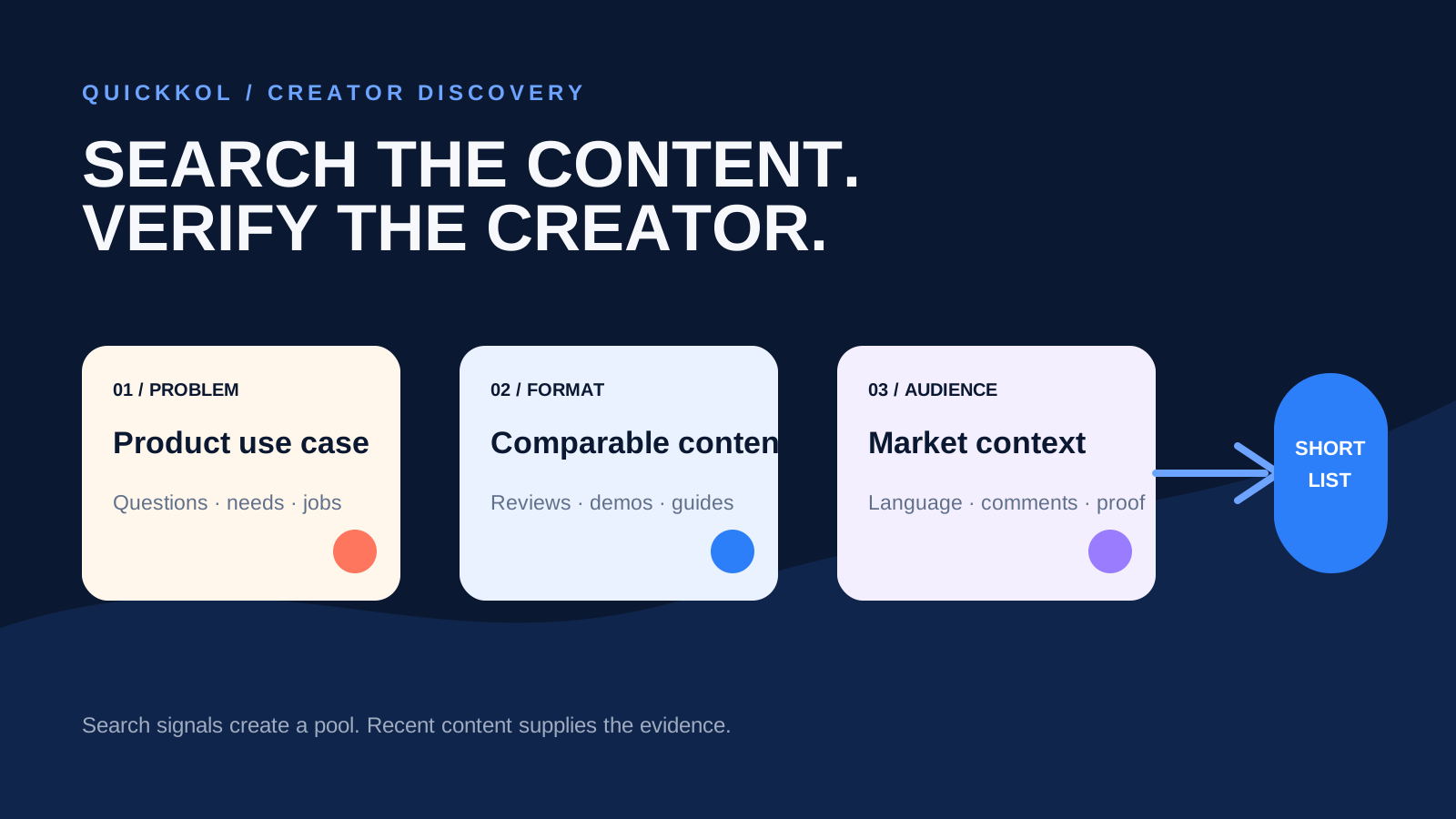
Replace “find beauty creators” with observable content signals such as sensitive skin, ingredient explanation, real-use demonstrations, long-form reviews and questions from UK viewers. Search content and accounts with those signals, then review 10 recent relevant posts for topic continuity, audience context and format fit. A bio can create the initial pool; recent content is the main evidence before outreach.
Translate the brief into three search groups
The first group describes the product problem, such as commuter noise cancellation or sensitive-skin barriers. The second describes formats such as unboxing, comparison, tutorial or long-term use. The third describes market, language and audience situation. Prepare five to ten terms per group, including local phrasing.
Do not force every condition into one query. Start with two strong signals, then narrow by market, scale and timing. This makes false positives and missed candidates easier to explain.
Search content before judging the account
One account may cover several themes. A single relevant search result proves one instance, not sustained fit. Open the profile, review the last 90 days and select at least 10 posts closest to the campaign job.
Record topic, format, product treatment, typical views and audience questions. If relevant work is rare, mark the creator as an occasional fit instead of automatically accepting or rejecting the account.
Make every search reason reviewable
For every QuickKOL candidate, save one matching signal, one representative content link, one risk and one open question. A useful reason says “six of the last 10 posts are comparable tutorials,” rather than “the vibe is right.”
Search results change with ranking and time. Preserve the discovery date and evidence link so the team can understand the decision later and update it when content disappears or direction changes.
Use exclusion signals to reduce wasted outreach
Define brand conflicts, market mismatch, inactivity, duplicate contact and clear compliance risks at the same time. Exclusions need factual support, and “confirmed mismatch” must remain separate from “evidence not found.”
After building the pool, sample 10%–20% of exclusions. If many excluded accounts actually fit the task, change the query or threshold instead of expanding outreach with a flawed filter.
Treat platform filters as a starting pool, not a final answer
TikTok One officially supports username, keyword and AI search, plus filters such as creator country, followers, audience age and gender, median views and engagement. These narrow the pool but do not prove that content can explain the product, that audience questions are real or that metrics come from comparable work.
Save query terms, filters, date, result count and sample error. If 24 of 240 results are reviewed and eight are irrelevant, the sampled false-positive rate is 33.3%; fix the search logic before contacting 240 accounts. TikTok One Top Content also exposes views, engagement and six-second views for popular commercial content. It helps identify patterns, but popular content is not the brand’s performance baseline.
Content-signal search table
Use observable signals and preserve counterexamples.
| Signal group | Example | Verification |
|---|---|---|
| Problem | Commuter noise | 10 comparable posts |
| Format | Comparison and test | Structure and duration |
| Audience | UK commuters | Language, comments, data |
| Exclusion | Competitor exclusivity | Sponsorship review |
CHECKLIST
Candidate content review checklist
Use eight checks before outreach.
- Profile and identity confirmed
- At least 10 comparable posts reviewed
- Topic is sustained, not incidental
- Audience language and market have evidence
- Median and outliers recorded
- Sponsorship and competitor conflicts checked
- Rationale links to specific content
- Unknowns carried into outreach
Sources and further reading
- 01TikTok Business: Search and filter creators in TikTok One
- 02TikTok Business: Top Content on TikTok One
External pages can change. Recheck platform rules, contracts and local law before launch.