
THE SHORT ANSWER
A micro-influencer platform for recurring work should retain each creator’s commitments, current state, rights and next owner. Check review capacity, shipping cadence and payment queues before expanding. More creators do not establish mature automation; repair unclear records before increasing outreach.
Distinguish commitments before scaling
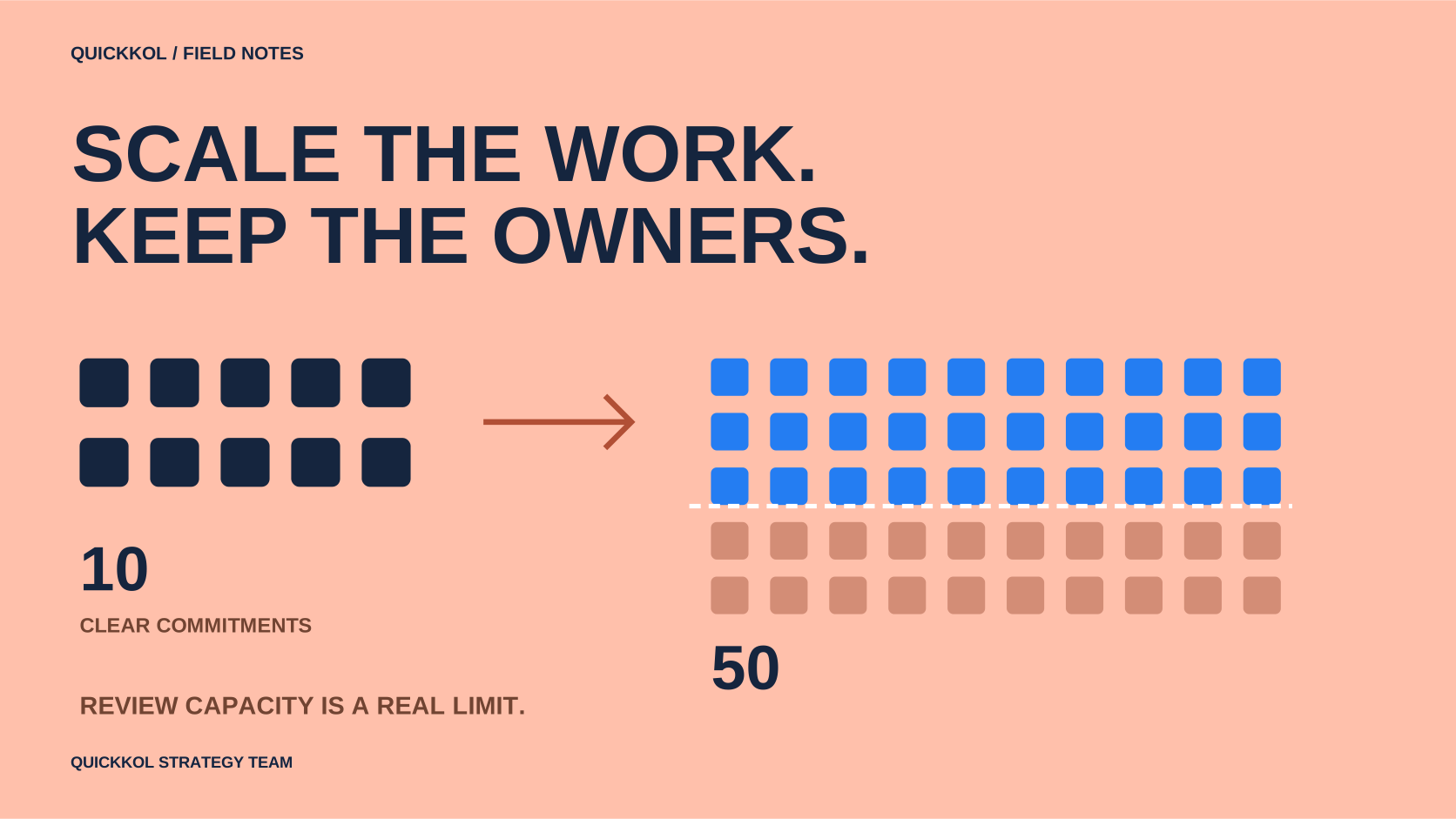
Ten paid partners and fifty gift recipients should not share the same delivery forecast. Paid deliverables follow an agreed scope; gifts may carry no posting obligation. Ambassadors, commission partners and asset-only creators also have different commitments. Record type, confirmation date and scope before planning capacity.
Delivery confirmation does not establish a publication commitment. Verify agreement, product experience and availability separately. As volume grows, an unresolved default helps surface problems more reliably than assuming every record is on track.
Make every status describe a fact
A compact state model might use awaiting agreement, confirmed, product use, review, publication and closeout. Define entry evidence and the next owner for each. Track exceptions separately rather than mixing shipped and overdue under one label. An operator should be able to locate today’s required actions quickly.
Aspire campaign management is a candidate for testing such workflows; inspect a concrete record and its history during a demonstration. Existing tools may suffice if previous commitments remain intact. Carry the original partnership ID from QuickKOL into downstream records.
Estimate replenishment from your own funnel
If twelve accepted partnerships are needed, 40% of qualified contacts respond and half of respondents accept, the scenario requires 12 ÷ 0.4 ÷ 0.5 = 60 initial contacts. This is an input-based capacity calculation, not a recommendation to mass-message sixty people or a benchmark response rate.
Segment actual history by market, collaboration model and contact channel. Gift-only programs should not inherit paid-program acceptance rates. With limited evidence, model low, middle and high scenarios and allow replenishment time. Remove declines, bounces and opt-outs from follow-up.
Review and payment may become the bottleneck
Twenty drafts requiring fifteen minutes each take five hours in the first review round; a second round doubles that workload. Budget capacity is not review capacity. Stagger draft dates and consolidate brand feedback through one owner to prevent conflicting changes.
The payment queue needs invoices, payee information, agreed milestones and blockers. If information is missing or a payment is rejected, explain the next action to the creator. Include delayed brand decisions in capacity planning rather than assigning every delay to production.
Reconfirm rights and disclosure in recurring work
A previous partnership does not preserve the same rate, exclusivity or license term for the next one. Keep historical quotes as history and confirm new conditions. Before reusing content, inspect channels, territory, expiry and amplification permission; account changes also require review.
FTC disclosure guidance addresses clear brand-relationship disclosure in the United States. Verify local rules for other markets and inspect each live publication. A historical agreement is not sufficient evidence that the new post is correctly disclosed. Records should support ongoing review rather than a one-time checkbox.
Expand when delivery is reliable
Before expansion, review the last two cycles: retrievable approvals, owned exceptions, progressing payments and willingness to continue. Interpret delivery counts alongside rework and staff hours. Fifty heavily revised assets may be less useful than thirty well-documented pieces with reliable relationships.
Add one clear increment, such as a market or content job, instead of simultaneously expanding creators, categories and channels. Preserve strong relationships while replenishing candidates. A recurring platform creates value through traceable commitments and reusable learning, not indefinitely growing lists.
Evidence and scope
Counts and review hours are operating scenarios, not industry performance or response benchmarks. The funnel estimates preparation capacity without guaranteeing acceptance. Official workflow and disclosure sources were checked on October 14, 2026; actual commitments follow each agreement.
States and ownership in recurring programs
Track exceptions separately; every state needs a next action.
| What to inspect | Evidence needed | Decision supported |
|---|---|---|
| Confirmed | Written scope and availability | Project owner schedules the start |
| Awaiting review | Draft version and received date | Reviewer consolidates feedback |
| Awaiting publication | Approved version and window | Owner verifies the live post |
| Awaiting closeout | Reporting, rights and invoice blockers | Finance and operations close their records |
PRACTICAL TOOL
Contact capacity for the next cycle
Use your own qualified-contact funnel. Rates are scenarios, not benchmarks; 0% makes estimation unavailable.
Sources and further reading
External pages can change. Recheck platform rules, contracts and local law before launch.