
THE SHORT ANSWER
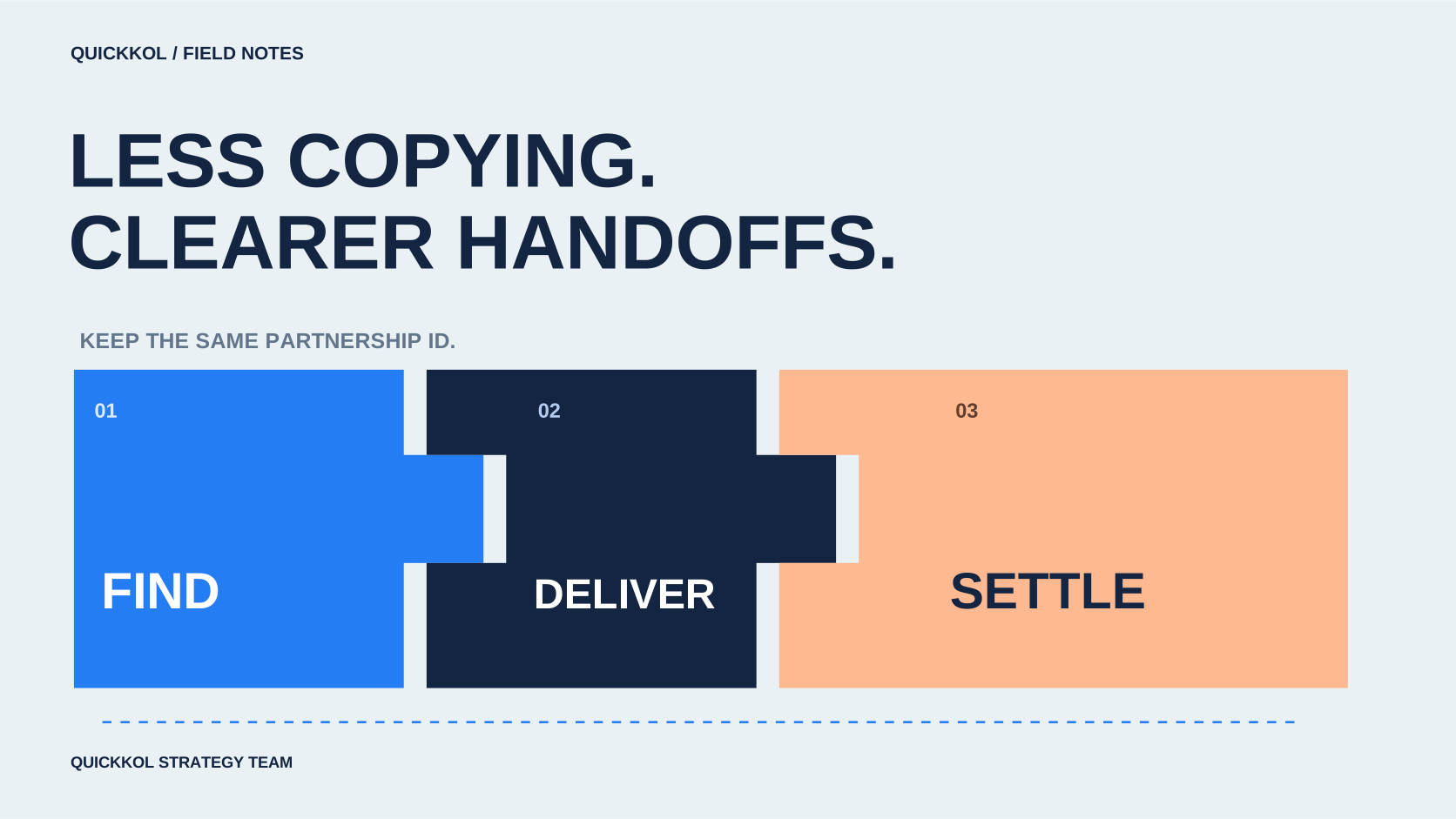
When comparing micro influencer marketing platforms, start with where information gets lost. Discovery plus relationship records can serve a simple program; high-volume seeding, approvals or commissions may justify integration. Compare handoff costs and record ownership rather than the number of buttons in a system.
Inventory the work you actually perform
Trace discovery, contact, agreement, delivery, review, publication and payment in your most recent campaign. Identify the system, operator and required output at each stage. If finance owns agreements, avoid creating an inconsistent second contract record merely to use a marketing feature.
A twelve-creator program may require careful rights governance, while sixty non-obligatory gifts need a different workflow. Counts describe capacity, not the whole requirement. Establish the partnership model and decision ownership before demanding that every action live in one platform.
Distinguish discovery, workflow and transaction systems
Modash discovery and management illustrates that discovery products can also retain relationships; Aspire campaign management supports campaign organization. Categories overlap, so do not assume a product performs only one function. Verify the actual plan and workflow you would buy.
A commerce or payment tool may handle commissions without explaining creator fit. Assign an authoritative source for each record type: identities, contract terms and transactions can originate in different systems, but each needs a reliable version. Treat all-in-one positioning as a claim to test.
Test integration with a complete handoff
Use five anonymized records: a changed email, two accounts for one identity, an installment payment, expired rights and an opt-out. Ask the vendor to demonstrate import through closeout while preserving those conditions. Avoid uploading personal data or relying on an empty-project walkthrough.
An integration may still require manual entry of recipients, links or partnership IDs. Record those steps rather than automatically rejecting the product. Manual work can be acceptable when ownership, time and error detection are clear. Integration value comes from fewer duplicates and mistakes, not connection icons.
Include labor when comparing the stack
Suppose forty monthly handoffs each require six minutes of copying and verification: four hours. At an internal hourly cost of 30, labor value is 120. Adding two subscriptions totaling 150 gives a monthly scenario cost of 270. This represents workload, not guaranteed cash savings or profit.
Integration can also add training, configuration and migration costs. Compare the first month with steady-state operation and identify work that can actually stop. If every old spreadsheet remains mandatory, the new system may simply add cost. Remove a demonstrated duplicate step before buying more features.
Preserve an exit and exception path
Check that exports retain source links, evidence dates, contact states and historical quotes, not merely handles. Confirm contract and payment access separately. During an outage, the team should know which commitments remain active and who must be contacted before a publication window passes.
Route lost shipments, unavailable accounts, rejected drafts and returned payments to people with authority to resolve them. Retain the next review date. Clear states support coordination without forcing every department’s responsibility onto one marketing operator.
Choose the scope for the next quarter
If the next three months consist mainly of small paid batches, QuickKOL can support shortlist preparation and outreach alongside existing finance and documents. Repeated partnerships, multi-market shipping and rights approvals create different priorities: history, logistics and permission records rather than a larger discovery database.
Keep a one-page decision record covering solved problems, remaining manual work, data ownership and triggers for expansion. Revisit the stack as the delivery model changes instead of turning a pilot’s temporary arrangement into a permanent dependency.
Evidence and scope
Vendor capabilities reflect official pages reviewed on October 14, 2026, not hands-on testing. Creator counts and handoff volumes are operating scenarios. Define authoritative records and exit arrangements from verified access rather than an untested integration promise.
Handoffs in three software arrangements
This compares operating models; verify capabilities in the relevant plan.
| What to inspect | Evidence needed | Decision supported |
|---|---|---|
| Discovery plus documents | Shortlist, evidence and contact history | Support narrowly scoped batches |
| Integrated campaign platform | States, approvals, delivery and exceptions | Reduce recurring handoffs |
| Campaign plus commerce or finance | Partnership IDs mapped to transactions | Preserve authoritative records |
| Manual fallback | Live commitments and next actions | Continue during an outage |
CHECKLIST
Handoff acceptance checks
Use this reference alongside your working records.
- Name authoritative identity, contract and transaction records
- Run anonymized exception records through the workflow
- Measure copying, correction and training time
- Verify exports support continuing commitments
- Define an operational trigger for expansion
Sources and further reading
External pages can change. Recheck platform rules, contracts and local law before launch.