
THE SHORT ANSWER
When evaluating influencer marketing platforms with EMV calculation, inspect methodology and scope before comparing totals. EMV can support performance analysis within a consistent method; it is not actual revenue, profit or proven incrementality. Require inputs, coefficients, versions and comparability conditions.
Establish what the provider means by EMV
CreatorIQ EMV definitions describe a proprietary digital earned-media performance measure using creator panels. This makes provider methodology essential; identically named fields across products need not be equivalent. This guide neither recreates the proprietary formula nor treats its estimate as cash.
Determine whether the metric supports brand conversation, content comparison or planning. An unexplained higher total is not proof of accuracy. Separate observed and estimated inputs and ask how hidden interactions, missing posts or coverage changes affect results.
Inspect content scope rather than infer it from the name
A method may distinguish organic mentions, sponsored posts and other brand-related content. CreatorIQ EMV definitions separately list sponsored EMV, so earned should not be assumed to exclude paid partnerships. Verify included accounts, brand detection, deduplication and reporting windows.
Ask how multiple brand mentions are allocated, repeated captures are deduplicated and removed or private content is handled. Confirm whether brand, media and creator accounts share the same set. Align scope before interpreting a larger panel as improved performance.
Trace inputs to their original definitions
YouTube impression definitions specify thumbnail visibility and display-time conditions, showing why impressions are not simply another name for all views. A valuation tool using impressions, views or interactions needs source definitions and windows. A common coefficient does not unify different underlying behaviors.
Separate measured, estimated and unavailable data and preserve raw fields. Do not replace missing impressions with followers and describe the result as observed performance. Confirm coefficient updates, approval and reproducibility of historical reports.
Show sensitivity to the chosen coefficient
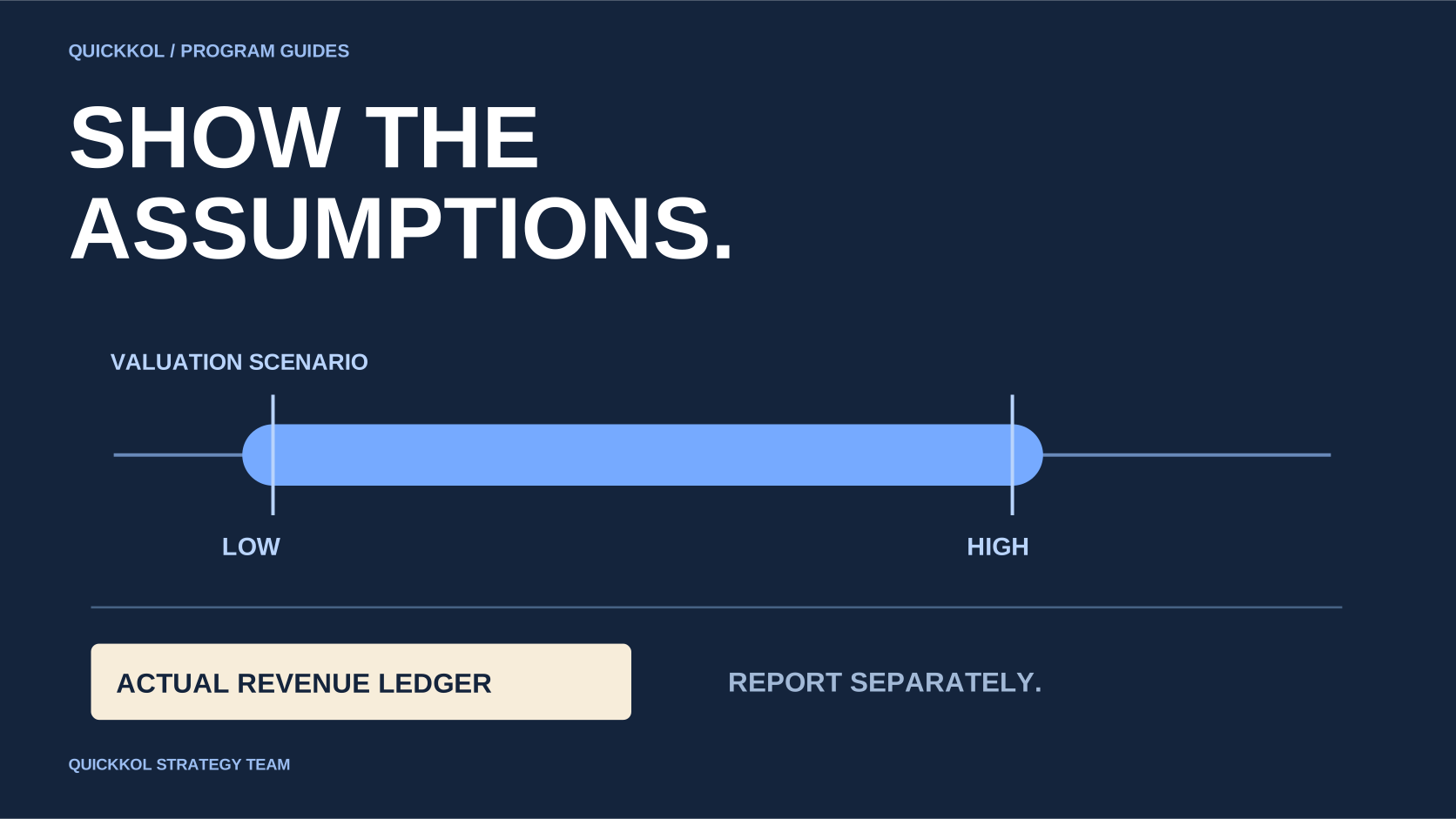
For 100,000 qualifying impressions, a simplified per-thousand equivalent-value scenario with rates of five and fifteen gives 500–1,500 in one currency. Rates are user assumptions, not market benchmarks or a vendor EMV formula.
Changing coefficients alone produces a 1,000 difference, making uncertainty clearer than a precise-looking point estimate. Avoid adding other valuations for the same behavior without a non-overlap method. Sensitivity analysis explains a model; it does not establish revenue or an avoided advertising expense.
Separate valuation from revenue, cost and incrementality
CreatorIQ measurement-methodology overview presents SMV and EMV as complementary methods, reinforcing the need to understand their distinct purposes. A media estimate should not enter the revenue ledger as sales or profit. Transactions, refunds, margin and complete costs require separate evidence.
Actual confirmed revenue of 600, campaign cost of 800 and a valuation range of 500–1,500 can coexist. Taking the upper estimate minus cost does not establish a 700 profit. Even revenue above cost does not prove incrementality without suitable comparison or experimentation.
Buy for explainability and version control
Give candidates the same deduplicated content and request sources, missing-data handling, coefficient meaning and report versions. A proprietary method may remain undisclosed while still explaining scope and influential factors. Switching for larger numbers contaminates historical trends with method changes.
QuickKOL content evidence and definitions can organize analysis context; this guide does not claim it implements a vendor’s proprietary EMV. Verify the actual product. Useful valuation software explains changes, valid comparisons and commercial conclusions that the estimate cannot support.
Evidence and calculations
Official methodology and impression sources were checked October 15, 2026. All scenario numbers are illustrative. The tool is a simplified impression-equivalent sensitivity analysis, not a vendor EMV implementation, benchmark rate or revenue forecast.
Four measures to keep distinct
Monetary labels do not make different measures additive or interchangeable.
| Decision area | What to verify | Action or boundary |
|---|---|---|
| Provider valuations such as EMV | Method, scope, coefficients and version | Interpret under comparable conditions |
| This sensitivity scenario | Same impressions and assumed rates | Show model uncertainty |
| Actual revenue | Transactions, attribution and refunds | Do not infer from media estimates |
| Incrementality and profit | Comparisons, margin and complete cost | Require additional evidence |
PRACTICAL TOOL
Impression-equivalent value sensitivity
Use assumed per-thousand rates only. This is not a vendor EMV formula; revenue and cost remain separate.
Sources and further reading
- 01CreatorIQ EMV definitions
- 02YouTube impression definitions
- 03CreatorIQ measurement-methodology overview
External pages can change. Recheck platform rules, contracts and local law before launch.