
THE SHORT ANSWER
A risk register should include the risk, trigger, likelihood, business impact, preventive action, contingency, owner, decision date and status. Record issues that could change objective, cost, timing or compliance rather than every minor problem. Review high risks weekly, convert triggered items into tasks, and record actual occurrence and cost at closeout to improve the next baseline.
Write risks as observable events
“The creator is unreliable” cannot be managed. “A signed creator has not confirmed the product works 48 hours before rough-cut production” can trigger a backup decision. Describe cause, event and impact.
Use one-to-five likelihood and impact levels for prioritization, while preserving reasoning and action rather than relying on the score alone.
Cover seven common risk groups
Common groups include creator availability, contract and payment, product logistics, content and review, disclosure and compliance, rights and amplification, and data and reporting. Keep only items material to the current campaign.
A product delay may affect both experience time and publication, but it can remain one risk with connected milestones listed under impact.
Pre-write decisions for high risks
Who activates a backup after creator withdrawal? After how many shipping days does the format change? Does inadequate disclosure pause publication? Who approves delay when ad access is missing? Decide before the trigger.
Contingencies also have costs. A replacement may change the audience, express shipping increases cost and shorter review may increase error risk.
Close risks instead of carrying them forever
Update status and outcome when a risk expires, triggers or is replaced by new scope. Once the event occurs, move execution into tasks or an incident record and preserve only decision context in the register.
At closeout, compare forecast and actual cost by risk group. If the same risk occurs in three campaigns, move it into the standard workflow or budget instead of treating it as exceptional.
Prioritize expected impact while preserving judgment
Likelihood from one to five multiplied by impact from one to five produces a one-to-25 priority score. A customs delay with likelihood four and impact five scores 20. A lower-probability disclosure breach may score 10 yet remain a blocking item. The score helps allocate attention but does not override compliance or brand boundaries.
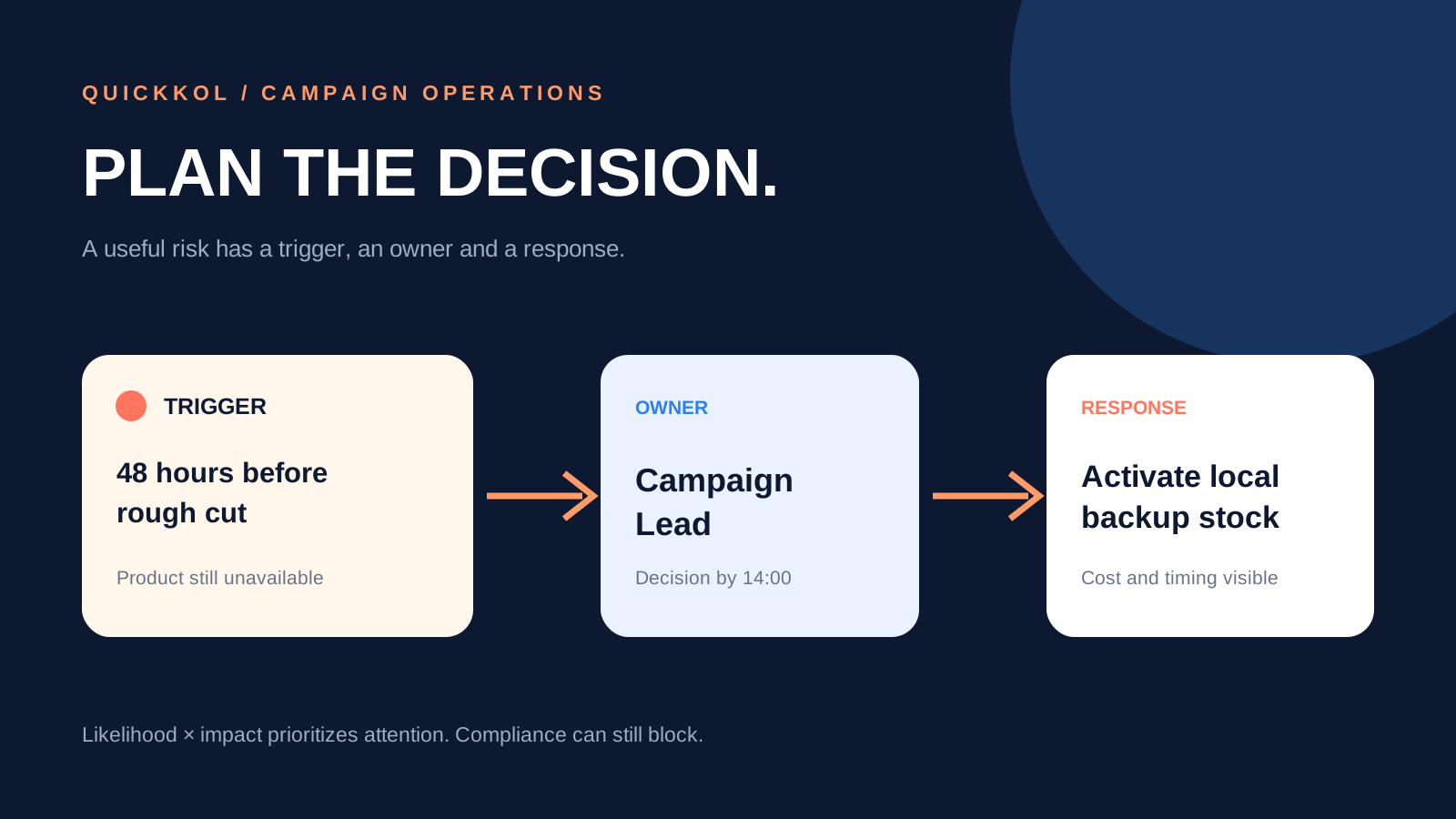
Every high risk needs a timed trigger. “Product unusable 48 hours before rough cut” triggers rescheduling or backup activation; “disclosure not approved 24 hours before publication” pauses launch. Without triggers, the register only describes anxiety. At closeout, count forecast risks that occurred, direct cost and delay days to improve the next campaign.
Risk register fields
Convert triggered risks to tasks and record actual outcome.
| Field | Example | Purpose |
|---|---|---|
| Risk and cause | International delay | Understand source |
| Trigger | Not delivered 48h before cut | Start decision |
| Likelihood and impact | 4 × 5 = 20 | Prioritize |
| Contingency | Local backup stock | Reduce impact |
| Owner | Campaign lead | Own decision |
CHECKLIST
Campaign risk review order
Use eight checks weekly for material risks.
- Are high-risk triggers approaching
- Availability or backups changed
- Contract or payment blocked
- Logistics affects product use
- Review remains on time
- Disclosure and claims approved
- Rights and ad access available
- Data and reporting available
Sources and further reading
- 01FTC: Disclosures 101 for Social Media Influencers
- 02TikTok Business: Working with creators on TikTok One
External pages can change. Recheck platform rules, contracts and local law before launch.