
THE SHORT ANSWER
Separate clicks, orders, cancellations, returns, net revenue, commission, fixed fees and rights cost. Net revenue excludes refunds and discounts; total cost includes commission, creator fees, product, platform charges and additional rights. CPA equals total cost divided by valid orders, while net ROAS equals net revenue divided by total cost. Codes, links and platform attribution can claim the same order, so define deduplication priority first.
Define valid orders and net revenue
A valid order usually completes payment and passes the return window. Preorders, subscriptions and high-return categories need different confirmation timing. Define treatment of order value, tax, shipping and discount.
With 100 orders, 10 cancellations and 15 returns, valid orders equal 75. Reporting the initial 100 overstates conversion and commission efficiency.
Combine fixed fees and commission
Hybrid work can combine publication fee, sales commission, product, platform fee and usage rights. Commission alone understates acquisition cost; publication fee alone ignores sales incentives.
Save fixed and variable cost by creator and asset, then aggregate to campaign level to compare commission-only, fixed-fee and hybrid models.
Set attribution priority across links and codes
A shopper can click a creator link, use another channel’s code and also appear as a platform conversion. Define an order-level deduplication key and priority, then report directly identifiable and assisted impact separately.
Google Analytics UTM parameters distinguish source, medium, campaign and creative, but inconsistent capitalization fragments reporting. Test naming before publication.
Interpret results by cohort and market
New versus repeat customers, market, margin and return rate change affiliate value. The same CPA means different things for a high-margin subscription and a low-margin one-off product.
Keep raw orders, net orders, cost and definition version in QuickKOL so changes can be traced to content, product, offer or attribution rules.
Start with net revenue and valid orders
Google Analytics guidance for custom campaign URLs calls for consistent parameters such as utm_source, utm_medium and utm_campaign. For affiliate creators, reconcile links, codes and platform orders at the order level before removing refunds, cancellations, tests and duplicate attribution.
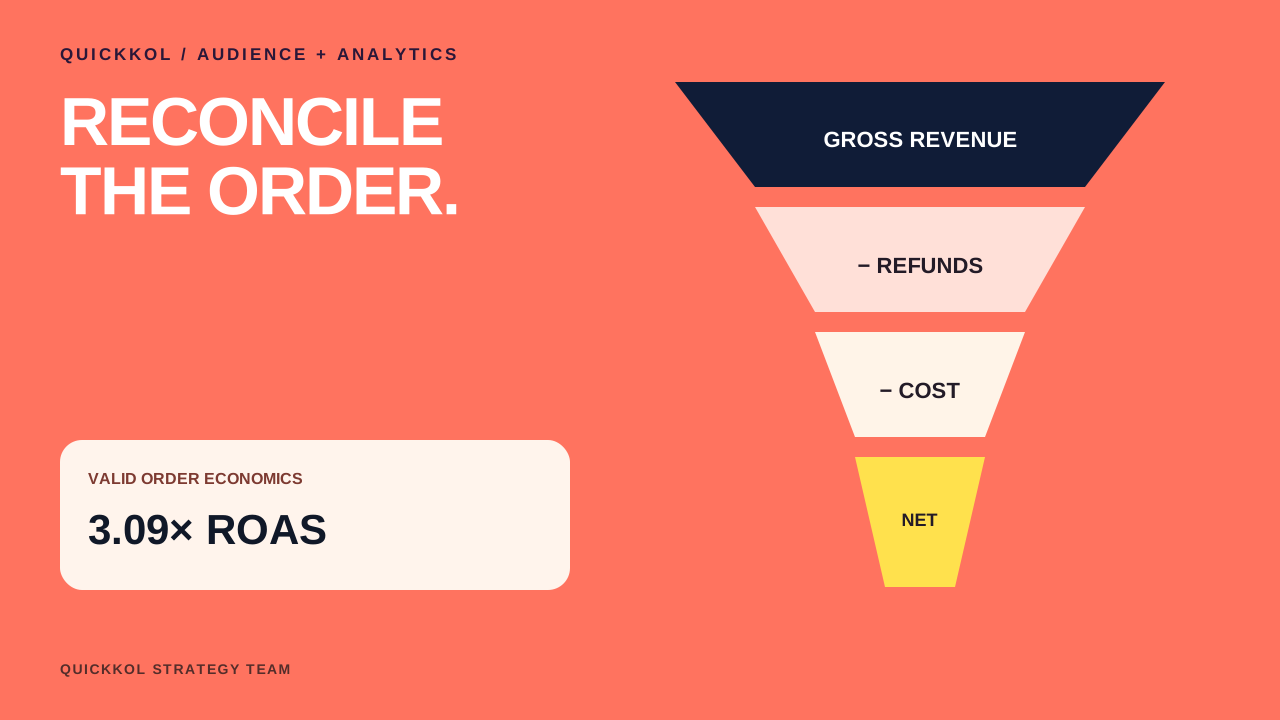
For gross revenue of 120,000 and 12,000 in refunds, net revenue is 108,000. A 12% commission is 12,960; with 22,000 in fixed and other costs, total cost is 34,960 and net-revenue ROAS is 3.09. With 720 valid orders, cost per valid order is 48.56. Report the observation and refund windows so day-three orders are not treated as final.
Affiliate conversion reconciliation
Reconcile at order level before creator totals.
| Field | Definition | Exclude |
|---|---|---|
| Gross revenue | Attributed order value | Test orders |
| Net revenue | After refunds and cancellations | Unsettled orders |
| Valid orders | Meets window and rules | Duplicate attribution |
| Total cost | Commission, production and other cost | Unrelated overhead |
PRACTICAL TOOL
Affiliate creator economics calculator
Calculate comparable results from net revenue, valid orders and full cost.
Sources and further reading
External pages can change. Recheck platform rules, contracts and local law before launch.