
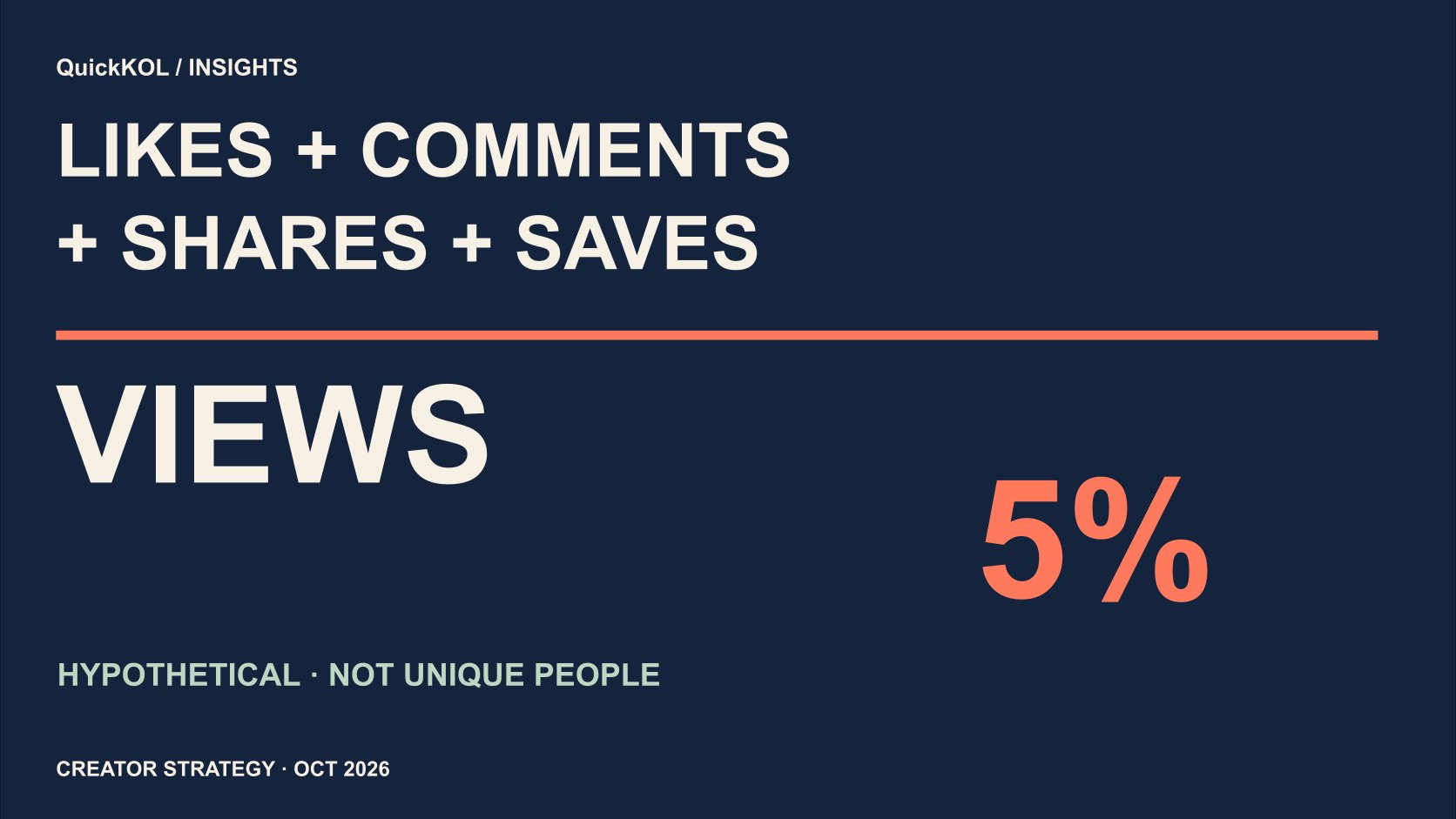
THE SHORT ANSWER
This TikTok engagement rate calculator adds likes, comments, shares and saves, then divides by views from the same video and window. Hypothetical defaults produce one thousand interactions from twenty thousand views, or five percent. Views are not unique people, and interactions are not distinct participants. The worksheet fetches no account data. It makes the chosen arithmetic transparent rather than promising a universal TikTok quality score or replacing a campaign evaluation.
Why use a view denominator here
This worksheet asks how many defined interactions appear relative to recorded views. It does not ask what share of followers watched. A TikTok video can be viewed by people who do not follow the account, so account scale and recorded viewing are different denominators answering different questions.
A follower-based measure can have a purpose when clearly labeled. Do not switch denominators between candidates to produce a preferred percentage. The denominator guide develops that choice. Select the measure before looking at the results and retain the source definition. The value of a view-based worksheet lies in a clear question and reproducible inputs, not in claiming that every other definition is invalid or that one ratio captures the complete quality of the creator.
Recalculate the five-percent default
Eight hundred likes, sixty comments, ninety shares and fifty saves total one thousand interactions. Divide by twenty thousand views and multiply by one hundred to obtain five percent. This is a hypothetical calculation, not an industry average, expected result or pass threshold.
Changing an interaction category can change the numerator definition. Report which actions are included instead of using an unexplained engagement label. The metric-definition guide helps preserve that dictionary. A teammate should be able to reproduce the number from the working rows and understand why another worksheet may produce a different result. Precision in the output is useful only when the included actions and observation window are equally clear.
Do not turn unavailable actions into zeros
If saves or shares are unavailable, leave them blank so the tool requests a complete dataset. A separate likes-and-comments worksheet can be useful, but rename it and compare the same narrower definition. Do not claim it still uses the full numerator on this page.
For creator-provided native information, preserve the authorized source and date without requesting login credentials. Keep public observations and native reports distinguishable. The single-post worksheet discusses the same missing-data principle for Instagram, while the platform definitions remain separate. A smaller consistent dataset can support a bounded question. A fuller-looking dataset assembled by assuming unavailable actions are zero can produce a misleading comparison even when the calculator performs every arithmetic operation correctly.
Inspect vendor methods before comparing
Modash’s TikTok documentation describes a view-based method involving likes, comments, shares and saves, with its own sampling and median treatment. This page calculates the entered video observation; it does not reproduce the full vendor score. Keep those roles distinct.
Matching action names do not guarantee matching sample scope. Preserve the vendor label, capture date and aggregation method rather than subtracting its result from this worksheet and declaring one incorrect. The tool-stack guide explains why meaning must survive a data handoff. A vendor metric can be valuable within its stated design, while a manual worksheet is valuable because the team can inspect its particular inputs. Neither should inherit the other’s label without a justified alignment.
Views and actions can repeat
One person may view repeatedly and may like, comment and share. Five percent describes actions relative to views, not five percent of people participating. It cannot identify unique buyers or estimate follower authenticity. Use count-based labels that match the actual source.
Small denominators can also create large swings. Four interactions from twenty views produces a hypothetical twenty percent, but offers little evidence about broad commercial performance. Report absolute counts beside the rate. A striking percentage is not automatically a stronger opportunity than a lower rate observed across a more relevant and substantial sample. The brand still needs content, audience and commercial evidence, particularly when the video’s purpose is a product explanation rather than maximizing every available action.
Choose a multi-video aggregation rule
For several videos, inspect the distribution, simple mean, median or pooled interactions divided by pooled views according to the question. These summaries are different. Do not preserve only one total score or decide whether a popular outlier belongs based on which conclusion the team prefers.
Align windows, formats and paid status. The aggregation worksheet explains the arithmetic difference between equal observation weight and denominator weighting. Applying the principle to TikTok still requires the TikTok numerator to remain consistent. An aggregation rule cannot repair incompatible inputs. Retain the video-level rows so another reviewer can see whether the summary reflects a typical asset, a few highly distributed videos or a mixture unsuitable for the proposed campaign comparison.
Connect engagement to the next result
Inspect whether comments concern the product question, the demonstration is clear and the destination works. High interaction can accompany controversy or entertainment unrelated to purchase. It does not automatically establish commercial value. Evaluate the response in relation to the content job.
For orders, use defined tracking, deduplication and refund rules. The conversion guide develops that path. Do not multiply one thousand interactions by an unsupported conversion assumption and present the result as a revenue forecast. A useful review can conclude that the explanation needs improvement or that the destination failed while acknowledging that the view-based ratio itself was calculated correctly. Arithmetic, interpretation and commercial attribution remain separate parts of the analysis.
If the ratio exceeds one hundred percent, inspect units and source consistency rather than automatically truncating it. Action counts and distinct-person shares have different constraints. The worksheet should preserve the entered arithmetic while the reviewer investigates whether the data supports that interpretation.
Save a reproducible report
Record the video URL, window, five inputs, formula, result and missing-data explanation. With zero views, report unavailable instead of replacing the denominator with an arbitrary small value. After changing inputs, confirm that the labels still describe the source.
QuickKOL can support content understanding and candidate research. The calculator supplies neither live data nor account certification. A teammate receiving the worksheet should be able to reproduce the arithmetic and identify the next verification task. That is the intended outcome: a transparent view-based observation that remains connected to its evidence, rather than a precise-looking number detached from the content, people and commercial question it was collected to help explain.
Research date, evidence and limitations
Sources reviewed October 21–22, 2026. Workflows are editorial recommendations and numerical examples are hypothetical, not observed campaign results, creator rankings or offers.
Hypothetical inputs and interpretation
Editorial analysis and labeled hypothetical examples, not performance rankings, quotes or guarantees.
| Item | Default | Meaning |
|---|---|---|
| Interaction total | 1,000 | Likes + comments + shares + saves |
| Views | 20,000 | Not unique people |
| View-based ratio | 5.00% | Not a benchmark or sales forecast |
PRACTICAL TOOL
TikTok view-based engagement worksheet
Defaults are hypothetical. Use consistent definitions and windows; leave unknowns blank and enter zero only when confirmed. This tool fetches no accounts.
Sources and further reading
External pages can change. Recheck platform rules, contracts and local law before launch.