
THE SHORT ANSWER
A credible Instagram crypto influencer follower authenticity rate study requires a defined account population, sampling method, operational labels and explicit treatment of unknown data. This article provides a study protocol and hypothetical calculations. It reports no completed empirical study, measured population rate or individual authenticity ranking. Public signals can support bounded questions, but they do not reveal every follower’s identity, purchasing behavior or the creator’s intent.
Define the estimand
Neither crypto influencer nor authentic follower is a self-defining statistical category. Specify how an account qualifies, the language and market scope, the observation date and the content window. Then state exactly which quantity the study intends to estimate. A clear estimand prevents the title from promising more than the method can deliver.
A visible-profile review may estimate the share of selected profiles showing defined public signals. That is not automatically the share of all followers who are real people. Align the question with obtainable evidence. The metric-definition guide provides a useful discipline: name the object, unit, denominator and limitation before collecting values. A study becomes difficult to interpret when those choices are made only after the results are known.
Construct the sampling frame
Describe the queries, databases or voluntary lists used to construct the account frame, and identify which accounts may be absent. Language, visibility and tool coverage can all affect inclusion. A convenient list should not be called a random sample merely because the reviewer selected several rows without strong preferences.
Freeze eligibility rules and the observation date before classification. Keep exclusions and their reasons. If more accounts are added later, identify the new batch rather than silently changing the denominator. The reproducible-query guide helps preserve discovery provenance. A transparent incomplete frame is more useful than an apparently comprehensive population whose missing segments cannot be described, because readers can at least judge the scope to which the eventual findings apply.
Use observable operational labels
Separate observed characteristics, model estimates and indeterminate cases. Sparse public information, repetitive comments or unusual relationship patterns can be review signals without establishing that an account is a bot. Do not infer private identity from a language or photograph. Use labels that describe what was actually observed.
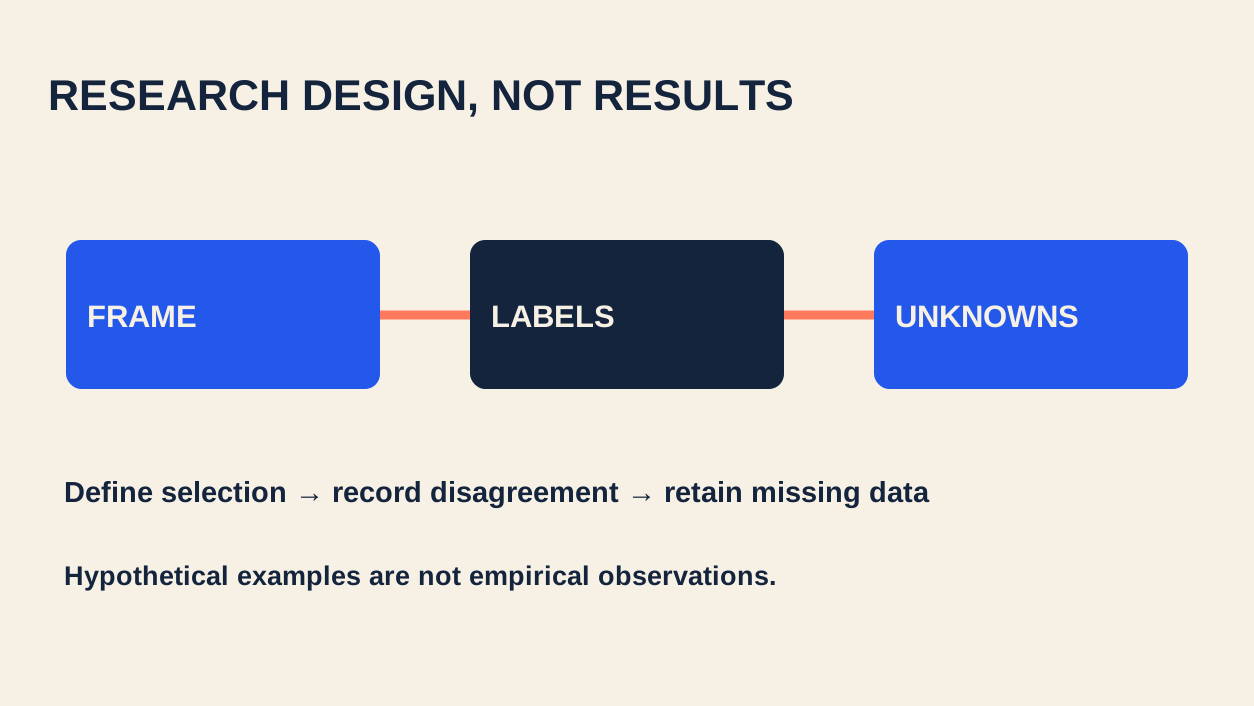
Write the classification rules before review and test them with independent reviewers. Preserve disagreement rather than resolving it through an undocumented intuition. Classification itself needs evaluation; entering a label into a spreadsheet does not make it ground truth. The fake-follower review guide develops this evidence boundary at campaign scale. For a study, the same boundary matters more because a small labeling mistake can be repeated across many rows and then amplified by an aggregate percentage.
Do not average incompatible model outputs
Modash’s official documentation explains signals and limitations behind its audience-quality estimate. It does not provide a measured result for the crypto accounts in a study that has not been conducted. If several vendors are used, retain their definitions, dates and coverage separately.
Different scores may reflect different samples or methods. Without a justified calibration model, averaging them and calling the result more accurate authenticity is unsupported. A defensible report can present disagreement as a limitation or investigate it on a defined subset. The database provenance guide helps preserve the source fields needed for that comparison. Model outputs should remain identifiable as model outputs even when the study also includes manual observation or creator-provided reporting.
Hypothetical calculation: preserve unknowns
Imagine five selected accounts with twenty visible profiles reviewed per account: one hundred profile observations. Twelve require further review, twenty-eight are indeterminate and sixty show none of the defined signals. These hypothetical categories produce twelve, twenty-eight and sixty percent of the selected observations. They do not establish eighty-eight-percent authenticity.
Followers may also overlap across creator accounts. Without deduplication, one hundred observations are not necessarily one hundred independent people. Keep that distinction in the unit label. All numbers here are invented to illustrate reporting. A real study would need its actual selection process, classification evidence and dependence assumptions before making an inferential claim. Unknown cases are part of the result, not inconvenient rows that can be removed to create a cleaner headline.
Distinguish account averages and pooled shares
If one account contributes ten observations and another ninety, the average of their account-level percentages answers a different question from the pooled share across all one hundred observations. Choose the unit and weighting rule before seeing which result is more striking. Show both only when each has a clearly stated interpretation.
Do not attach a standard random-sampling margin of error to a nonrandom convenience sample and imply population precision. Report coverage, reviewer disagreement and appropriate sensitivity scenarios with their meaning explained. The campaign-aggregation worksheet illustrates the arithmetic distinction in a different context. A formal-looking interval cannot repair an unsuitable sampling frame or unvalidated labels; uncertainty needs to reflect the actual design rather than the availability of a convenient formula.
Keep promotion disclosure separate
The SEC published a crypto-promotion disclosure enforcement case in 2022. That historical case does not measure Instagram fake followers or establish the authenticity of any current account. Promotion-disclosure risk and audience authenticity are distinct research questions, and one cannot supply missing data for the other.
This protocol does not evaluate token value or recommend an investment. If a commercial project concerns a regulated product, assign the relevant market review separately. The study report should explain what its evidence addresses and what remains outside scope. Keeping those questions separate avoids a misleading narrative in which a serious issue in one domain is used to imply misconduct in another domain without the necessary account-specific evidence.
Prepare a reproducibility package
A completed study should preserve the protocol version, account-selection rules, data dates, field dictionary, classification instructions, reviewer disagreement and aggregation code. Publish the materials necessary and appropriate for scrutiny without exposing an unnecessary list of individual followers. A reproducibility package should explain the analysis while respecting the limits of the data route used.
If the study has not been performed, say so as this article does: protocol and hypothetical examples. QuickKOL can support creator discovery and content understanding, but it does not turn an uncollected dataset into a research result. Credibility comes from letting readers assess the boundary of the evidence. The word study in a title is not a substitute for sampling, validation or observations that actually occurred.
Research date, evidence and limitations
Sources reviewed October 21–22, 2026. This is an original protocol; no account sample was collected and no authenticity rate measured. All figures are hypothetical. The SEC source supports historical disclosure context only.
Hypothetical profile observations; not study findings
Editorial analysis and labeled hypothetical examples, not performance rankings, quotes or guarantees.
| Category | Hypothetical count | Permitted interpretation |
|---|---|---|
| Further review | 12 / 100 | Defined signals in selected observations |
| Indeterminate | 28 / 100 | Not confirmed authentic |
| No defined signal observed | 60 / 100 | Not identity verification |
CHECKLIST
Before you put this into practice
Record the answers in the campaign working file.
- Define the unit in advance
- Report unknowns
- Separate models and observations
- Claim no unperformed study
Sources and further reading
External pages can change. Recheck platform rules, contracts and local law before launch.