
THE SHORT ANSWER
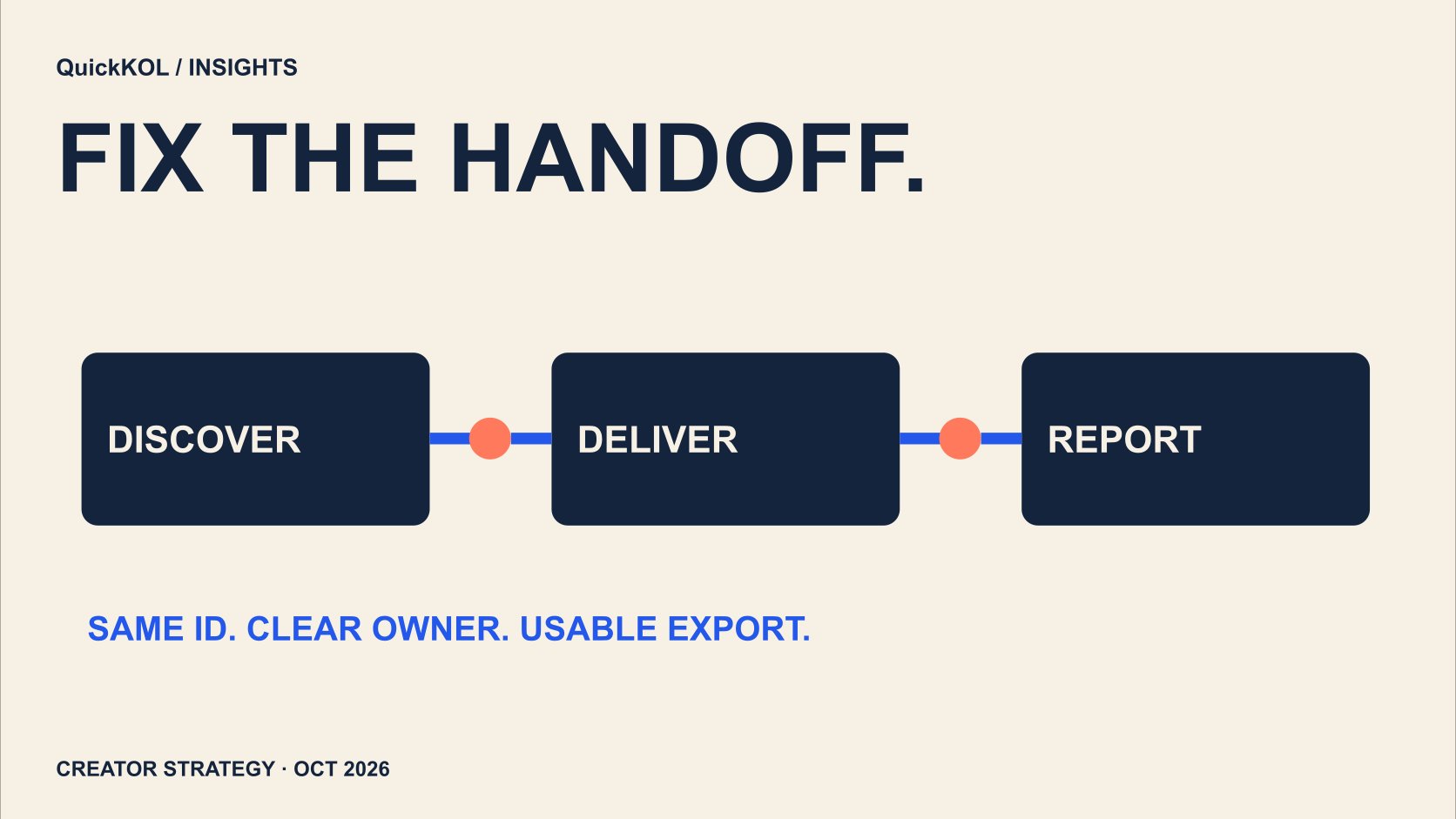
Choose influencer marketing tools by tracing where one real collaboration record loses information. Discovery, communication, delivery and reporting can live in different systems, but the stack needs shared identifiers, owners and usable exports. Repair one broken handoff before adding several overlapping subscriptions. This guide diagnoses information continuity across a small stack; it complements the separate buying scorecard and rollout guide rather than offering another generic ranking of tools.
Diagnose one real record
Choose a recent project and follow it from brief to closeout. Record each copy, rename, lookup and wait. Do not begin with the most popular product category. Begin with the part of the job that repeatedly requires reconstruction.
Write the problem as a specific statement: the sender cannot see the selection reason, or the report cannot be connected to the approved asset. Those are testable handoff failures. The platform workflow guide develops the sequence. A team can then compare changing a rule, assigning an owner or adding software against the same problem. Without that diagnosis, a new subscription may make the interface more attractive while leaving the underlying reconstruction work almost unchanged.
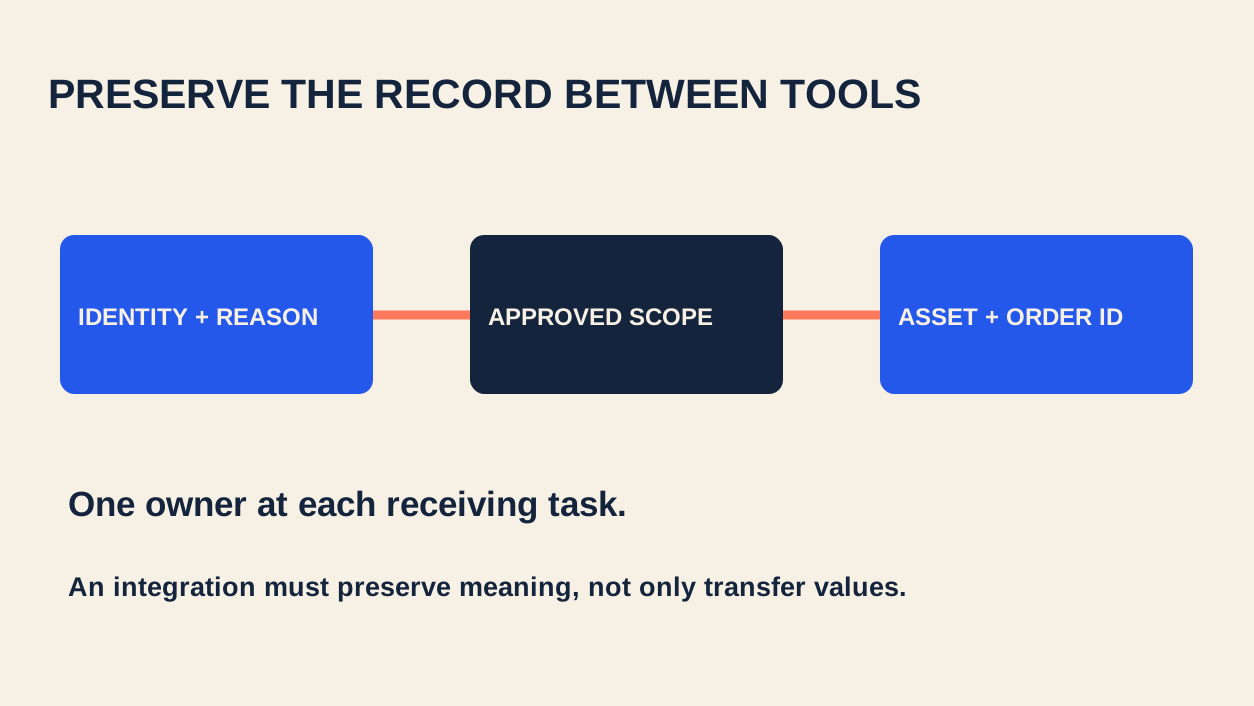
Discovery to outreach: preserve reason and identity
A discovery output should include account identity, relevant work, task-based reason and unknowns, not merely a name and follower count. If the sender receives only scale, they must repeat research or write a generic invitation. The missing context is the handoff problem.
QuickKOL can support brief interpretation, discovery, content understanding and outreach preparation. Evaluate whether a teammate can continue the task from the output rather than counting generated candidates as completed work. The shortlist workflow guide provides a usable record structure. A tool creates value here when the research reason survives the transition into a commercial conversation, allowing the sender to verify the reference and make a proposal the recipient can actually understand.
Outreach to delivery: preserve the agreed scope
Interested, quoted, agreed and in production are different states. Operations needs the latest fee, deliverables, rights and dates. A large message history does not make those facts easy to find. Preserve the decision and its original source.
Name who can approve a change so an idea in a conversation does not automatically become a task for fulfillment, the creator or finance. A small relationship sheet may be sufficient for a limited campaign. Test it before purchasing a more elaborate system. The brief-change guide helps distinguish approved scope from a request still under discussion. The best tool choice may be a narrower one when the real problem is unclear authority rather than insufficient automation.
Delivery to reporting: connect assets and outcomes
Retain live URLs, asset identifiers, approved versions, publication dates and rights. Order reporting also needs tracking definitions, deduplication and refund treatment. Metrics do not become comparable merely because several panels appear in one interface.
Google Analytics transaction-ID documentation provides a reference for purchase deduplication. Each metric still needs its own definition and window so the same order is not counted repeatedly across reports. The conversion-tracking guide develops the full reconciliation task. A reporting tool is useful when the team can connect the number to the correct asset and underlying event. It is less useful when attractive totals conceal missing identifiers or a mixture of observations collected at incompatible stages.
Turn documentation into test tasks
Modash’s official overview can inform discovery requirements, while Social Snowball’s current materials describe affiliate and creator workflows. These are starting points for tests, not evidence that this article performed an end-to-end trial of either product. Keep documented and personally verified capability distinct.
For each tool, write the input, required output, access, limitation and failure owner. Do not infer identical fields or integrations from a shared influencer-marketing label. The software-feature guide demonstrates this evidence-state method for one vendor. A test should follow a representative task through the actual configuration, including the export or handoff the team needs, rather than ending at a screenshot showing that the feature name exists somewhere in navigation.
Inspect identifiers and exports
Check stable relationships among accounts, people, campaigns, assets and orders. After export, retain field names, units, sources and dates. An integration-success message does not establish that all required context reached the next system. Inspect the receiving record.
Ask a teammate to continue a task from the exported material alone. If they must ask the original operator what a field means, record the gap. A small data dictionary may solve more than another integration. The database guide develops provenance and entity design. The aim is continuity of meaning, not merely movement of values. A stack can transfer thousands of rows successfully while still failing the practical test of helping someone make the next correct decision.
Worked example: calculate net effort
Suppose a tool saves four hours weekly but requires one hour of cleanup, forty-five minutes of synchronization and thirty minutes of maintenance. Net saving is a hypothetical one hour and forty-five minutes. These invented values describe a method, not a product performance claim.
Include training and error correction where relevant. If work simply moves to another department, one operator’s reduction is not necessarily a team-wide saving. Compare the same task volume and quality requirement before and after the change. The buying scorecard helps assess the broader decision. A useful cost model includes the bridges between systems, because that is often where an apparently efficient stack recreates the manual work it was purchased to remove.
Choose the authoritative place for correcting each shared field. Otherwise two systems can overwrite one another after teammates repair the same record differently. A named correction route is often more useful than another synchronization feature that moves inconsistent values faster between applications.
Repair one handoff at a time
Choose the handoff that most affects the current assignment and define the evidence of success and its owner. Run it on a limited batch before deciding to retain, replace or add a tool. There is no need to rebuild the whole operation when one explicit bridge can solve the immediate problem.
Evaluate QuickKOL against the tasks it actually supports. The final stack should reduce guessing, preserve evidence and allow work to continue when a product changes. A successful repair is visible in the receiving task: the sender can explain the candidate, operations can find the approved scope or finance can reconcile the order. That outcome is more meaningful than the number of applications connected to the same dashboard.
Research date, evidence and limitations
Sources reviewed October 21–22, 2026. Workflows are editorial recommendations and numerical examples are hypothetical, not observed campaign results, creator rankings or offers.
The working sheet for this task
Editorial analysis and labeled hypothetical examples, not performance rankings, quotes or guarantees.
| Decision | Evidence to keep | Next action |
|---|---|---|
| Discovery → outreach | Identity, work and reason | Check sender readiness |
| Outreach → delivery | Approved scope and dates | Check operations readiness |
| Delivery → reporting | Asset and order identifiers | Check reconciliation |
CHECKLIST
Before you put this into practice
Record the answers in the campaign working file.
- Start with one real record
- Repair one handoff first
- Export meaning with values
- Measure net team effort
Sources and further reading
- 01Google Analytics: Transaction-ID deduplication
- 02Modash: Official brand platform overview
- 03Social Snowball
External pages can change. Recheck platform rules, contracts and local law before launch.