
THE SHORT ANSWER
Social Snowball’s current public materials cover customer referrals, affiliate and creator operations, and creator search. Evaluate the product against the recruitment, tracking, discount-control and payout tasks your store actually needs. This is a documented-feature review, not a logged-in account test or an independent performance benchmark. A feature listed on a website becomes procurement evidence only after the team confirms access, limits, integration behavior and the result of a representative workflow.
Identify the program you need to run
Customer referrals, ongoing affiliates and one-off paid content start from different relationships. Map one actual journey: who joins, what they receive, what counts as a qualified result and when the brand settles compensation. A broad influencer-platform label does not explain whether the product suits that journey.
Prepare a representative test and expected outputs before a demo. For an affiliate program, that could mean enrolling one authorized test partner, creating a tracking route, completing a test order and reversing it through the approved refund process. The platform workflow guide helps identify handoffs. Keep the test small enough to inspect each record rather than relying on a polished tour through unrelated parts of the interface.
Referrals and affiliates: verify the rules
Social Snowball documents customer activation, affiliate management and configurable attribution on its official site. These are vendor descriptions, not confirmation that every rule or storefront configuration is supported in your account. Check the actual integration and plan before treating a capability as available.
Write the rule cases that matter: new versus returning customers, overlapping discounts, returns, partial refunds and a partner buying through their own route. Ask what happens in each case and inspect the resulting record. Save an approved rule sheet and compare it with the observed test output. A clear exception can be manageable; an unknown exception becomes difficult when finance discovers it only after creators expect payment.
Creator search: update the category assumption
The official Creator Search page currently describes Instagram discovery, lookalikes, creator insights and email outreach. An older assumption that Social Snowball has no discovery component would therefore be incomplete. Treat the current product route as something to verify rather than relying on a category description written years earlier.
A public page does not demonstrate coverage for your niche. Test a known relevant account and one difficult query. Inspect the available fields, update dates, contact provenance and export behavior. Ask which restrictions apply to the account and plan being demonstrated. Keep documented capability separate from the result of your own search test; neither a large advertised universe nor a polished example establishes that your hard-to-find candidates are covered.
Safelinks: inspect mechanism and limits
Safelinks documentation describes generating a unique single-use discount code for a customer who clicks the link. That differs from assigning one permanent public code to each partner. Understand the mechanism without turning marketing language about eliminating fraud into an unconditional guarantee.
Test the customer experience on relevant devices. Check repeat clicks, expiration, an existing cart discount and post-refund behavior. Record any friction as well as the intended control. A discount mechanism does not independently establish incremental sales or replace order reconciliation. The conversion-tracking guide explains why traffic provenance, purchase records and credit rules remain separate tasks even when the route reduces a particular kind of code sharing.
Seeding and communication: follow the status
The official overview includes seeding and communication workflows. In a demonstration, follow one partner from application through receipt confirmation, product selection, dispatch and an exception. A sent-message indicator is not proof that the fulfillment team has the information needed to ship the correct sample.
Check who can contact a partner, edit shipping information, resolve unavailable stock and close a declined invitation. If an external sheet remains necessary, name its owner and synchronization point. The seeding logistics guide develops the underlying operating requirements. Evaluate whether the tool preserves the decision and context at the next handoff, rather than merely displaying each step somewhere in the interface. A manual bridge is acceptable when its cost and responsibility are explicit.
Payouts: test your settlement conditions
The official overview describes payout options including cash, gift cards and store credit. Verify the provider, country availability, thresholds and fees for your configuration rather than inferring global support from an option name. The recipient’s ability to receive the payment is part of the test, not an administrative detail to resolve later.
Ask finance to inspect pending, approved, completed and failed states, plus refund adjustments and export fields. A settled amount should be traceable to a partner, period and approved qualification rule. The affiliate-outreach guide explains why those terms belong in recruitment as well. A persuasive commission offer becomes difficult to maintain when the team cannot explain how an earned amount turns into a payment the partner can actually receive.
Worked example: include operating effort
Suppose software costs a hypothetical $300 monthly and exception handling takes six staff hours valued internally at $35 each. The working model totals $510 before other costs. These invented figures are not Social Snowball pricing. Replace them with your actual quote and measured effort.
Compare another option using the same partner count, order scenarios and operating window. A higher subscription could require less cleanup, but that must be demonstrated rather than assumed. Do not insert a vendor customer’s revenue result into your own forecast. The pricing-contract guide helps translate the selected scope into a comparable total. Procurement is stronger when the model includes unresolved integration work and finance effort instead of counting only the most visible monthly fee.
Keep the demonstrated plan and configuration beside the feature checklist. A capability shown in a higher-tier demonstration may not belong to the quoted package, so resolve that mismatch before the purchasing recommendation turns a conditional feature into a promised operating requirement.
Conclude with evidence states
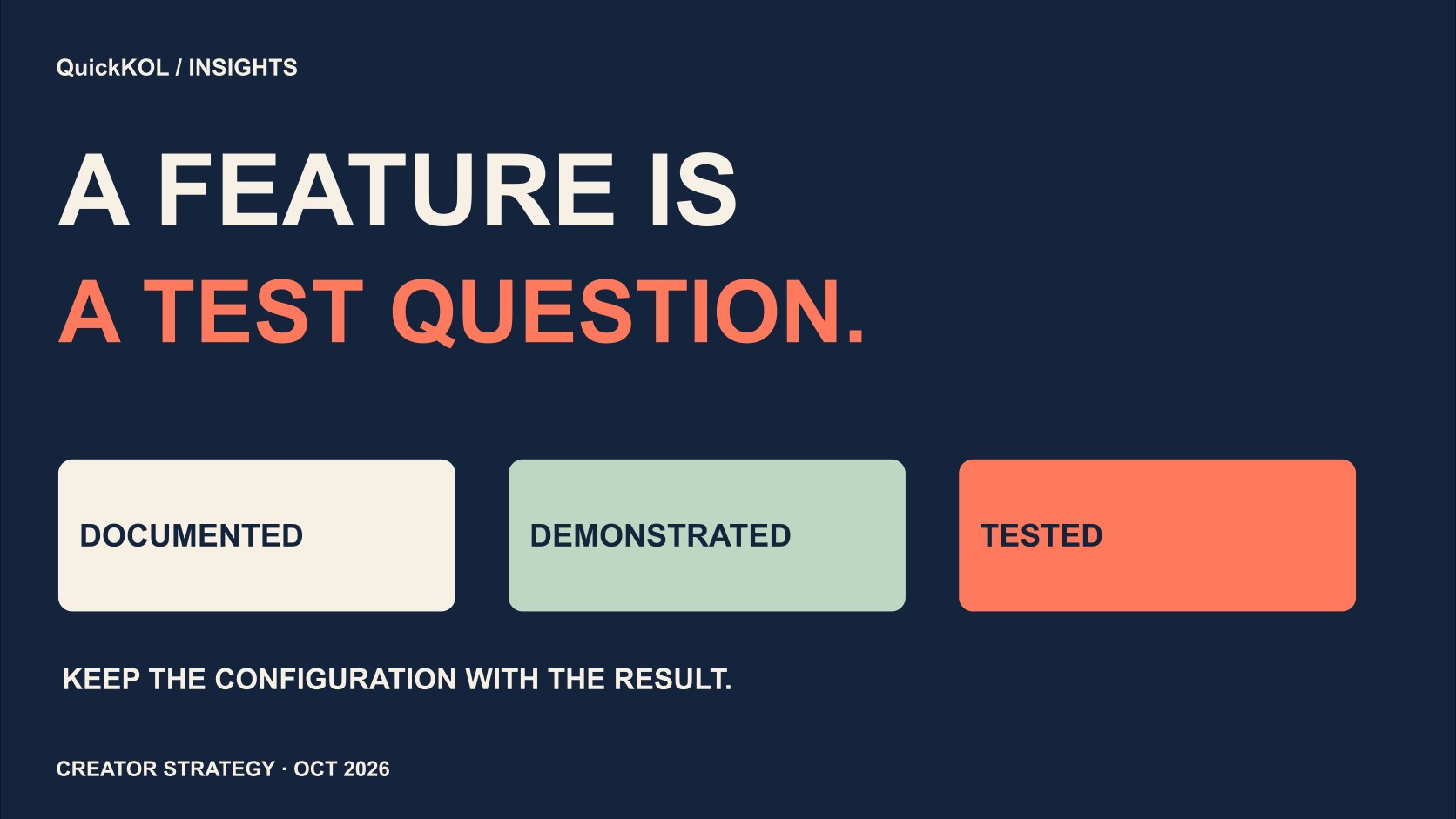
Mark each requirement as documented, demonstrated, personally tested or unresolved. Save the date, configuration and result rather than a single supported checkbox. If a critical workflow remains incomplete, make the recommendation conditional on resolving it. This creates a reviewable purchasing decision without pretending that reading product pages is equivalent to running the store.
QuickKOL can support brief interpretation, discovery, content understanding and outreach preparation. Do not infer parity with Social Snowball’s commerce, payout or affiliate capabilities from the shared creator-marketing context. Choose tools around the job and the evidence available. A useful recommendation explains which part of the operation becomes easier, which dependencies remain and who will maintain the resulting workflow after procurement.
Research date, evidence and limitations
Sources reviewed October 21–22, 2026. Based on official pages accessible October 21–22, 2026. No logged-in software test was performed. Verify availability, pricing and outcomes in your own configuration.
The working sheet for this task
Editorial analysis and labeled hypothetical examples, not performance rankings, quotes or guarantees.
| Decision | Evidence to keep | Next action |
|---|---|---|
| Documented | Official page and date | List test conditions |
| Personally tested | Configuration and full output | Inspect limits and exceptions |
| Purchase decision | Quote and net operating cost | Retain unresolved conditions |
CHECKLIST
Before you put this into practice
Record the answers in the campaign working file.
- Use no unverified pricing
- Test search coverage
- Separate code controls and incrementality
- Verify regional payouts
Sources and further reading
External pages can change. Recheck platform rules, contracts and local law before launch.