
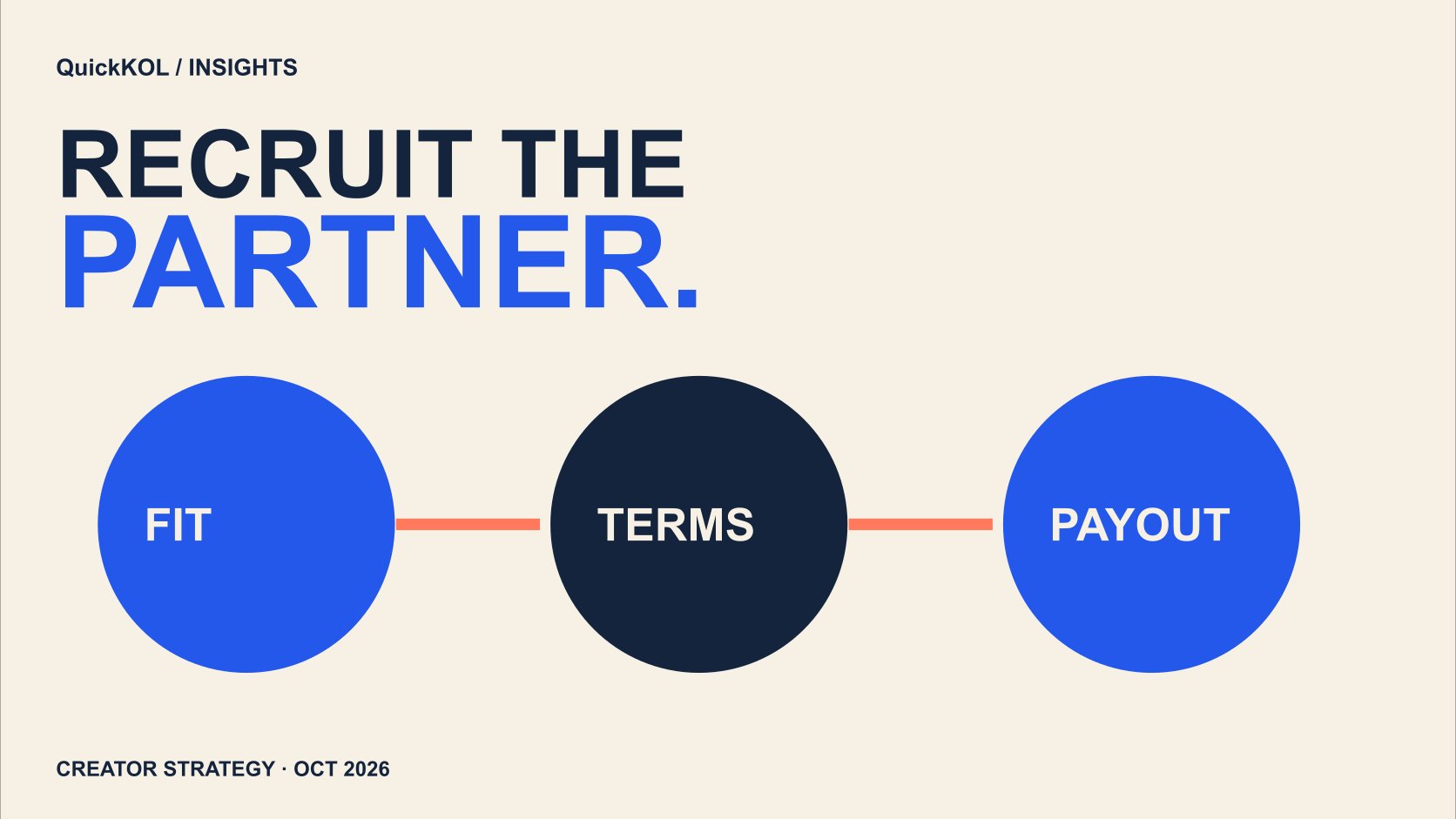
THE SHORT ANSWER
Affiliate outreach is the process of inviting suitable partners to promote a product under defined tracking and reward rules. Partners can include creators, publishers or existing customers. It is not a way to obtain a fixed production assignment for free. Explain commission, qualifying transactions, payouts, product access and support so the recipient can evaluate the arrangement. If the brand requires specific deliverables, discuss that work and its compensation separately from the sales incentive.
Decide whether an affiliate arrangement fits
A high commission cannot repair an unavailable product, unreliable stock or an untested checkout. Test the purchase route and support process before asking partners to take promotional risk. The offer should describe a functioning customer journey rather than a future possibility the brand hopes to build after recruitment.
Check whether the partner’s format provides a suitable route to the next step. Not every strong creator wants sales-dependent compensation, and declining that model does not imply weak content. The creator offer guide helps compare compensation structures. Affiliate outreach works best when the product, partner format and reward logic fit together, not when commission is used as a default answer to every request for a production budget.
Explain the partner fit
Reference a published piece or editorial area and explain how the product relates to the audience’s problem. A high-rate claim is not a substitute for relevance. State the category, intended user, supported market, relevant price context and available materials.
Personalization should concern the work rather than private assumptions. Let the recipient decide whether the product deserves further attention before asking them to register for hidden terms. The useful-reply guide helps frame one next decision. A clear fit reason also improves internal review: another teammate can check whether the offer is suitable and whether the brand’s description matches the actual product instead of approving a message based only on enthusiastic language.
Define the commission base
Ten percent can refer to net product revenue, order revenue or another defined base. Explain the treatment of taxes, shipping, discounts, refunds and subscriptions. The partner should not discover a smaller-than-expected denominator only when the first statement arrives.
State the attribution window and overlap rules, plus the point at which a pending amount becomes payable. A simple rule set can be sufficient when it is explicit. The ambassador economics guide develops the broader model. Keep the rule version and effective date with the invitation so a later conversation can distinguish the original offer from a subsequent program change. Commercial clarity depends on the qualifying base and timing as much as on the headline percentage.
A first-invitation example
Fictional example: “Hi Lee, your home-coffee-corner content is relevant to our compact coffee tool. We would like to invite you to review an affiliate arrangement based on confirmed net product revenue. The rate, return waiting period and payout method are explained in a one-page terms sheet. There is no fixed posting requirement; if you want to discuss custom production, we can agree on scope and fees separately. Would you like the product information and terms?”
Use actual approved terms when sending. The example illustrates structure, not an offer or recommended rate. A recipient should be able to understand the arrangement before committing to activity, and the brand should be able to identify exactly which reply it needs next.
Test tracking and payout first
Social Snowball’s official materials describe affiliate and payout workflows. That shows a category of software support, not that the brand’s own configuration is correct. Any selected tool needs verification against the actual storefront, market and approved rules.
Run an authorized test through link creation, order, refund, commission adjustment and payment state. Keep the result and unresolved exceptions. The software-feature guide provides a more detailed procurement test. Do not make the first real partner discover the system’s limitations through missing credit or delayed payment. A recruitment message is credible when the promised process has an operating owner and a tested path behind it, rather than only a percentage and a sign-up button.
Worked example: explain earnings without promising them
Suppose qualifying net product revenue is a hypothetical $800 and commission is ten percent, producing $80 pending. If $100 of product revenue is refunded and excluded under the stated rule, the amount becomes $70. These figures are invented to explain the calculation, not predict a partner’s earnings.
The waiting period, payment threshold and available payout route still matter. Do not label a pending amount cash received. The invitation can provide a transparent worked example while making clear that actual results depend on qualifying transactions and the agreement. Avoid presenting a vendor success story or another partner’s revenue as the recipient’s likely outcome, because neither establishes what this person will earn from the brand’s product and audience.
Assign reply and support ownership
After interest, provide terms, product information and approved materials. If the recipient asks about compensation, explain the difference between fixed work and commission rather than treating the question as a lack of enthusiasm. Close a refusal and stop the recruitment sequence.
Assign owners for broken links, settlement questions and product feedback. Partners need a route for resolving problems as well as a route for enrolling. The outreach operations guide develops status and ownership. A useful program does not require someone to prove they deserve payment before the brand will explain its offer. Support quality is part of the relationship and should be included in staffing and cost rather than assumed to happen informally whenever a partner needs help.
For subscription products, state whether compensation covers the first qualifying purchase or approved recurring payments. Do not imply lifetime earnings when the agreement supports only an initial order. The invitation should make the duration as understandable as the commission percentage itself.
Evaluate recruitment quality
Track interested, qualified, tracking-enabled, qualifying-result and settled states separately. Many sign-ups with no usable product experience can indicate a recruitment or readiness problem. Do not call every registration an active partner or treat enrollment count as proof of commercial success.
QuickKOL can support relevant discovery and personalized outreach preparation. Settlement, orders and affiliate rules still need verification in the appropriate systems. Run a small batch, resolve operational issues and then expand. Recruitment quality is visible when partners understand the terms, can perform the intended activity and can receive the reward under the rules. A large list of accounts does not establish any of those conditions by itself.
Research date, evidence and limitations
Sources reviewed October 21–22, 2026. Workflows are editorial recommendations and numerical examples are hypothetical, not observed campaign results, creator rankings or offers.
The working sheet for this task
Editorial analysis and labeled hypothetical examples, not performance rankings, quotes or guarantees.
| Decision | Evidence to keep | Next action |
|---|---|---|
| Invitation | Fit reason and terms | Ask for interest |
| Activation | Tested tracking and support | Confirm operational readiness |
| Settlement | Qualified amount and adjustments | Pay under the rules |
CHECKLIST
Before you put this into practice
Record the answers in the campaign working file.
- Discuss fixed production separately
- Define the commission base
- Test links and payout
- Promise no expected earnings
Sources and further reading
External pages can change. Recheck platform rules, contracts and local law before launch.