
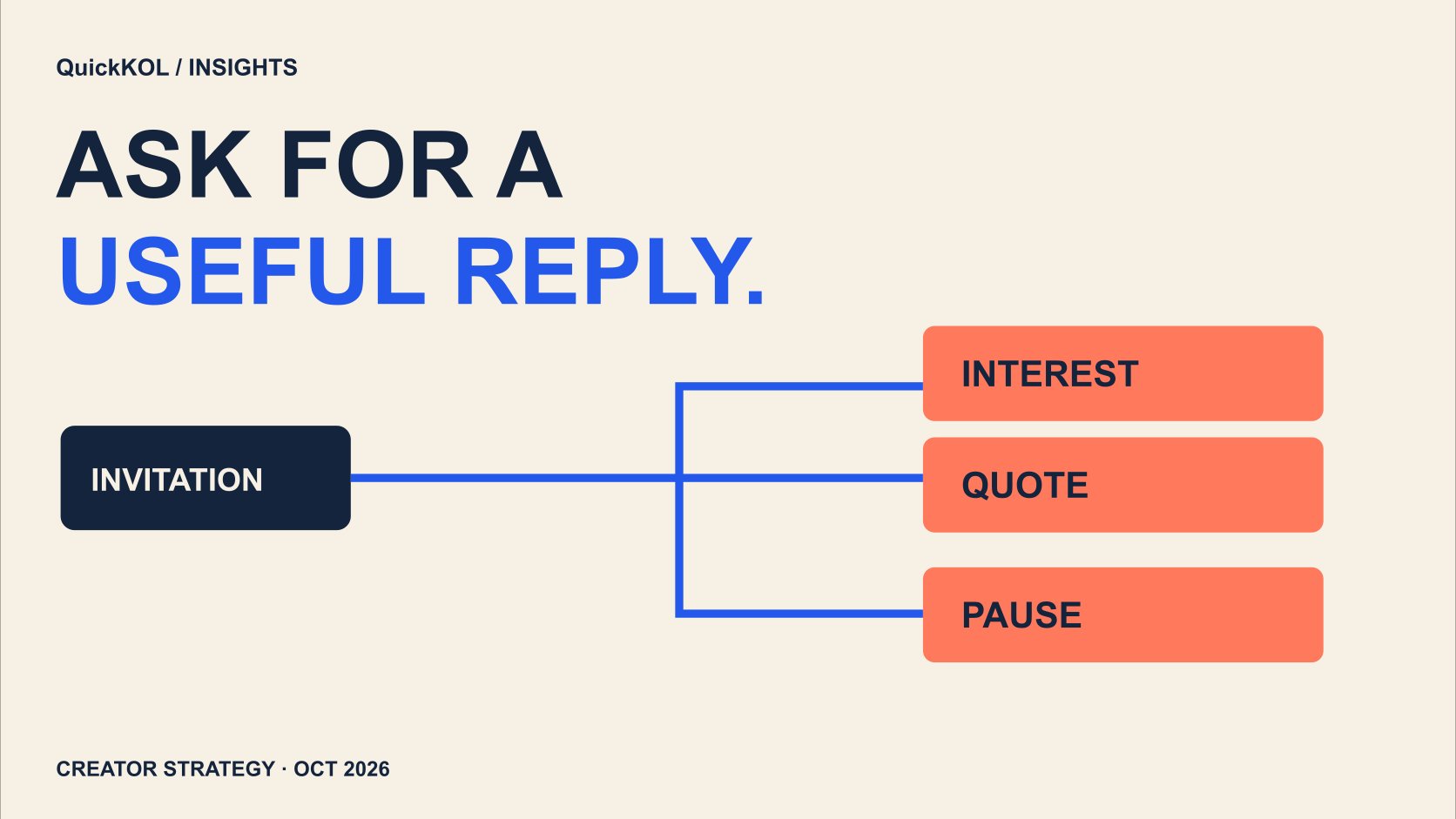
THE SHORT ANSWER
Influencer outreach is the process of starting and developing a relevant commercial conversation with a creator. A useful first message lets the recipient judge fit and gives the brand the information needed for one next decision. Start with a verified content reason, an honest description of the offer and a small qualification request. Then handle interest, quotations, refusals and timing separately. This guide focuses on the quality of the reply you request, rather than treating any response as campaign progress.
Know which offer you are authorized to make
Before opening an inbox, identify whether the proposal is paid production, an optional gift or a commission arrangement. These offers ask the creator to take different risks. If budget or timing is unapproved, describe the message as an availability inquiry rather than a confirmed assignment. Do not obtain a detailed creative proposal by implying that a purchase has already been approved.
Write the single missing fact that prevents progress: category availability, location, production capability or a quotation for a defined scope. Check the relationship record and assign one sender. A second teammate should not offer different terms while the first conversation remains active. The outreach operations guide explains how to maintain that ownership.
Use a content reason the recipient can recognize
A recognizable reference is more useful than an exaggerated compliment. Identify a published piece, the customer question it answered and the related assignment you want to discuss. A storage brand might reference a creator’s explanation of installation limits in rented apartments, then propose a paid demonstration of another renter-friendly product. The connection concerns the work rather than assumptions about the creator’s private circumstances.
Save the reference URL and your interpretation in the candidate file. Someone reviewing the message can then check whether the reference is accurate. QuickKOL can assist with brief interpretation, content understanding and outreach preparation; the sender remains responsible for verifying the account, the work sample and the proposed product facts.
First-message example: ask for one small decision
Here is a fictional first message: “Hi Alex, I manage creator partnerships at North Shelf. Your video about rental-wall restrictions clearly explained when an installation method is unsuitable. We are planning a paid product demonstration for November to help renters judge whether our organizer fits their space. Would you like to see a one-page brief? If it looks relevant, we can confirm scope, quotation and timing.”
The invented brand and creator illustrate message structure, not an actual offer. Include a real approved budget range when you can share one. If you cannot, state that you are requesting a quotation. Avoid attaching a large production assignment before the recipient has agreed that the category and opportunity are relevant.
Turn interest into a scoped conversation
An interested reply is permission to clarify the opportunity, not acceptance of a contract. Send the deliverable format, product constraints, production and publication windows, revision allowance and any intended advertising license. Ask for a quotation against that scope. Otherwise a low initial quote may reflect a smaller job, and later additions can appear like concealed requirements.
Treat repeated creator questions as evidence that the brief is incomplete. If several recipients ask about exclusivity or raw footage, update the shared brief instead of answering from memory each time. The collaboration workflow guide covers the transition into approval and delivery. Outreach succeeds when the next conversation starts with fewer ambiguities, not simply when an inbox receives more messages.
Route each reply to the right next action
A quotation above budget needs a scope discussion before a discount request. A recipient interested only in a sample needs clarity about whether publication is optional. A refusal closes the invitation; it is not a reason to approach the same person through several additional accounts. For a timing deferral, record the date the creator actually proposed rather than inventing a permanent follow-up permission.
FTC guidance identifies gifts as a possible material connection requiring disclosure when the product is endorsed. Optional publication does not mean optional transparency. Keep the commercial arrangement and the disclosure task separate in the record. A gift note can express appreciation, but it should never quietly replace the terms discussed in the outreach conversation.
Make a follow-up informative
Set an internal follow-up limit and avoid sending simultaneous reminders across email and several social accounts. A useful follow-up might add an approved budget, a later production window or a genuinely smaller scope. If nothing changed, keep the reminder brief and make it easy to decline. Do not invent urgency to compensate for a weak proposal.
Silence has several possible explanations, including workload, representation, timing and lack of fit. None justifies escalating pressure. A real deadline can be stated with its practical consequence, such as moving the shoot to another month. The follow-up guide offers a dedicated process for reminders. Preserve the reason a conversation stopped so the team does not restart the same unsuccessful sequence every week.
Measure useful replies separately
Suppose forty invitations were delivered, twelve received a response and seven resolved a relevant next decision. The hypothetical response rate is thirty percent, while useful decision replies represent 17.5 percent of delivered invitations. These are worksheet definitions, not industry benchmarks. Keep the denominator and decision rule beside the result.
Break the remaining outcomes into undelivered, incorrect contact, interest without an approved offer and quotation received. Each suggests a different change. Poor contact quality needs verification; an unclear assignment needs a better brief; budget mismatch needs different procurement choices. Change one variable in the next small batch and preserve the batch date. Otherwise a team can celebrate an improved percentage caused only by changing which replies it counts.
Leave a record another teammate can continue
At the end of each exchange, update status, owner, current scope and the next agreed date. A screenshot can preserve evidence, but it does not replace a searchable statement of the decision. Keep the original message route and a concise summary so a teammate can verify the interpretation without reconstructing the entire conversation.
A practical handoff test asks four questions: why was this creator selected, what did the brand propose, who owes the next action and when should contact stop? Run that test on a small real batch before expanding volume. More automation cannot repair an offer the brand cannot explain. The strongest outreach process makes relevant conversations easier for both parties and leaves declined opportunities closed cleanly.
Research date, evidence and limitations
Sources reviewed October 21–22, 2026. Workflows are editorial recommendations and numerical examples are hypothetical, not observed campaign results, creator rankings or offers.
The working sheet for this task
Editorial analysis and labeled hypothetical examples, not performance rankings, quotes or guarantees.
| Decision | Evidence to keep | Next action |
|---|---|---|
| Interested | Category and timing confirmed | Send the scoped brief |
| Above budget | Equivalent-scope quote | Discuss scope or close |
| Declined | Original reply | Close and stop follow-ups |
CHECKLIST
Before you put this into practice
Record the answers in the campaign working file.
- Assign one owner
- Keep the work reference
- Name the compensation model
- Define a useful reply
Sources and further reading
External pages can change. Recheck platform rules, contracts and local law before launch.