
THE SHORT ANSWER
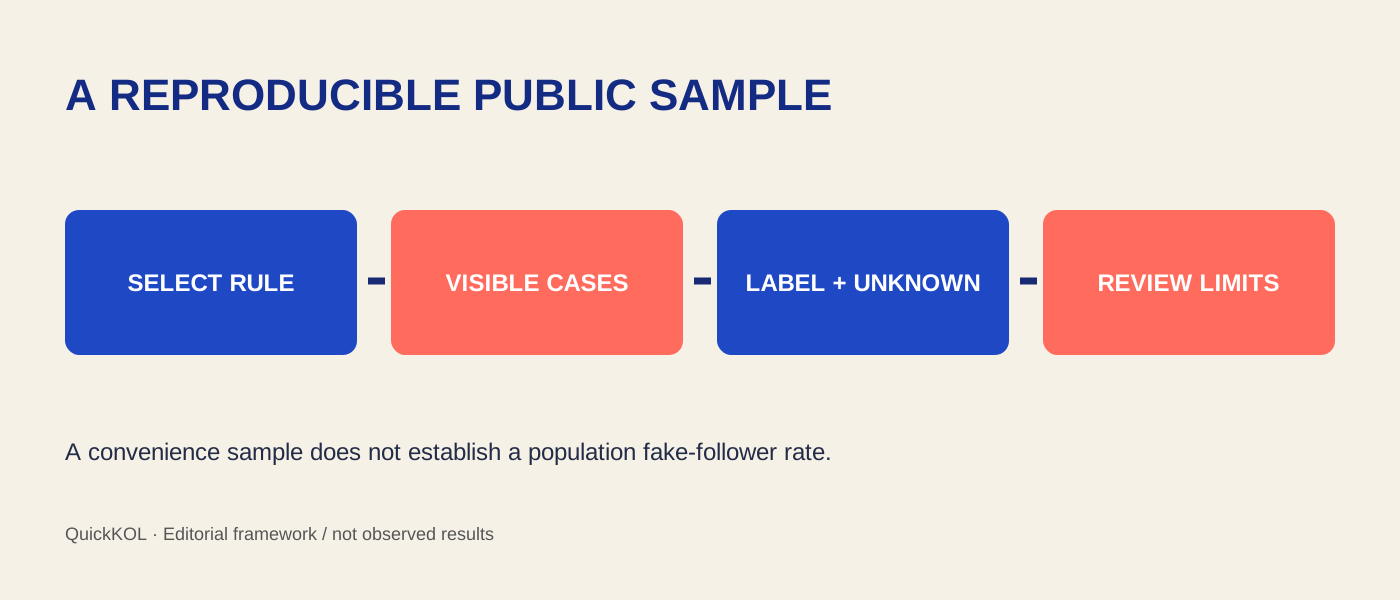
A public sample can reveal patterns worth investigating only when its collection rule is documented. Selecting whatever a page shows first is not automatically random sampling. Record the access route, time, positions and unknown labels, then limit the conclusion to the records actually reviewed. Without a suitable sampling frame, do not publish a precise-looking authenticity rate for the whole follower population or imply that more decimal places have solved selection bias.
Define what is accessible
Record whether the accessible material is a follower list, commenters or a subset exported by a tool. Those are different populations. They are not interchangeable simply because each appears near the same account. Respect the available access route instead of bypassing restrictions to complete a predetermined sample size.
The follower-checker guide provides useful identity and observation fields. Confirm the correct account and time before preserving a sample boundary. If only a small portion is visible, state that limitation. The report should not imply that every follower was inspected. This initial definition determines what the later percentages can mean. It also prevents a reviewer from using a comment sample to make a claim about all followers when non-followers may be among the people who commented.
Write the selection rule
Fix the access route and selection method before review, such as specified positions in a visible list at a stated time. This makes the process explainable, but it remains a convenience or systematic selection unless inclusion probabilities are known. Reproducibility of a rule does not establish representativeness of the population.
Do not expand around suspicious-looking records after seeing them and then pool the expansion into the original percentage. Investigative follow-up can be useful, but label it separately. Preserve why those additional records were selected. This prevents the investigator’s curiosity from silently changing the sample. A clear file can contain both an initial structured review and a targeted follow-up without pretending they were produced by the same selection mechanism or support the same numerical conclusion.
Code observations before interpretations
Use a small set of observable fields, such as visible public work, clearly repeated text and unavailable information. These are not automatic fake-account rules. Preserve unknown when language or context cannot be interpreted confidently. Do not make an uncertain classification merely to avoid blanks in the worksheet.
Modash describes a network-signal model in its methodology documentation. A manual public review does not reproduce that model. Do not describe a few visual checks as equivalent detection technology or borrow a vendor threshold to certify your sample. The purpose is a transparent exploratory record. Keep the reviewer’s interpretation separate from the underlying observation so another person can disagree, correct or add context without losing what was originally visible.
Worked example: unknown labels change the bounds
Suppose forty reviewed records contain twelve flagged under the project’s rule, twenty unflagged and eight unknown. Flags represent thirty percent of the inspected sample. If every unknown also met the flag condition, the arithmetic upper bound would be fifty percent. These are hypothetical labels used to explain missing-category treatment.
The range is not a confidence interval, a whole-audience fake-follower rate or a measured detection accuracy. It is simply two treatments of unknown classifications in that sample. Do not use it to infer who purchased followers. Report the rule and counts together. A compact presentation can say twelve flagged, eight unresolved, forty reviewed, which often communicates the evidence more honestly than a headline percentage that encourages readers to forget the sampling and classification limits.
Support a second review
Ask a second reviewer to assess a subset independently and inspect the reasons for disagreement. If one flags a missing avatar while another leaves it unknown, resolve the rule before calculating a combined result. Averaging judgments does not automatically create a valid label.
Retain anonymous record identifiers and the necessary source context rather than circulate ordinary users’ personal details in a broad report. The aim is better coding consistency, not a claim that human agreement has established true identity. Keep disagreements visible when they matter to the commercial decision. A review can improve the process even if several cases remain unresolved. That outcome is more useful than an artificial consensus created because the reporting template has no space for uncertainty.
Use findings to choose the next step
When a pattern persists, name the additional evidence needed: a field explanation, context for an interval or a dated audience summary. Ask a specific question rather than hold the creator responsible for every account behavior on the internet. Keep the consequence proportional to the assignment.
The review-memo guide connects observations to purchasing decisions. A distribution-heavy project can pause an unresolved critical condition, while asset production should be evaluated against its own scope. Exploratory sampling should not automatically become a public conclusion. State who owns the follow-up and what answer would change the decision. This turns a limited check into useful research while preserving the difference between a pattern that deserves attention and a supported allegation about manipulation.
Keep a repeatable sample record
Keep the account, time, access route, rule version, record count, classifications, unknown treatment, reviewer disagreements and next action. A later check should create a new version rather than overwrite the original observation. This lets another analyst understand whether a change reflects the sample, the rule or the account context.
Use the follower-checker guide and review-memo guide to make the process explainable. QuickKOL can help organize research and prepare contact, but adding a public sample to a tool does not remove its coverage limitations. The final statement should remain within the actual observation boundary. A modest, reproducible check with unresolved cases can still help a brand ask a better question without pretending it has audited every follower or independently validated a commercial fraud model.
What if two reviewers classify the same case differently?
Compare each reviewer’s evidence and visible context before resolving the label. Seniority or a majority vote is not additional identity evidence. Preserve a disagreement state, refine the definition if necessary and revisit affected cases under the revised rule. Do not change only the final total while erasing the earlier labels. A later reviewer needs to know whether the result changed because new evidence appeared or because the classification rule changed. That distinction is essential when a small sample contains only a few ambiguous cases.
Does a larger sample remove bias?
Not necessarily. If the access route exposes a particular ordering, more records can preserve the same bias. Understand collection before increasing the count. A larger sample may reduce some random variation, but it does not automatically repair an incomplete sampling frame. Report that distinction rather than use volume as a substitute for a defensible selection method.
Research date, evidence and limitations
Sources reviewed October 23, 2026. Workflows are editorial recommendations. Numerical examples are hypothetical, not client outcomes, quotes or rankings.
A working comparison
Editorial analysis and labeled hypothetical examples, not performance rankings, quotes or guarantees.
| Task | Evidence | Action |
|---|---|---|
| Initial sample | Fixed access and position rule | Record actual coverage |
| Classification | 12 flagged, 20 unflagged, 8 unknown, hypothetical | Keep unknown unresolved |
| Follow-up | Records added after a finding | Separate from the original sample |
CHECKLIST
Before you put this into practice
Record the answers in the campaign working file.
- Write the rule first
- Commenters are not followers
- Bounds are not a confidence interval
- Preserve review disagreements
Sources and further reading
External pages can change. Recheck platform rules, contracts and local law before launch.