
THE SHORT ANSWER
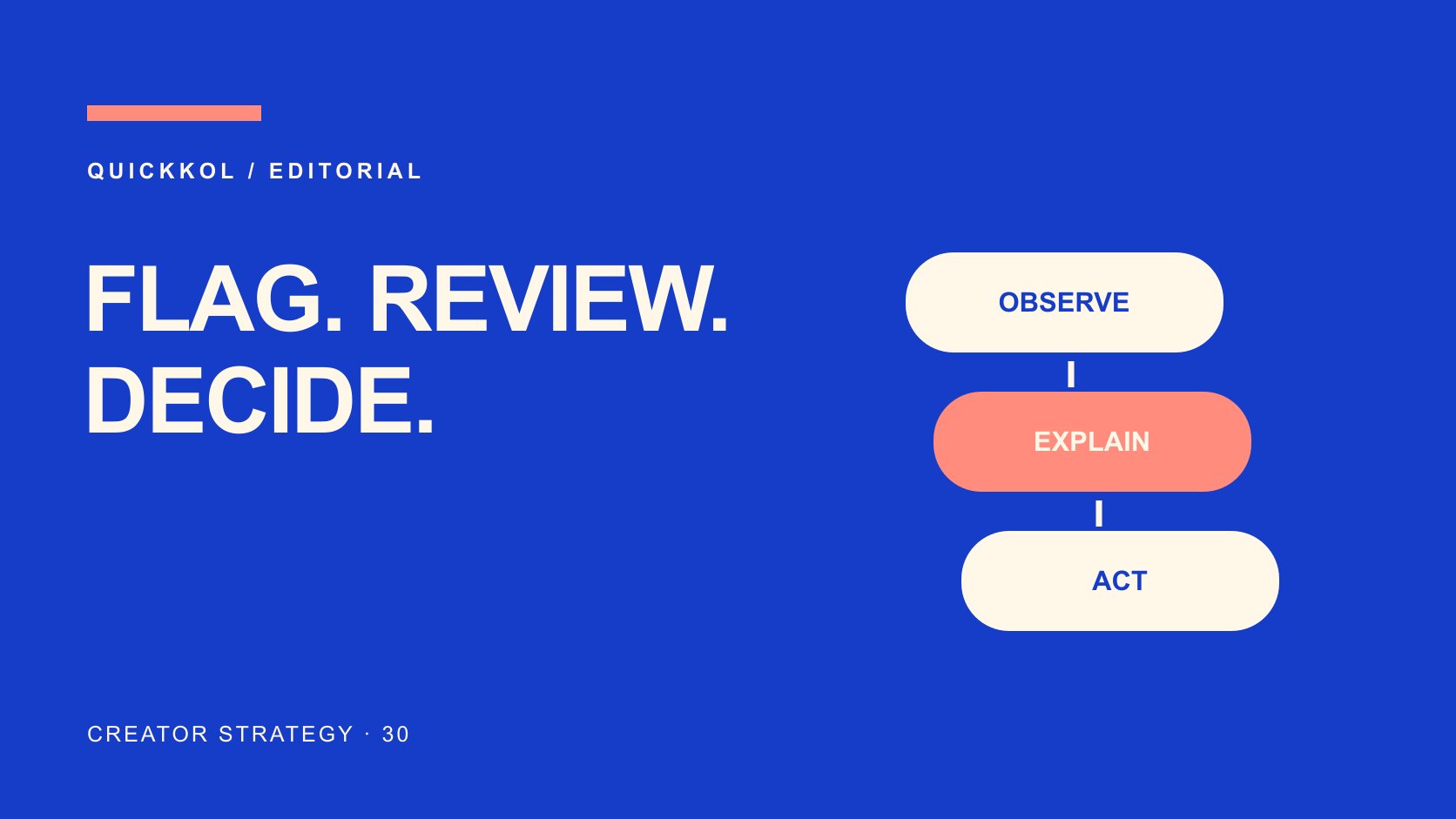
After a fake-follower check reveals an anomaly, write a review memo before changing the campaign. Separate what was observed, plausible explanations, missing evidence and the commercial action under consideration. A tool estimate is not proof of cheating, and a creator may not control the source of an anomaly. Keep purchasing caution distinct from a public allegation and make the conclusion revisable when new evidence arrives.
Begin with observations only
Name the account, source, time, field and observed change. “A tool returned a risk estimate on this date” is an observation; “the creator bought followers” is a much stronger conclusion. If a screenshot lacks a date or sample description, include that limitation in the first paragraph rather than omit it for readability.
The follower-checker guide helps preserve the original record. Keep personal taste about the creator’s style out of the factual section. Creative fit and data interpretation are different questions. A useful memo should allow someone who disagrees with the eventual decision to accept the description of what was actually observed. This is the foundation for a fair review and prevents an uncertain label from becoming an uncontested fact as the document moves between teams.
List alternative explanations
Unusual growth could be associated with a viral post, an event, an account change or traffic whose source is unclear. These are hypotheses to investigate, not substitute facts. State what evidence would support or weaken each explanation. Include possibilities that challenge the reviewer’s first impression rather than only those that reinforce it.
Modash’s documentation notes that legitimate accounts can naturally accumulate bots. That does not certify any particular account, but it illustrates why an audience estimate should not automatically become a claim about the creator’s intentional behavior. Keep the inference chain explicit. The memo can identify a commercial uncertainty without declaring motive. This allows the brand to ask a focused question and review the answer instead of requiring the creator to disprove a broad accusation that was never supported in the first place.
Connect uncertainty to the assignment
If the purchase is asset production, audience authenticity may not be the only decisive condition. If the main contribution is organic distribution, relevant audience evidence may carry greater weight. Explain which obligation is affected before applying a general rejection rule. The same unresolved field can matter differently across assignments.
The audience-quality guide helps separate these judgments. Options include requesting evidence, narrowing a pilot, pausing or declining this purchase. None requires calling the creator definitively fraudulent. Keep the decision tied to what the brand can support under its current constraints. A task-specific explanation is more accurate and easier to revisit than a permanent blacklist entry created from one uncertain observation. It also protects future teams from treating a cautious procurement choice as a factual finding about someone’s conduct.
Make the evidence request proportional
State the window and field you want to clarify, and allow relevant summaries or an explanation. Do not ask for passwords, an entire follower list or unrelated customer information. The question should address the anomalous record, not demand that the person prove their character. Keep the burden proportionate to the commercial decision.
Preserve the request, response and unanswered points. No response may leave a condition unverified; it does not automatically prove cheating. If the campaign timetable requires a decision, explain that the purchase is being paused because the necessary evidence is unavailable. The minimum-evidence guide provides a staged request method. This approach gives both parties a clear next step and avoids escalating the language simply because the brand is under deadline pressure or disappointed by an incomplete answer.
Worked example: three decisions from one signal
Imagine an unexplained growth spike. An asset-production project might continue discussing production after identity and work checks. An organic-distribution project might first request audience evidence. A large ongoing program might pause until a critical condition is resolved. These are different purchasing obligations, not three competing declarations of whether a person is good or bad.
The scenarios are hypothetical and do not describe an investigation of any named creator. Each decision should include its reason and reassessment condition. For example, a pause could end when a dated audience summary resolves the relevant market question, while a production-only scope could explicitly exclude distribution claims. This makes the response concrete. It also prevents a cautious team from using a vague risk label to avoid deciding which part of the proposed collaboration is actually uncertain.
Separate payment and public communication
Handle completed and accepted work according to the actual agreement. A risk signal does not automatically erase payment obligations. A contractual dispute needs the relevant terms, evidence and responsible review; a marketing article should not predict a legal result. Keep that issue separate from whether the brand wants to commission additional work.
Limit circulation of the internal memo so an unverified label is not forwarded as a settled fact. If the review discovers an account-identity error, correct downstream records rather than add a small note only in the original file. The next campaign owner should not inherit a false association. A fair review process includes correcting the organization’s own mistakes, not only requesting more evidence from the creator when the tool output is difficult to explain.
Close with a revisable conclusion
Close with known facts, unresolved questions, the current campaign action, owner, review date and the new evidence that would change the decision. Avoid labels such as permanently safe or permanently fraudulent when the available record cannot support them. A commercial decision can be firm for this project while the factual interpretation remains limited.
Use the follower-checker guide, audience-quality guide and minimum-evidence guide to make the conclusion inspectable by another teammate. QuickKOL can support content research and outreach preparation; the judgment still needs to respect source limitations and the actual agreement. A completed memo should reduce ambiguity and preserve a correction route. Its value is not how forcefully it describes risk, but whether the next person can understand what happened and act without inventing missing facts.
What if new evidence changes the conclusion?
Create a revised version, retain the original observations and explain the basis for the change. Notify people who relied on the earlier conclusion and correct affected lists or tasks. A working review process should accommodate better evidence. Do not preserve an outdated judgment merely to make the record appear consistent; preserve the history so the correction itself is understandable.
Research date, evidence and limitations
Sources reviewed October 23, 2026. Workflows are editorial recommendations. All worked examples are hypothetical, not client results, creator rankings or quotations.
A decision sheet for this assignment
Editorial analysis and labeled hypothetical examples, not performance rankings, quotes or guarantees.
| Condition | Evidence | Decision |
|---|---|---|
| Observation | Dated, sourced anomaly | Do not infer motive |
| Interpretation | Support, disconfirmation, unknowns | Request proportionate evidence |
| Decision | Current scope and conditions | Keep a revision route |
CHECKLIST
Before you put this into practice
Record the answers in the campaign working file.
- Separate fact and inference
- Do not circulate unverified allegations
- Tie decisions to the assignment
- Allow better evidence to change the conclusion
Sources and further reading
External pages can change. Recheck platform rules, contracts and local law before launch.