
THE SHORT ANSWER
This Instagram engagement calculator adds confirmed likes, comments, shares and saves, then divides by a stated follower base. It also calculates the action count and gap associated with a target rate you choose. The result is descriptive arithmetic, not distinct engaged people, an official universal platform metric or a forecast. Missing inputs must be resolved before calculation rather than silently converted to zero.
Choose the question the rate answers
An action rate against a follower base describes the relationship between recorded interactions and account size at a stated observation. It does not show how many distinct viewers were reached or the probability of responding after a view. Put the denominator name beside the result so the number remains interpretable outside the calculator.
The denominator guide explains alternative questions. If you need interactions per view, use suitable view data and give the output that name. Do not swap followers for views while preserving the old comparison label. A metric is useful when its components match the decision. This calculator is intended for a transparent follower-base exercise, including a planning target, rather than a universal score that can rank every format, account and reporting source.
Align the four action counts
Confirm that all four action counts describe the same assets and reporting window. One post’s likes and a month’s saves do not form a coherent sum. Keep hidden or unavailable fields unknown until the evidence route is clarified. A confirmed zero is different and can be entered.
Several actions can come from one person, so the total is not a count of distinct participants. Preserve the components for reconstruction instead of handing over only a percentage. The metric-definitions guide helps make this distinction explicit. If one field cannot be obtained, choose and label a different supported formula outside this four-action calculation rather than pretend the complete version was measured. Consistency of scope is more important than making every row in the report look equally complete.
Check a tool’s formula before comparison
Modash documents an Instagram formula using median likes and followers. That is different from the four-action sum on this page. Different values do not automatically mean one system made an arithmetic mistake; they may answer different questions. Keep the documented definition attached to the source output.
Preserve the reporting window and aggregation method as well. A four-action rate should not be compared with a like-based median and described as a performance lift. Align components and sample before making that comparison. This also matters when someone exports a field with a short name such as ER. The apparent simplicity of the column can hide substantial methodological differences, so the working file needs more explanation than the label alone provides.
Worked example: return to action counts
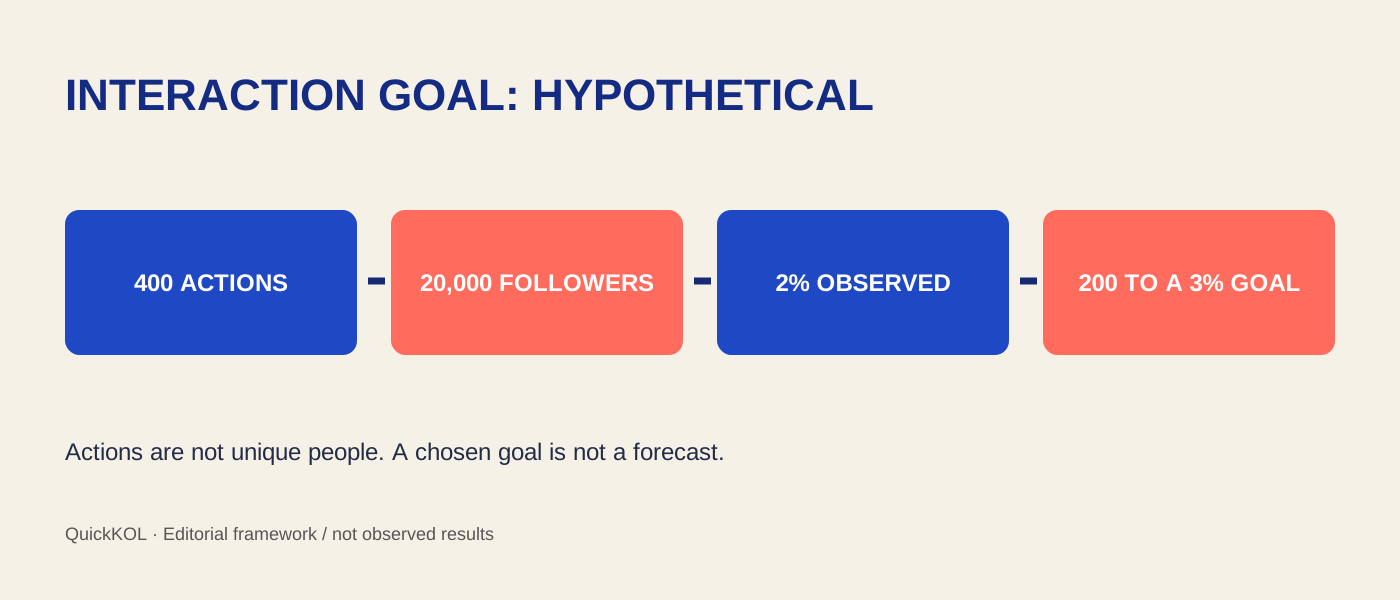
Suppose likes are 280, comments twenty, shares thirty and saves seventy. Total actions are 400. Against 20,000 followers, the rate is two percent. A chosen target of three percent corresponds to 600 actions, leaving an arithmetic gap of 200. These are hypothetical inputs, not an industry benchmark.
The gap does not mean two hundred additional distinct people are required, and it does not predict that a particular edit will generate those actions. The target is a scenario the reader selected. Keep that assumption beside the result. A practical use is checking whether a proposed target is being discussed consistently in counts and percentages, rather than allowing different teammates to use the same rate language while imagining different underlying activity.
Choose a target for a reason
A target can come from a format-matched reference or an explicit planning scenario, but name its basis. The default three percent is not a platform requirement. An interaction target also cannot replace clear explanation, permitted use or agreed delivery acceptance. Keep the creative and commercial obligations visible.
You can inspect customer questions, asset usability and destination behavior as separate observations. If the main purchase is production, missing a chosen rate does not automatically change the agreed payment scope. The content-review guide helps add qualitative context. A target is most useful when the team knows what it will do with the result: revise one explanation, inspect distribution conditions or continue observing. It is less useful when it becomes a retrospective demand that was never discussed with the creator.
Handle zero and invalid inputs
A zero follower base leaves this formula without a valid denominator. Blank values, negative counts and fractional action counts are rejected. A zero target is allowed, and an already achieved target produces a zero remaining gap rather than negative actions needed. The arithmetic should preserve these distinctions clearly.
The calculator does not read an account or store submitted observations. Whether the inputs are comparable remains a source question. An interactive component cannot verify a mismatched window or add precision to rounded counts. Check the record before copying the output into a campaign summary. Keep the observed rate and the chosen target as different fields, and label which one describes evidence and which one describes a scenario the team may revise.
Save the output with its inputs
Retain the asset scope, window, four action counts, follower base, formula, target basis and output. A later calculation needs a new version so a data refresh is not confused with a changed target. Both can alter the presentation without indicating the same kind of performance change.
Use the denominator guide, metric-definitions guide and content-review guide to explain the current result. QuickKOL can assist with understanding work and preparing research leads; the numerical observations still need an appropriate source. A completed calculation should help someone reconstruct the result and its limits. It should not become a forecast of growth, a count of distinct customers or a promise that a paid collaboration will reach the chosen target simply because the gap is now visible.
How should a fractional target count be interpreted?
When a chosen rate corresponds to a fractional action count, reaching at least that rate requires rounding the count upward. For example, 101 followers and a one-percent goal correspond to 1.01 actions, so the minimum whole count is two. These are hypothetical inputs. The threshold is arithmetic, not a forecast or a requirement for two different people to act. Multiple actions can still come from one person. Preserve the chosen target and denominator beside the result so the rounded count does not appear to be a separately observed metric.
Can an action rate exceed one hundred percent?
It can, because actions are not deduplicated people and distribution can extend beyond followers. A value above one hundred percent deserves a definition check, but it does not by itself prove an error or manipulation. Inspect the components, window and denominator before interpreting it. The appropriate question is whether those observations support this formula, not whether the percentage resembles an expected benchmark.
Research date, evidence and limitations
Sources reviewed October 23, 2026. Workflows are editorial recommendations. Numerical examples are hypothetical, not client outcomes, quotes or rankings.
A working comparison
Editorial analysis and labeled hypothetical examples, not performance rankings, quotes or guarantees.
| Task | Evidence | Action |
|---|---|---|
| Observed scenario | 400 actions / 20,000 followers, hypothetical | 2% action rate |
| Chosen target | 3%, not a benchmark | Equivalent to 600 actions |
| Arithmetic gap | 600 − 400 | 200 actions, not people |
PRACTICAL TOOL
Interaction and target-gap calculator
Defaults are hypothetical. Enter confirmed nonnegative whole counts from one scope; results are not distinct people or predictions.
Sources and further reading
External pages can change. Recheck platform rules, contracts and local law before launch.