
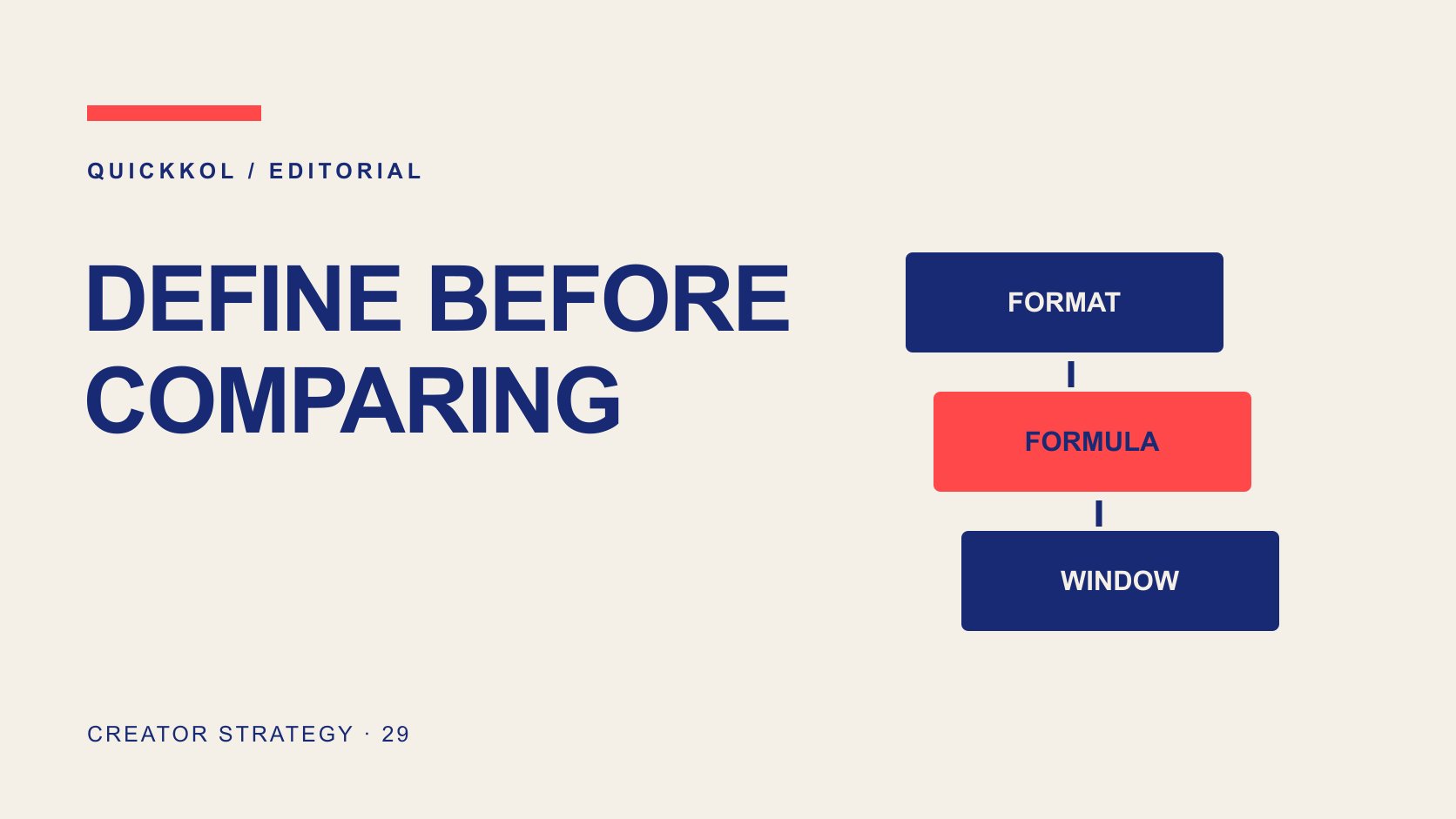
THE SHORT ANSWER
Before comparing Instagram engagement rate, align the counted actions, denominator, selected posts, observation timing and aggregation method. Two percentages called engagement rate may represent different metrics. Keep the definition and missing-data states beside the result, then interpret differences within comparable formats and tasks. One universal threshold should not decide every account.
Attach a definition card to each result
Record interaction actions, denominator, post set, time window, observation date, aggregation and missing-data treatment. Engagement rate of 3% alone is not a reviewable finding. Another teammate needs enough information to understand what was counted and what the percentage can support.
The metric-definitions guide helps write the card. Choose the formula after defining the question rather than let a tool’s default become the success standard for every task. A distribution decision may need a different denominator from a creative-delivery review. Keeping the definition beside the value also makes later changes visible: if the formula changes, the team can explain that the series changed instead of presenting a discontinuity as a sudden improvement or decline in the creator’s performance.
A vendor definition is not a universal platform standard
Modash documentation describes its Instagram engagement-rate approach using a defined recent set and a likes-to-followers method. It provides a vendor definition, not evidence that every tool counts the same actions or uses the same window and aggregation. Preserve the source and platform applicability when using the result.
Do not transfer a TikTok or YouTube denominator into Instagram simply because the interface uses the same metric name. The useful question is whether the definition fits the decision and whether the comparison uses the same definition. A team can use a vendor metric consistently while clearly distinguishing it from an internal total-actions formula. That is more transparent than rename both engagement rate and assume the difference will not matter to anyone reading the report.
Format and post selection affect comparability
Short videos, images, series and special activities can serve different jobs. Select a relevant comparison set and record exclusions with reasons. Do not keep only the best or worst posts to support the conclusion the team already wants. A format-matched set is still limited evidence, but its scope is easier to understand.
The performance-benchmark guide helps bound the set. State when the sample is small instead of treating one high value as stable capability. Different observation windows can change accumulated interactions without a change in content quality. Keep the post-selection rule and reading dates with the data so another reviewer can distinguish a genuine measured difference from a change in what was included or how long each post had to accumulate actions.
Worked example: the same actions, different bases
Suppose there are 400 actions, 20,000 followers and 10,000 reached accounts. The rates are 2% by followers and 4% by reach. These hypothetical results do not contradict each other; they answer different questions. Actions also need not represent unique interacting people because one person can take several actions.
The interaction-goal calculator uses an explicit actions-and-followers definition. If comparing with a reach-based result, first align the question rather than declare one value more real. Do not cap an action rate at 100% merely because it looks unusual; inspect the numerator and denominator. Equally, a mathematically valid rate is not automatically relevant evidence for a commercial decision. The formula needs both correct arithmetic and a definition that fits the task.
Separate mean, median and aggregate ratios
For hypothetical post rates of 1%, 2% and 9%, the arithmetic mean is 4% and the median is 2%. They describe different properties of the set. Do not choose whichever looks more favorable without explaining the method. A median reduces the influence of an extreme value but does not automatically make a small or biased sample representative.
Adding actions and then dividing by added denominators is another aggregation. Its usefulness depends on the denominator and repeated observations. Repeated follower bases do not become unique people merely because they are summed. Record the chosen method and do not splice different aggregations into one historical trend. A clear report can show more than one statistic when each answers a stated question, without implying that they are interchangeable.
Explain changes with measurement limits
When a rate changes, first inspect the definition, post set, window, missing data and follower snapshot before interpreting the content. Unknown values should not become zero, and rounding can affect small differences. Preserve the original observation when correcting a record so the revised series remains explainable.
The reporting guide separates observation, possible explanation and next action. QuickKOL can assist research organization. A useful conclusion states the conditions under which the measured value changed rather than automatically call every increase marketing success. The team can then decide whether to improve measurement, examine a creative difference or gather more evidence. That is a stronger basis for another commission than a universal good-or-bad threshold detached from format, task and data quality.
Can an unavailable action be removed from the formula?
You can choose another supported metric, but rename it and state the components. Do not continue claiming that the complete four-action version was measured. If the historical series changes, mark the break rather than splice the values into one apparently consistent trend.
With only likes available, use a like-based definition instead of pretending shares and saves were zero. This narrows the comparison but makes it reviewable. A team can maintain two series if each has a purpose and a clear dictionary; it should not select between them after seeing which result looks better.
The decision record should also say whether the narrower definition still answers the question. If it does not, collect more evidence or defer the comparison. Correct arithmetic on incomplete or mismatched inputs cannot solve a measurement problem. Preserving the missing state is therefore part of analytical quality, not a formatting defect to hide before presenting the report.
Does engagement rate prove purchase intent?
Not by itself. An action can reflect interest, entertainment, a question or another motive. If the task concerns sales, design visit, transaction and incremental evidence separately rather than derive orders from likes.
Engagement rate can be a research signal when its definition and limits remain visible. It should not replace the commercial question the brand ultimately needs to answer. Keep the metric useful by stating what it observes and which decisions still require another kind of evidence.
Research date, evidence and limitations
Sources reviewed October 23, 2026. Workflows are editorial recommendations. Numerical examples are hypothetical, not client outcomes, quotes or rankings.
A working comparison
Editorial analysis and labeled hypothetical examples, not performance rankings, quotes or guarantees.
| Task | Evidence | Action |
|---|---|---|
| Definition | Actions, denominator and timing | Display beside the result |
| Set | Format, selection and missing data | Explain exclusions |
| Aggregation | Mean, median or aggregate ratio | Do not splice unlike series |
CHECKLIST
Before you put this into practice
Record the answers in the campaign working file.
- Same name is not the same definition
- Actions are not unique people
- Do not fill missing values with zero
- Engagement does not prove purchase
Sources and further reading
External pages can change. Recheck platform rules, contracts and local law before launch.