
THE SHORT ANSWER
Good influencer reporting begins with the next decision and links it to evidence. An executive memo can be short when it connects to metric definitions, source records, missing data and revisions in an appendix. Separate delivery, distribution, associated orders and causal lift. The reader should understand why the observations support continuing, changing or stopping a practice without needing to reconstruct the campaign from screenshots and chat messages.
Name the decision to approve
Open with a specific choice: continue a format, change a destination, renew a license or pause expansion. Do not assemble every campaign output into a dashboard with no decision. The executive reader needs to know what approval or action the report supports and which observation is most relevant to that choice.
The useful-brief guide helps recover the original assignment. State what the campaign was intended to answer, what evidence is now available and what remains unresolved. Keep newly discovered questions separate rather than rewrite the objective after seeing the outcome. A report can acknowledge a useful unexpected finding without pretending it was the original success criterion. This makes later comparisons fairer and helps the next team understand why a particular recommendation was made.
Keep three layers in the memo
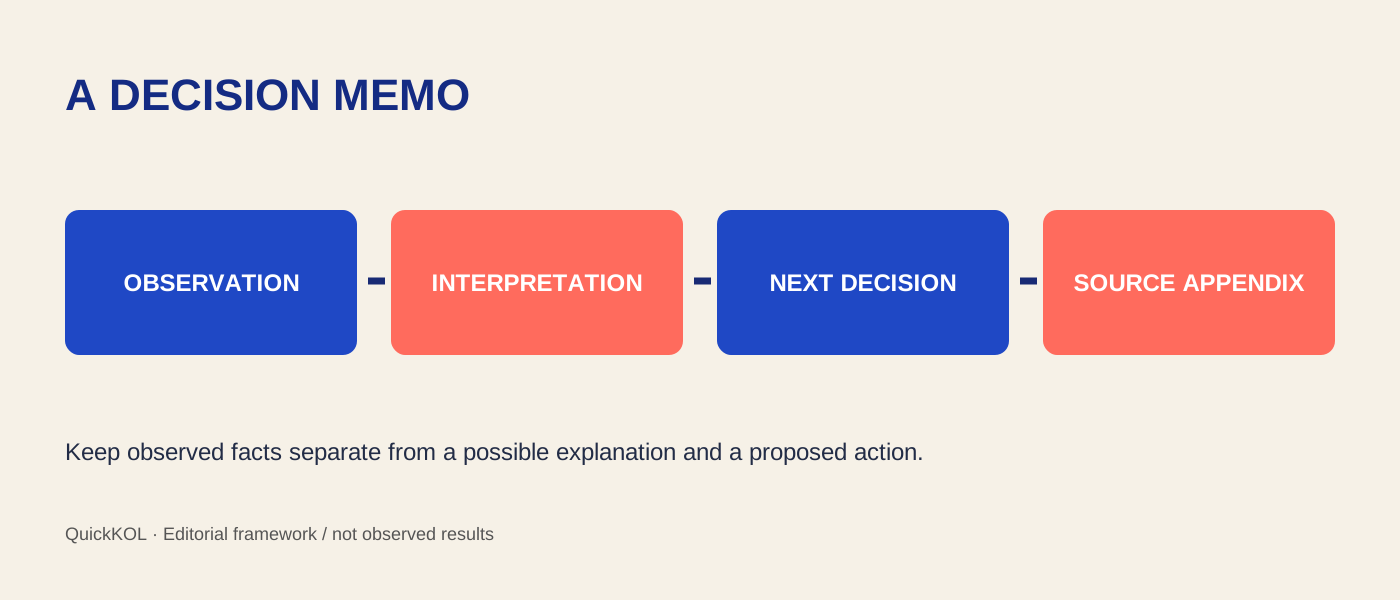
Keep observation, interpretation and recommendation as separate layers. An observation can say which assets were delivered and which data was obtained. An interpretation can identify a possible explanation gap. A recommendation can propose another demonstration. Do not write the interpretation as though it were directly measured.
Link each important recommendation to an evidence identifier. Readers can scan the memo or inspect the appendix without the first page becoming a wall of screenshots. A compact report should reduce navigation effort rather than remove the source. Include the decision owner and expected action date. This turns reporting into an operating handoff and makes it easier for someone to challenge the recommendation without losing agreement about the underlying observations.
Place definitions beside data
For each metric, retain name, components, denominator, window, source and aggregation method. Identical names do not guarantee identical formulas, and cross-platform values may not be directly comparable. A metric dictionary should travel with the table rather than remain in a separate analyst’s memory.
The metric-definitions guide provides a starting point. Comments, likes and saves are actions; distinct participants are people. Summed reach is not necessarily deduplicated reach across assets. A report can show several definitions when each serves a stated question. Avoid choosing whichever ratio looks strongest for each creator and placing the results in one ranking. Consistency and clear exceptions are more useful than a uniform display that hides differences in what was actually measured.
Report missingness and revisions
Record how many assets have usable data and which are unavailable because of deletion, authorization or collection conditions. Unavailable is not zero. Preserve report versions when later orders or refunds change the historical view. A frozen summary and a live reporting window should be identified differently.
The analytics-acceptance guide provides exception tests. Show coverage independently so differing permissions are not mistaken for creator-performance differences. Manual entries need a source and owner rather than silently overwrite the system result. These details belong in the report because they affect interpretation. The executive memo can summarize the limitation in one sentence while the appendix retains enough information for another analyst to reproduce the selection and understand why a record was excluded.
Separate order association from lift
Google Analytics documents UTM parameters for identifying campaign traffic. Link association, code use and self-reported source are different evidence routes. They should not simply be added together, and they do not alone prove that an order would not have happened without the campaign.
Use associated orders or name the attribution model explicitly. If discussing incrementality, provide the design and limitations as a separate claim. The conversion-tracking guide develops the implementation side. A useful executive memo can still show business evidence without overstating it. Keep the order identifier and reconciliation route in the appendix so the same purchase does not appear several times through different evidence paths. Strong wording cannot compensate for a relationship the data does not establish.
Worked example: one action from three observations
Suppose three assets meet the agreed delivery conditions, data coverage is eighty percent, repeated comments ask about size and the destination lacks sizing information. A defensible recommendation is to improve the page and commission one clarification before expanding the roster. Adding creators would not directly address the observed explanation gap.
The counts and coverage are hypothetical. Link the recommendation to actual question evidence in a real report rather than claim the change will necessarily increase sales. The next test can inspect whether the explanation is complete and whether the uncertainty persists. This makes reporting useful even when the evidence does not support a confident revenue conclusion. It also helps the budget owner understand why the proposed next step is smaller and more specific than another broad distribution wave.
Make the appendix usable by the next teammate
The appendix should retain asset identifiers, current rights, sources, dictionary, versions and open issues. Keep owners visible. Delivering a report is not automatically project closeout when renewals, payments or data revisions remain pending. Identify those actions separately from analytical questions.
Use the useful-brief guide, metric-definitions guide and conversion-tracking guide to produce a record someone can continue using. QuickKOL can assist with research and organization, while conclusions remain grounded in the actual collected evidence and agreed scope. The completed report should explain the next decision, provide a route to inspect its basis and show what could change it. It should not require the reader to accept a polished total whose definitions and limitations disappeared during presentation.
How should report revisions be controlled?
Label a revision with time, reason and affected conclusions. Retain the earlier version as superseded rather than leave two apparently current reports in circulation. Update the summary when the underlying chart changes, not only the chart itself. Identify one current-version route and the internal owner responsible for the update. Also state whether the revision changes the next decision. A corrected denominator can alter a displayed rate without altering the recommended action, while a newly identified rights issue may require an immediate operational change. Keep that distinction explicit.
What if executives only read one page?
Keep the decision, a few critical observations, the main limitation and owner on one page, with evidence identifiers and an appendix link. Brevity should order information around the decision rather than delete limitations. A reader can understand the recommendation quickly while retaining the option to inspect how it was produced.
Research date, evidence and limitations
Sources reviewed October 23, 2026. Workflows are editorial recommendations. Numerical examples are hypothetical, not client outcomes, quotes or rankings.
A working comparison
Editorial analysis and labeled hypothetical examples, not performance rankings, quotes or guarantees.
| Task | Evidence | Action |
|---|---|---|
| Memo | Decision, observations and limitation | Name the next owner |
| Metric table | Definition, window and coverage | Keep definitions distinct |
| Appendix | Assets, sources and versions | Support review and handoff |
CHECKLIST
Before you put this into practice
Record the answers in the campaign working file.
- Name the decision first
- Separate observation and interpretation
- Show gaps and revisions
- Trace recommendations to evidence
Sources and further reading
External pages can change. Recheck platform rules, contracts and local law before launch.