
THE SHORT ANSWER
An executable content license identifies the asset, authorized user, media, edits, start, end and person responsible for stopping use. Paid media also needs the relevant platform permission, but technical ability to run an ad is not the same as contractual permission. This article provides negotiation and operating fields rather than a complete legal template for every jurisdiction. The objective is a schedule that production, purchasing and media teams can all interpret consistently.
Identify who can license what
The U.S. Copyright Office describes protection for original fixed works and the exclusive rights associated with copyright. A project still needs to identify the actual rights holder. The creator, photographer, production company and other third parties may control different elements. Do not assume the person who published a video owns every component.
Connect the contracting entity, authority to license and delivered file. Music, other people and incorporated material may need separate attention. Keep unresolved clearance questions visible before media launch. The contract-scope guide helps organize responsibilities. The purpose is not to create a universal legal conclusion from a public webpage, but to ensure the parties discuss the real asset and the rights they can actually grant rather than sign a broad phrase whose underlying authority has never been checked.
Identify the licensed assets
Assign an asset_id to each final video, image and version, with file name, duration, ratio and approval date. Scripts, raw footage and finished edits can be different deliverables. Receiving a folder does not automatically establish permission for every file it contains. The licensed object should be identifiable after the original project manager leaves.
Agree which unused material may be retained and which must not appear in a new advertisement. If a new cut requires approval, define the route and response expectations. Keep the approved version available to media staff rather than make them choose among similarly named exports. This ordinary version discipline can prevent a rights problem as well as a factual one, because an earlier draft may contain music, wording or background people that were removed from the final agreed asset.
Separate media, territory and identity
Organic publication, a brand website, email, retail pages and paid social are different uses. List territory, language and publishing identity separately rather than let digital channels cover every future need. The useful question is where the audience will encounter the asset and which entity will be responsible for that use.
The usage-rights guide helps structure these fields. A purchase for US Instagram advertising should not silently become global retailer distribution. If several entities need access, identify them and discuss the scope rather than let brand and affiliates expand without explanation. Narrow language can be easier to operate and renew. The schedule should give the media team a usable answer, not force them to interpret a broad legal phrase whenever a new partner asks for the file.
Keep platform access as a separate layer
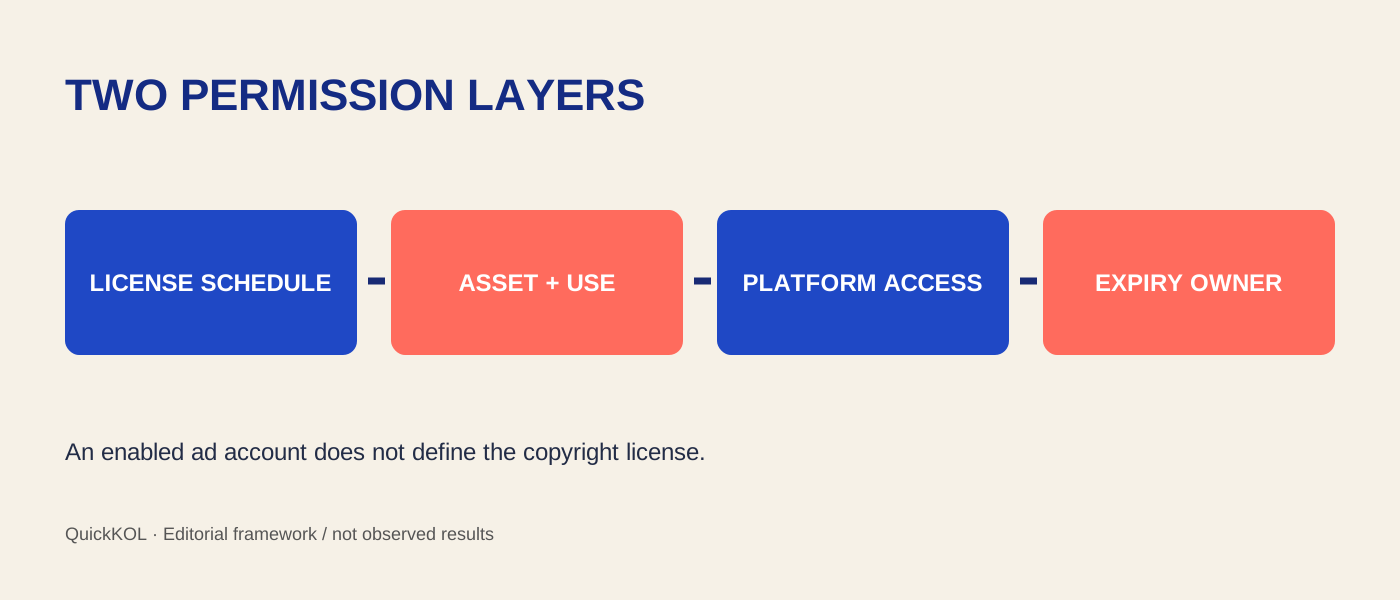
Meta Blueprint treats partnership advertising and partner controls as specific operational topics. Keep the license schedule and platform authorization state as separate records. A signed agreement does not guarantee technical readiness, and an enabled control does not define the contractual term or permitted edits. Both layers need confirmation.
Record who requests access, who approves it, whether it concerns an account or content and who acts when use stops. Do not substitute password sharing for an appropriate authorization route. Check current platform instructions for the actual account and campaign configuration. The Instagram-roles guide explains the responsibility split. This separation helps prevent two common misunderstandings: the media operator assuming access means unlimited rights, and the commercial owner assuming the contract alone has made the asset ready to advertise.
Define start, expiry and renewal
A term can begin on an agreed date, first paid use or another event, but the trigger needs an observable record. State whether organic retention and advertising permission have different durations. A delayed launch should not automatically become an indefinite extension because no one recorded when the clock started.
Before expiry, a named owner decides whether to stop or request a renewal quote. Silence is not an operating instruction to continue. The agreement should address the practical treatment of advertising, accessible assets and retained archives as appropriate to the project. Keep the renewal decision separate from payment for the original completed work. A schedule is useful when it prompts a timely action, not merely when it contains an end date that no one responsible for media delivery will see.
Worked example: a limited-use schedule
Imagine final video V01 licensed to one brand for thirty days of US Instagram paid advertising, with subtitles and ratio crops allowed, excluding raw footage, other brand identities and permanent use. Record the first-use date and expiry operator. These are hypothetical negotiation fields, not a complete clause ready for signature.
If the brand later wants website use or a longer term, request the additional scope and fee. Do not reinterpret a limited license as a buyout of everything. Check whether the permitted crop preserves qualifications and relationship information. The media buyer should be able to read this schedule and select the correct file, placement and stopping date without reopening the entire negotiation. If an essential field remains unclear, resolve it before launch rather than rely on the fact that the creator already delivered the video.
Hand the schedule to actual users
Give production, purchasing, media and asset-management staff the same accepted version. Each new placement, subtitle, translation or publishing identity should be checked against scope. Record changes as new versions instead of treating earlier approval as permission for an expanding set of uses.
Use the contract-scope guide, usage-rights guide and Instagram-roles guide to preserve both the license and technical permission record. QuickKOL can support early research and outreach preparation; the agreement needs appropriate project and jurisdiction review by the responsible parties. Completion means the actual users know which asset may be used, how and until when. A signed document kept only in a purchasing folder does not by itself prevent an expired ad from continuing or an unapproved edit from entering the next campaign.
Does payment mean copyright transfer?
Do not infer that from payment alone. Production compensation, a license and a transfer of rights are different arrangements governed by the actual agreement and applicable rules. Discuss the use the brand needs rather than let bought the content stand in for a rights description. A limited license can be entirely suitable when its scope is clear and the operating team can follow it.
Research date, evidence and limitations
Sources reviewed October 23, 2026. Workflows are editorial recommendations. All worked examples are hypothetical, not client results, creator rankings or quotations.
A decision sheet for this assignment
Editorial analysis and labeled hypothetical examples, not performance rankings, quotes or guarantees.
| Condition | Evidence | Decision |
|---|---|---|
| Licensed object | Final V01, hypothetical | Exclude unagreed raw and old versions |
| Use | US Instagram ads, 30 days, hypothetical | Record identity, edits and term |
| Platform permission | Relevant account and content state | Verify both before launch |
CHECKLIST
Before you put this into practice
Record the answers in the campaign working file.
- Verify licensing authority
- Identify asset versions
- Separate license and platform access
- Own stopping at expiry
Sources and further reading
External pages can change. Recheck platform rules, contracts and local law before launch.