
THE SHORT ANSWER
A fake follower detection tool should produce reviewable risk evidence rather than pronounce a creator guilty. Test platform coverage, missing-data treatment, edge cases and explanation quality before using a label to reject someone. Accuracy claims require credible ground-truth labels. Without those labels, you can still evaluate whether the system preserves uncertainty and supports a careful human decision, but you cannot honestly report a measured fraud-detection accuracy rate.
Define the decision the tool supports
Choose whether the tool supports pre-outreach screening, pre-contract review or investigation of an anomaly after publication. Each decision needs a different level of evidence. An automated flag may justify further research, but it should not automatically trigger a public allegation or nonpayment for accepted work. State the operational consequence before choosing a threshold.
The audience-quality guide helps separate creative fit from data risk. A risk tool should complement work and commercial checks rather than erase them with one score. Ask what the reviewer must learn before changing the campaign decision. This prevents procurement from optimizing for an impressive-looking fraud percentage when the real need is a defensible process for handling uncertain candidates without delaying every project or unfairly harming a creator’s reputation.
Verify actual coverage
Modash’s official documentation limits its fake-follower and credibility estimates to Instagram. Discovery coverage on another network should not be mistaken for equivalent fraud-metric coverage. Verify the platform, source and update behavior for each field you intend to use. Ask the vendor to demonstrate the actual record rather than point to a general multi-platform logo strip.
When data is unavailable, the expected output is unavailable, not safe. Evaluate coverage, explainability and risk estimation separately. Include a known unsupported case in the demo and inspect the export as well as the screen. A system that silently treats missing evidence as low risk can make the shortlist appear cleaner while reducing the amount of information behind the decision. Retain this distinction when the data moves into an agency report or procurement file.
Build a case set without inventing truth
A case set can contain records with well-supported labels, explicitly unknown records and synthetic records used to inspect data handling. A fabricated follower-growth curve is not evidence that a real creator cheated, and successful handling of that curve does not establish real-world detection performance. Label the purpose of each case.
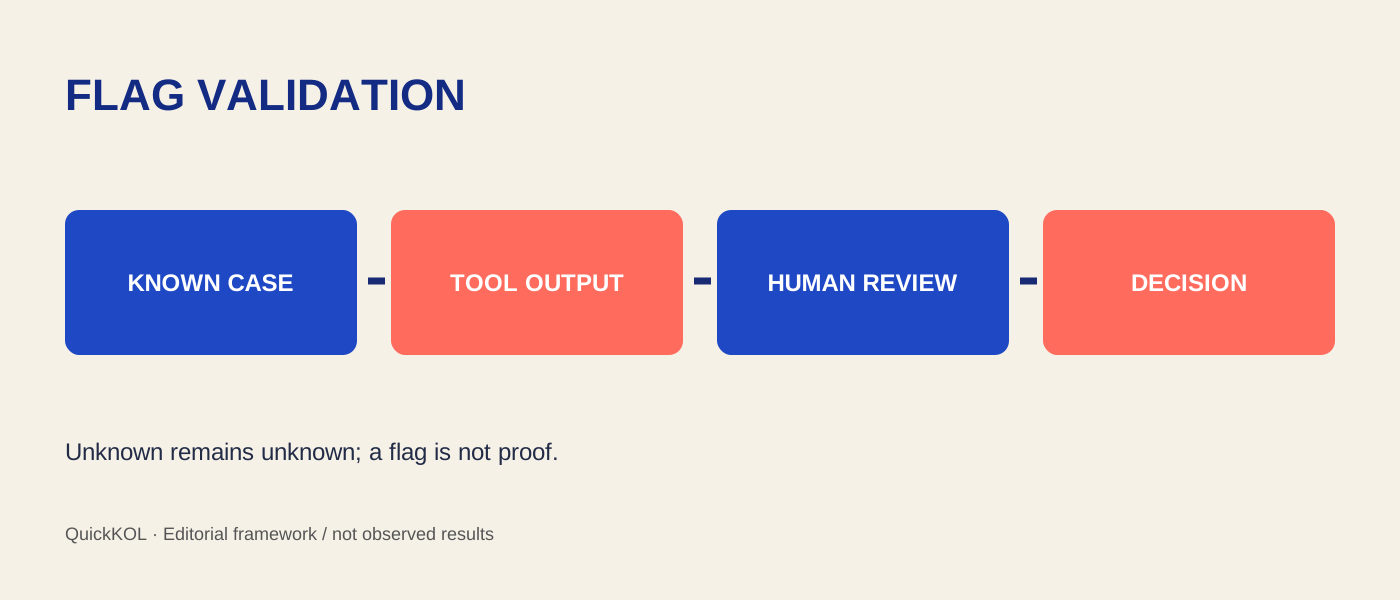
For every reference label, record the basis, reviewer and disagreement. If the label is only someone’s impression, call it a human judgment rather than ground truth. Without credible labels, focus on usability, explanation and exception handling. This still reveals important product limitations. It simply avoids turning an internal demonstration into a published claim that the vendor detects a certain proportion of fraud or performs equally across languages, creator sizes and content niches that were never represented in the exercise.
Inspect false positives, false negatives and unknowns
A false positive flags a case that the credible reference evidence does not support as problematic. A false negative misses a case with a sufficiently supported problem label. Those rates can be calculated only when the reference labels are reliable. Preserve an unknown category rather than force every case into pass or fail.
Inspect boundary situations such as a viral post, a return after inactivity, a username change or a shift in audience geography. None proves authenticity or fraud by itself. Their value in the test is showing whether the tool explains the signal or simply repeats a categorical conclusion. Ask what information could overturn the flag. A system that cannot accommodate correction may be convenient for filtering but unsuitable for a consequential review in which the brand needs to justify its treatment of a specific creator.
Worked example: precision is not coverage
Imagine twenty test cases with credible reference labels. A tool flags five; three match supported problem labels and two are false positives. Precision among the flags is 3/5, or sixty percent. You still need the total number of supported problem cases to calculate recall. The example demonstrates different denominators, not a measured result for any vendor.
If another ten cases have no usable data, report them as uncovered. They are not correct decisions simply because no flag appeared. Keep the case selection visible as well: a deliberately difficult test set does not estimate the prevalence of fraud in the market. A useful procurement report separates performance on labeled cases, coverage of the intended roster and the manual work needed to resolve unknowns. Combining them into one percentage conceals precisely the tradeoffs the buyer needs to understand.
Make explanations usable in review
Ask for the triggering signals, original observation time, model version and limitations in the export. A reviewer should be able to ask the creator a project-relevant question instead of demanding that they prove their entire identity or audience is real. Keep the inquiry proportional to the decision at stake.
Do not request passwords or circulate unverified labels publicly. Preserve versions when new evidence changes the assessment and explain why the commercial decision changed. The review-memo guide separates observations, interpretations and actions. A tool passes this workflow test when its output can support a respectful question and a revisable decision. If the export contains only a score with no context, the brand may need a different evidence route before using it in a consequential conversation.
Turn acceptance results into a usage rule
Define which cases can continue through ordinary research, which require manual review and which remain pending because evidence is missing. Name the owner, evidence requirement and review date. Do not elevate the vendor’s default threshold into an industry standard simply because it is preselected in the interface. Your operating rule should reflect the assignment and the consequences of a mistaken decision.
Use the audience-quality guide and review-memo guide to preserve the case set and its limitations. QuickKOL can help research creator content and prepare outreach, while an independent risk output still requires source-aware review. Repeat the acceptance exercise when a material model, coverage or workflow change occurs. The goal is a useful decision system whose limitations are known, rather than a permanent badge that claims an account has been conclusively certified or condemned.
Can you buy without ground-truth labels?
You can compare coverage, explanations, exports and review effort while acknowledging that detection accuracy has not been measured. Start with an assisted-research use case, limit automated consequences and preserve a human route for disputed cases. Document what the pilot actually establishes. A product may still be useful for organizing signals even when the team lacks the evidence needed to validate its strongest fraud-detection claim.
Research date, evidence and limitations
Sources reviewed October 23, 2026. Workflows are editorial recommendations. All worked examples are hypothetical, not client results, creator rankings or quotations.
A decision sheet for this assignment
Editorial analysis and labeled hypothetical examples, not performance rankings, quotes or guarantees.
| Condition | Evidence | Decision |
|---|---|---|
| Labeled cases | Traceable reference basis | Then discuss errors |
| Unknown cases | Insufficient labels or data | Do not force a pass |
| Tool signals | Time, model and explanation | Route to human review |
CHECKLIST
Before you put this into practice
Record the answers in the campaign working file.
- Check platform coverage
- Unknown is not safe
- Synthetic cases are not market results
- Allow correction
Sources and further reading
External pages can change. Recheck platform rules, contracts and local law before launch.