
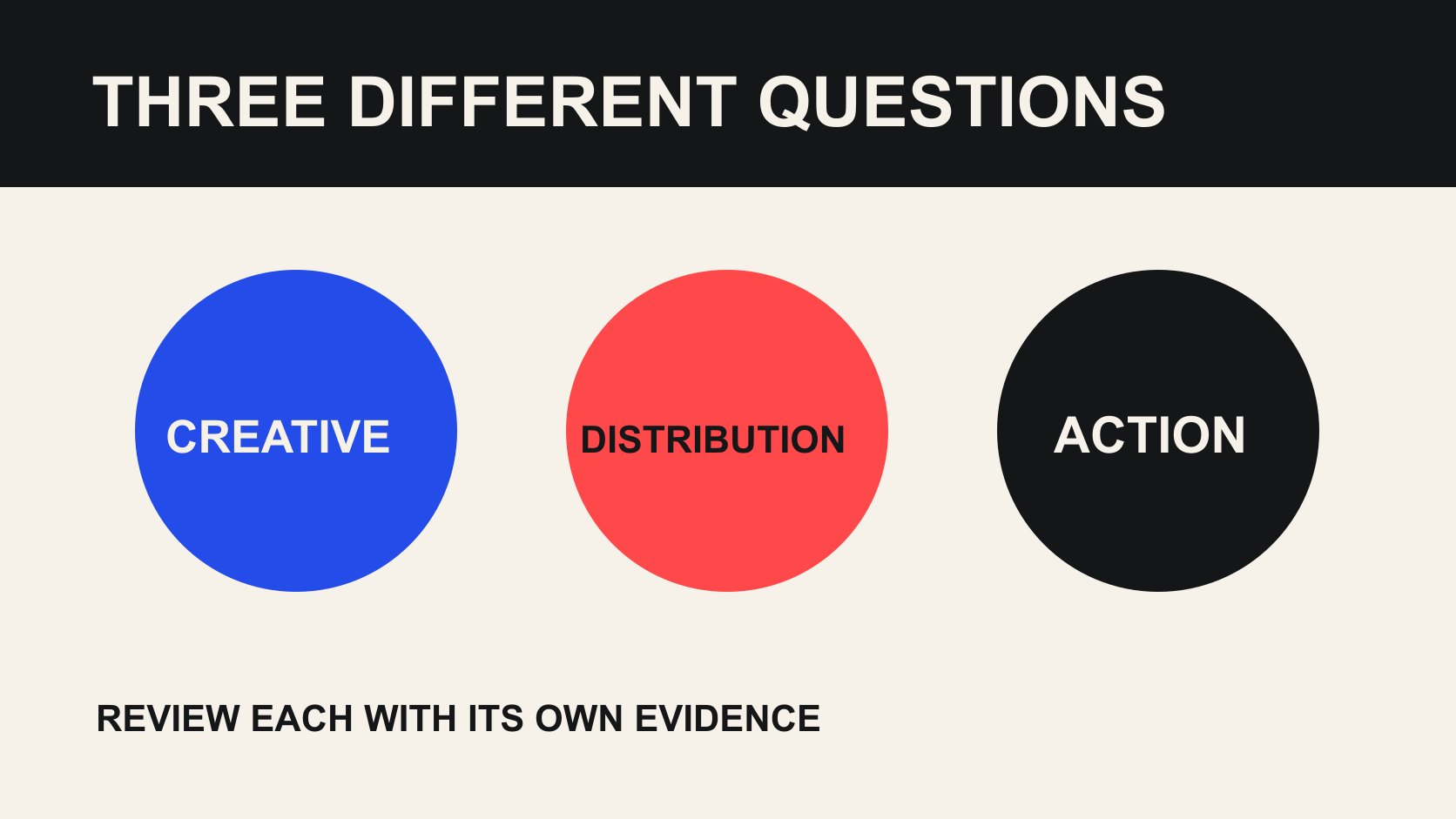
QuickKOL editorial graphic; not actual account metrics or a platform interface.
THE SHORT ANSWER
TikTok analytics should answer three separate questions: did the work accurately perform its content job, what distribution was observed across platform and paid activity, and which off-platform actions can the records support? Fix the version, window, source and paid state before comparison. Views, comments and visits are not one interchangeable result, and none independently proves incremental sales.
Split the review into distinct questions
Project closure often compresses creative work, distribution and business outcomes into did it perform well? Yet an unclear opening, limited early distribution, broken link and out-of-stock product are different problems with different owners. Define the content job first: explain an operation, answer a concern, show a use situation or invite a relevant audience to learn more. Then choose the observation that addresses it.
Creative review can inspect whether the work fulfilled the brief, whether people repeat an unanswered question and whether important facts were misunderstood. Distribution review retains available plays, timing, sources and paid context. Off-platform review checks destinations and events. These are related without automatically forming a proven funnel when evidence is incomplete.
The creator campaign measurement guide helps connect questions with ownership. Do not export every metric first and invent a plausible explanation for each later. A useful report identifies what to change and who needs to participate. If it produces only a composite score, the team may still be unable to distinguish a script problem from a media, website or product problem. Keep the three questions visible even when stakeholders request a short summary, so condensation does not erase the reason for the analysis.
Fix the version, publication time and observation window
Record the specific video, creator account, content version, actual publication time, time zone and observation cutoff. Deleting and reposting, changing a description, adding paid support or replacing a destination can alter the interpretation. Do not combine screenshots from different versions as though they form one continuous record. Retain original evidence locations for checking.
An early creative review and later business review may be useful, but their duration should follow the assignment rather than a universal best TikTok review day. When comparing videos, state whether observations use equal publication age or the same calendar period. These answer different questions. A video with a long accumulation period cannot establish how a newly released piece performed at the same stage.
If a field is still processing, mark it provisional and set the next check instead of filling it informally. Missing snapshots remain missing; today’s total cannot reconstruct the earlier value. Agreeing on windows in advance reduces selective reporting without removing differences in subject, audience and distribution. Hand over those limits with the result. When a campaign has several episodes, retain each episode’s observation window instead of treating the whole series as if every video began at the same time.
Review the content job before explaining outcomes
Inspect the actual video against the brief: is the main question clear, is the product accurate, can the demonstration be followed, and are conditions and relationship explanations retained? This review can proceed before every analytics field is available, but it does not replace behavioral evidence. Label editorial judgment as judgment rather than a platform-issued quality score.
Attach observations to a particular moment or sentence. People repeatedly ask about installation prerequisites is more actionable than the content is not engaging. Revisit whether the prerequisite was explained and whether cropping, captions or a rushed demonstration obscured it. Accurate content with recurring questions may need a supplementary explanation rather than wholesale rejection.
The TikTok engagement definition guide helps inspect actions and denominators. One engagement rate cannot automatically explain the opening, pace or credibility, especially when action definitions differ. A lower percentage is not independently a verdict on a creator’s capability. Identify an observable problem before designing a specific change and the evidence needed to examine it. This keeps the review connected to work the team can improve rather than encouraging a different script every time a number moves in an unwelcome direction.
Use comments as a bounded sample of questions
The TikTok comment insights guide describes comment analysis and AI-assisted categorization. It can help organize visible discussion, but its categories are not a survey of everyone who watched. Noncommenters, unavailable comments and different filters affect the sample. Six of ten sampled comments mentioning price does not mean 60% of the audience considers the product expensive.
Retain sampling time, sorting or filters, count, language and exclusion rules. When removing irrelevant material, keep the reason rather than retaining only comments that support the desired conclusion. If AI helps classify, inspect original text against the categories, particularly sarcasm, dialect and context. Do not infer an individual’s age, country or purchasing eligibility from one comment.
Group questions by a repairable issue: missing fact, unclear operation, service restriction, subjective preference or something outside scope. Name the relevant owner. A sample can identify questions worth answering without estimating market shares. If the decision needs representative research, arrange an appropriate method rather than treating label counts as a demand forecast. A useful handoff can include a small set of anonymized examples with context, avoiding unnecessary collection or circulation of personal profiles unrelated to improving the explanation.
Separate organic distribution, paid support and limits
TikTok recommendation explanation describes several signals and personalized conditions. It does not provide a certain retrospective explanation for the distribution of one video. Lower views can have several contexts. The result alone does not establish suppressed reach or punishment of a creator. Retain an unverified explanation as unknown.
Record paid support, activation time, objective and available report sources. TikTok Brand Partner tag documentation describes arrangements involving partnership tags, reporting and advertising authorization. Check actual sharing and settings. Access to a particular video does not guarantee every historical asset or metric, and it does not replace agreement on content use.
Do not add potentially overlapping organic and paid report views and call the sum unique people. Inspect objects, fields and deduplication definitions first; display separate columns when these are unclear. Once media support begins, label later observations with the changed state rather than continuing to describe them as purely organic performance. Whether the content should be retained and whether the advertising met its objective can have different answers. A single success or failure label should not erase that difference or assign the media team’s settings to the creator’s creative judgment.
Check destinations and identifiers before interpreting actions
If the goal includes visits, bookings or demo requests, test links, mobile destinations and events before publication. Google Analytics campaign URL guidance explains parameters for campaign sources and creative identifiers. Those labels help interpret visits from tagged entry points; they do not independently establish that a creator caused additional purchases.
Record where the actual link appears, whether it works and whether redirects or sharing alter its parameters. Public views and website sessions are different units. Some viewers may arrive through other paths or never click. Do not automatically assign untagged visits to the creator or force totals from two reports into a person-by-person funnel.
When actions are limited, inspect whether the page serves the right market, the form can be completed, the offer remains valid and qualification criteria are clear. These are possibilities to verify, not default explanations. Separate website, media and content ownership instead of ending with a general demand for the creator to improve conversion. State which action conclusion the record supports and which evidence is missing. This allows a useful next step even when the team cannot establish a complete path from an individual view to a business outcome.
Practice a bounded interpretation with a scenario
Suppose two product explainers have equal observation windows. Video A records 20,000 views and video B records 8,000. A has paid support; B does not. B’s visible comments repeatedly ask about a point the video attempted to explain. Ranking views alone cannot establish that A has better creative work, and B’s comments cannot establish universal audience misunderstanding. These are hypothetical numbers, not platform observations or targets.
First verify report objects and paid states. Then inspect whether B’s answer is difficult to find because of captions, framing or wording. If an expression gap is identifiable, change that element in a later version while retaining the other conditions. If the evidence is absent, continue investigating rather than selecting a certain cause to complete the review.
A also needs separate checks of its media objective, factual accuracy and destination. A defensible conclusion may be that the explanation fulfilled its task while advertising outcomes remain unresolved. Connect each finding to evidence and an owner instead of selecting one overall winner. This rehearsal helps turn movement into executable checks rather than reducing complex conditions to a verdict about a person.
Close with a specific repair or next observation
Write the next step as an action: add an installation prerequisite, correct a caption, test a destination, confirm sharing conditions or align reporting windows before the next partnership. Give it an owner, completion condition and follow-up observation. Continue optimizing is not a complete handoff, and an unsupported change should not carry a promised percentage improvement.
Retain original reports, sampling rules, content versions and material limits so the next colleague can inspect the review. If a field becomes unavailable, update its state. If a product change makes an explanation outdated, check assets still in use. These operating conditions belong in the review alongside the post-publication screenshot.
Finally, distinguish editorial recommendations from platform documentation and direct observation. Without a reliable general TikTok success benchmark, do not supply a precise-looking standard. Good analysis makes the next learning step clear while preserving what remains unproven. It does not require every project to become a success story. A specific correction with an evidence plan is a useful outcome even when the current report cannot answer the broader commercial question the team originally hoped to resolve.
Research date and limitations
Sources reviewed October 29, 2026. Methods and tables are editorial recommendations; hypothetical numbers are not industry benchmarks. Platform conditions can change. Named references are research entry points, not live rankings, endorsements or confirmed partnerships.
Three questions and their evidence
Describe layers alongside one another; do not turn them into a causal funnel without appropriate evidence.
| Review layer | Record | Example next action |
|---|---|---|
| Creative | Brief, version, exact expression and question | Add a missing prerequisite |
| Distribution | Window, source, organic and paid states | Check media settings and comparability |
| Comments | Sample, sorting, time and classification checks | Answer a recurring question |
| Website actions | Link, destination, events and limits | Repair a form or clarify inquiry criteria |
CHECKLIST
TikTok review handoff
Each finding should answer a specific question.
- Define the content job and version.
- Retain windows, time zone and paid-state changes.
- Check comment categories and sample limits.
- Check distinct conditions for data access and asset use.
- Test website entry points and events.
- Hand over an owned action with an evidence plan.
Sources and further reading
- 01TikTok: Comment insights
- 02TikTok: How TikTok recommends content
- 03TikTok: Brand Partner tag (April 2026)
- 04Google Analytics campaign URL guidance
External pages can change. Recheck platform rules, contracts and local law before launch.