
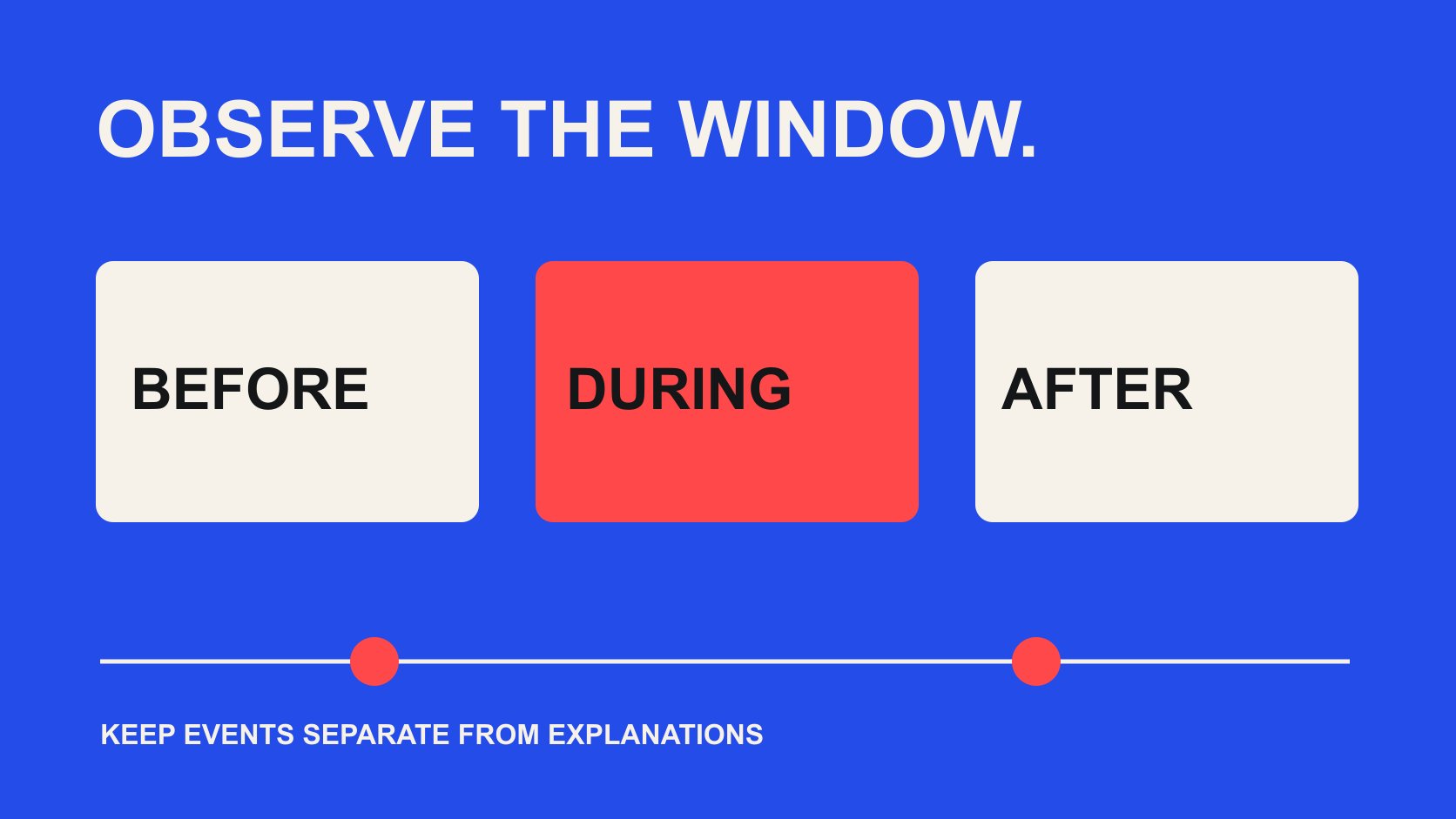
QuickKOL editorial graphic; not actual account metrics or a platform interface.
THE SHORT ANSWER
An Instagram follower tracker can record changes in an account’s follower total within a defined window. Two totals alone cannot identify who arrived or establish that a creator partnership caused the change. Set the observation question, available source and consistent windows first, then log concurrent advertising, posts, offers and cleanup events. Report the observed net change, unverified explanations and next investigation separately.
Choose the question before collecting the count
Brands often ask how many followers a creator brought after a campaign, while holding only the brand account’s opening and closing totals. Those are different questions. The change combines follows, unfollows and account-management effects, potentially alongside several communication channels. Reframe the request around something the available evidence can answer: did the observed net movement differ around publication, and what deserves further investigation?
Define the account being observed. Is it the main brand account, a regional account or the creator’s account? If the business wants local inquiries, a worldwide follower total may provide only context. Growth cannot independently establish the newcomers’ countries, interests or likelihood of purchasing. Each requires other appropriate evidence. Do not label every increase a partnership result simply because the report needs a positive outcome.
The Instagram follower change log guide helps organize snapshots; this article places those records inside a campaign timeline. Write down the decision the observation should inform, such as retaining a content approach, investigating advertising effects or requesting better audience evidence. If the team would take no different action under any result, reduce collection frequency rather than treating routine screenshots as an effectiveness evaluation in their own right.
Define comparison windows before seeing the result
Choose a fixed time zone, boundaries and collection rhythm before inspecting the curve. Equal-length before, during and after windows can be a useful editorial observation method, but there is no universal requirement to observe seven days. A product launch, a single video and a series running for several weeks have different rhythms. Explain why the chosen windows suit the actual question.
Retain publication times rather than dates alone. A comparison ending Monday morning and another ending Sunday night may differ in duration and time of day. Across markets, distinguish the reporting time zone, creator publication time and team working time. Do not move the campaign start back to a convenient low point and place the end at the highest count after seeing the result.
Continue observing delayed movement if useful, but add a window and retain the original plan instead of overwriting its definition. If the original snapshot was missed, disclose the gap and the alternative record available. Earlier comparison windows may reveal variation, although a few historical points do not establish a stable baseline. Comparable timing reduces some interpretive problems; it does not automatically remove seasonality, advertising or effects from other content.
Keep provenance and precision with every snapshot
At minimum, retain the account identifier, actual observation time, displayed value, source, collector and notes. A public page may round its count, a creator screenshot may capture another moment, and a native report may use a different field. Combining them into one highly precise curve creates comparability that the underlying observations do not have. A display of 10K is not an exact 10,000 from which single-follower movements can be calculated.
Meta official API documentation describes access routes and permissions relating to professional accounts. Before using an integration, check the particular product, account type, authorized object and currently available fields. Do not generalize one route’s requirements to every route or promise private historical information for any public account. A third-party product label does not establish that native verification has occurred.
Mark an absent snapshot as missing rather than zero. If the source changes during the campaign, retain the break, compare definitions at an overlapping point where possible, and decide whether the records can be joined. Keep original evidence separate from the working sheet with appropriate access controls. An observation task requires explainable records, not the creator’s password or personal information unrelated to the project decision.
Place an event log beside the movement
Log known events that could affect following behavior: brand posts, other creator publications, paid media, giveaways, stock availability, press coverage, service incidents and account management. Give each event a start, end, market and evidence source. Record what is known to have happened. Put uncertain explanations in an investigation column instead of drawing them as established growth drivers.
The Meta spam-follower announcement introduced a bulk removal feature in 2024. That establishes account management as a possible context for changing totals; it does not prove that cleanup caused a particular account’s decline. Apply the same restraint to advertising. Knowing that paid media was running does not separate advertising and creator contributions within the total. The event log provides context rather than automatically allocating credit.
Ask relevant teams to update the log during the project rather than reconstructing it from memory at month-end. A small promotion may be absent from the main project sheet while still changing why people visit the account. A destination failure may affect off-platform outcomes. Keeping this context does not make the report less useful. It helps the team avoid assigning every repairable problem elsewhere in the journey to one creator’s explanation or performance.
Calculate net movement without overstating it
Consider a hypothetical example with an exact opening total of 10,000 and closing total of 10,120. Net movement is 120, or 1.2% of the opening total. That does not mean only 120 people followed during the window, or that every new follower remained. When follows and unfollows both occur, two totals retain only their offsetting result.
Suppose an earlier equal-length window showed net growth of 90. The campaign window exceeds that observation by 30, but the difference is not an identified creator increment. Without an appropriate causal identification design, it cannot be multiplied by an arbitrary follower value to calculate return. These numbers explain arithmetic; they are not an account case study, growth target or industry benchmark.
State the denominator behind percentages. The same net addition represents different relative movement at different starting sizes, and smaller accounts may show more volatile percentages. If the source is rounded, do not report decimal precision it cannot support. Put missing observations, inconsistent times and source changes beside the number instead of burying them in an appendix. Readers should immediately see both the observation and the limit on what it can establish.
Handle a break in the observation record
Suppose the opening record retained only a public 10K display, and an exact native total became available three days later. Do not subtract the rounded opening display from the precise later value to manufacture a complete campaign growth number. Explain that the initial observation was rounded and that the reproducible exact series begins on day three. This limitation belongs to the record; the creator should not be asked to invent historical evidence.
Offer the business owner two practical choices: preserve the gap and narrow the current conclusion, or prepare a consistent source and capture time before the next partnership. If another authorized historical record exists, check that it covers the same account, moment and field before using it. Greater numerical detail alone does not establish greater reliability.
State which comparisons remain valid, which cannot be calculated and who will improve collection. The team can still assess the work, appropriate native reports and destination actions without declaring the whole assignment successful or unsuccessful from an incomplete follower series.
Do not substitute totals for audience and action evidence
Follower-total tracking does not supply a list of newcomers or reliably reveal their countries and purchasing behavior. Even if a separate report describes the account’s overall audience, do not apply that percentage to net growth and claim a known number of new followers from a particular country. The standing audience and people arriving during a window are different objects.
When website actions matter, test campaign links, destinations and events beforehand. Google Analytics campaign URL guidance helps distinguish campaign sources and creative identifiers. Those labels support source analysis without independently proving incrementality. The creator conversion tracking guide explains how to connect destination records to the project. Net followers, tagged visits and qualified inquiries can appear together, but they are not necessarily a person-by-person funnel.
When private data is unavailable, identify a next step supported by what exists. Check whether the link was used, whether audience questions concern shipping regions, or whether the partner can provide an appropriately shared native report. Do not fill the sheet with unsupported audience estimates. An explicitly unknown field is more suitable for a decision record than guessing a person’s country from language, profile imagery or isolated comments.
Turn the record into a decision memo
At closure, retain the question, windows, sources, net movement, concurrent events, limitations and next action. Label net growth of 120 during the campaign as an observation, and possible association with the partnership as an unverified explanation. If the business needs a causal contribution estimate, plan an evaluation suited to its conditions rather than attaching a scientific-looking attribution percentage to existing snapshots.
Do not automatically make a creator responsible when the brand total falls after publication. First review whether the agreement concerned content, publication, evidence access or an explicit outcome obligation. Then discuss changes for future work. Account movement can run in the opposite direction from the contribution of a particular piece of content. A fair review considers the work, audience responses and other activity instead of judging an individual from one account curve.
Make the next action specific: retain the collection definition for another window, repair the website destination, or agree on permitted reporting before the next partnership. Hand over original evidence locations and ownership so another colleague can reproduce the review. The tracker’s practical value is reducing unsupported explanations and showing which evidence the next assignment needs to prepare.
Research date and limitations
Sources reviewed October 29, 2026. Methods and tables are editorial recommendations; hypothetical numbers are not industry benchmarks. Platform conditions can change. Named references are research entry points, not live rankings, endorsements or confirmed partnerships.
Minimum observation record
This is an observation framework, not a causal evaluation or a guarantee that every source supplies all fields.
| Field | Record | Misreading to avoid |
|---|---|---|
| Account and timestamp | Identifier, time zone and actual capture time | Treating different moments as one snapshot |
| Source and precision | Native, screenshot or rounded public value | Inferring single-follower movement from 10K |
| Window and net change | Fixed boundaries, opening and closing values, difference | Calling the difference gross additions or causal lift |
| Concurrent events | Known event, timing and evidence | Treating timing as an established cause |
| Next decision | Owner, action and additional evidence | Inventing explanations to complete a report |
CHECKLIST
Prepare observation before publication
Each check should correspond to a record or an actual test.
- Set the account, question, windows and time zone.
- Check source, available permissions and displayed precision.
- Retain missing points, source changes and rounding.
- Ask relevant teams to maintain the event log.
- Explain net movement, audience evidence and website actions separately.
- Deliver bounded conclusions, original evidence and the next action.
Sources and further reading
- 01Meta: Official Instagram API collection
- 02Meta spam-follower announcement
- 03Google Analytics campaign URL guidance
External pages can change. Recheck platform rules, contracts and local law before launch.