
THE SHORT ANSWER
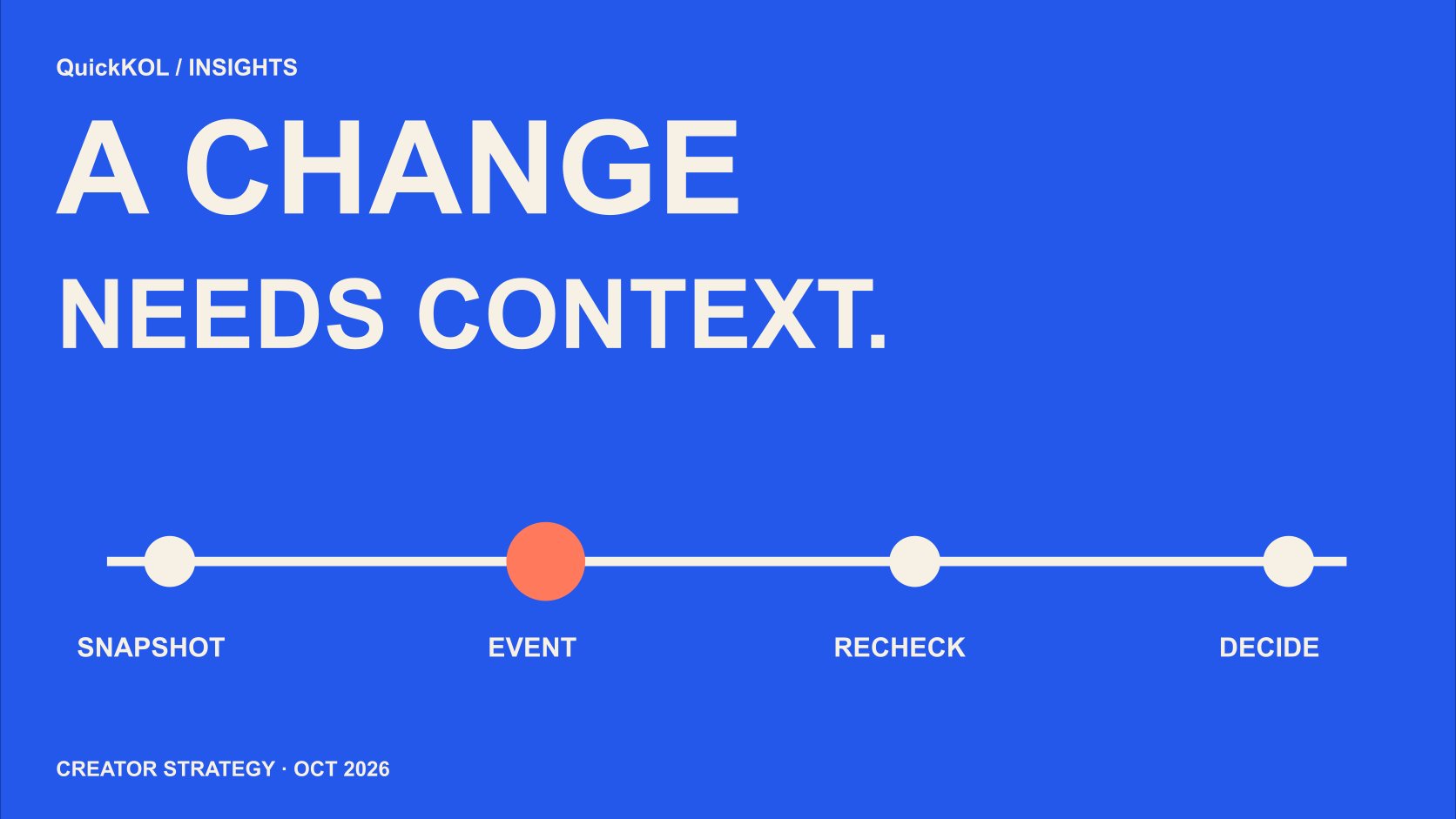
A repeatable followers-on-Instagram check uses dated snapshots from a consistent source, then investigates changes in context. Growth is an observation, not direct evidence of purchasing behavior or commercial value. Compare unusual dates with content events and source changes, and refresh the evidence needed for an actual partnership decision. This guide concerns ongoing monitoring, complementing the separate one-time audience audit and fake-follower evidence review.
Choose a monitoring purpose
Identity verification before recruitment, material-change monitoring during a campaign and evidence refresh before renewal are different purposes. Track the fields that can change the decision rather than reacting daily to small movements with no operational consequence. A simple purpose statement keeps the log manageable.
For example, renewal needs comparable content and audience evidence, not merely a newer follower total. Assign an owner and next review date to each requirement. The audience-audit guide covers the initial evaluation, while this process keeps relevant evidence current afterward. More frequent data collection is not automatically better when the team has no defined action for the values it collects or no way to distinguish a source revision from an actual account change.
Preserve the source precision
If a page displays 20K, preserve the rounded display and label its precision rather than pretending the source counted exactly 20,000 followers. Different tools and capture times can produce different values. A change log is only as interpretable as the original observations it retains.
Record the route, date, time zone and unit. When the source changes, start a separate series or clearly mark the transition. Otherwise a chart may show an apparent growth jump caused by a new data provider or display convention. The metric-definition guide helps document these differences. Keeping the raw display alongside any normalized working value lets a reviewer see which calculations are approximate and which use genuinely comparable observations.
Calculate absolute and relative change
For comparable hypothetical snapshots moving from 18,000 to 19,200, the absolute increase is 1,200 and relative change is approximately 6.67 percent. This describes two observations. It does not reveal daily growth between them or explain why the change occurred. Keep the interval visible beside the calculation.
Relative growth is unavailable when the starting denominator is zero. Rounded displays also limit the precision of a calculated change. Avoid turning uncertain inputs into an exact-looking conclusion by adding decimal places. The rate-denominator guide provides a related distinction between arithmetic and interpretation. A useful log shows the original values, the formula and the practical limitation together so another analyst can reproduce the result without inheriting an unsupported causal explanation.
Attach an event history
Place campaigns, media mentions, widely distributed posts, giveaways, account renaming and source changes beside the relevant observations. These are possible explanations until evidence connects them to the movement. Distinguish a known event from a causal conclusion.
Record less favorable context as well. A paused publishing schedule or the end of a series may affect production availability even when the follower count remains stable. Describe facts neutrally rather than treating growth as virtue and decline as misconduct. The log should help the team ask better questions. It should not become a narrative in which every increase proves quality and every decrease requires a defensive explanation from the creator regardless of the campaign’s actual needs.
Keep authenticity estimates separate
If the team periodically records an authenticity estimate, keep its original method and date separate from the follower series. Do not combine unrelated fields into an unexplained homemade quality index. Modash’s audience-quality documentation describes estimation signals and limitations; a growth log does not establish deliberate follower purchasing.
When sources disagree, inspect their definitions and refresh timing before considering a comparison. Averaging incompatible scores does not resolve the disagreement. Use the separate fake-follower review when a concern requires deeper investigation. Keeping the processes distinct prevents routine monitoring from becoming an escalating accusation mechanism, while still allowing a genuine unresolved risk to receive the focused review it deserves.
Set decision-relevant review triggers
A review trigger can be a scheduled contractual update, an identity change, a failed business route or expired evidence for a critical market condition. Avoid creating an arbitrary follower-decline threshold that automatically stops payment or labels the account unsuitable. A trigger should initiate a defined check.
Accepted work remains subject to the agreed payment terms. Ongoing monitoring is not a way to change a contract retrospectively. The campaign closeout workflow explains the separation between delivery acceptance and performance learning. Write who reviews the trigger, which evidence they request and what decisions they can make. This keeps the process proportionate and prevents an automated alert from acquiring authority that the team never intended to give it.
Report the implication for the campaign
A useful report says that audience geography needs refresh this month or that an account route has been corrected. An upward arrow alone does not tell the campaign owner what to do. When a change has no practical implication, record continued observation rather than inventing an action to justify the dashboard.
Suppose followers rise six percent across two months while comparable video observations use different windows. It would be unjustified to claim that commercial performance also rose six percent. Each outcome needs its own definition and evidence. The performance-benchmark guide helps align comparison groups. Keep the report concise enough that a teammate can distinguish a completed update, an unresolved question and a decision that actually requires their attention.
Mark manual corrections explicitly instead of blending them into the growth history. A repaired entry changes the record, not necessarily the audience. Retaining the previous value and correction reason helps a reviewer distinguish revised evidence from a new event requiring campaign action.
Maintain and retire the log
After the engagement ends, retain the records needed for its terms and stop ongoing collection that has no defined purpose. For a possible future candidate, keep the source route and a clear need for re-verification rather than presenting the old state as permanently current. A database needs retirement rules as well as refresh rules.
QuickKOL can support discovery organization and content understanding; the monitoring log still needs an owner and a specific use. Judge the process by whether it improves the next decision. A small dated record that explains a real change is more useful than a constantly updated chart the team cannot interpret. Close the loop by recording the review outcome, not merely the alert that prompted someone to look.
Research date, evidence and limitations
Sources reviewed October 21–22, 2026. Workflows are editorial recommendations and numerical examples are hypothetical, not observed campaign results, creator rankings or offers.
The working sheet for this task
Editorial analysis and labeled hypothetical examples, not performance rankings, quotes or guarantees.
| Decision | Evidence to keep | Next action |
|---|---|---|
| Snapshot | Raw display, source and date | Preserve precision |
| Change | Formula, interval and events | Separate observation and cause |
| Review | Trigger and outcome | Update the actual decision |
CHECKLIST
Before you put this into practice
Record the answers in the campaign working file.
- Align source and unit
- Label rounded values
- Review without a preset verdict
- Define maintenance and retirement
Sources and further reading
External pages can change. Recheck platform rules, contracts and local law before launch.